

Proposal template

Event proposal template

An event proposal template for event management companies and planners who run a business client's conference, launch or company day. Seven short sections: what the client told you, the plan week by week, what your fee covers and what the event budget covers, one planning fee and the next steps. Read it here or get it as a Word file and a PDF.

Michael Koper
By Michael Koper, founder of Nusii Updated
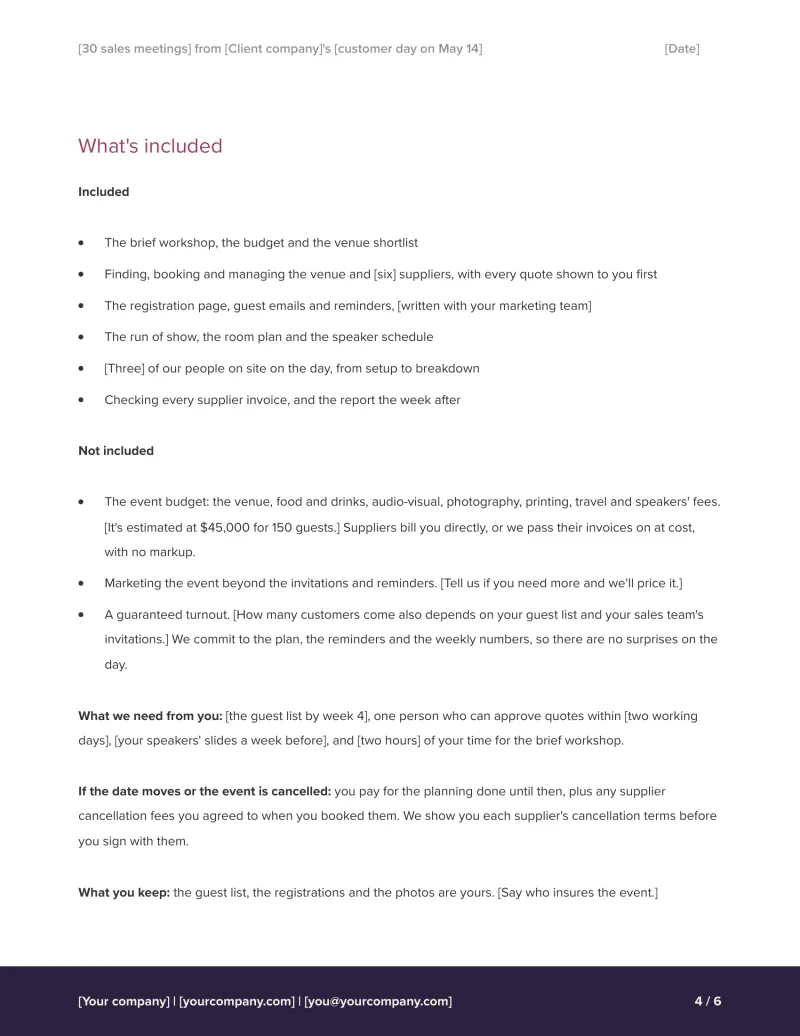
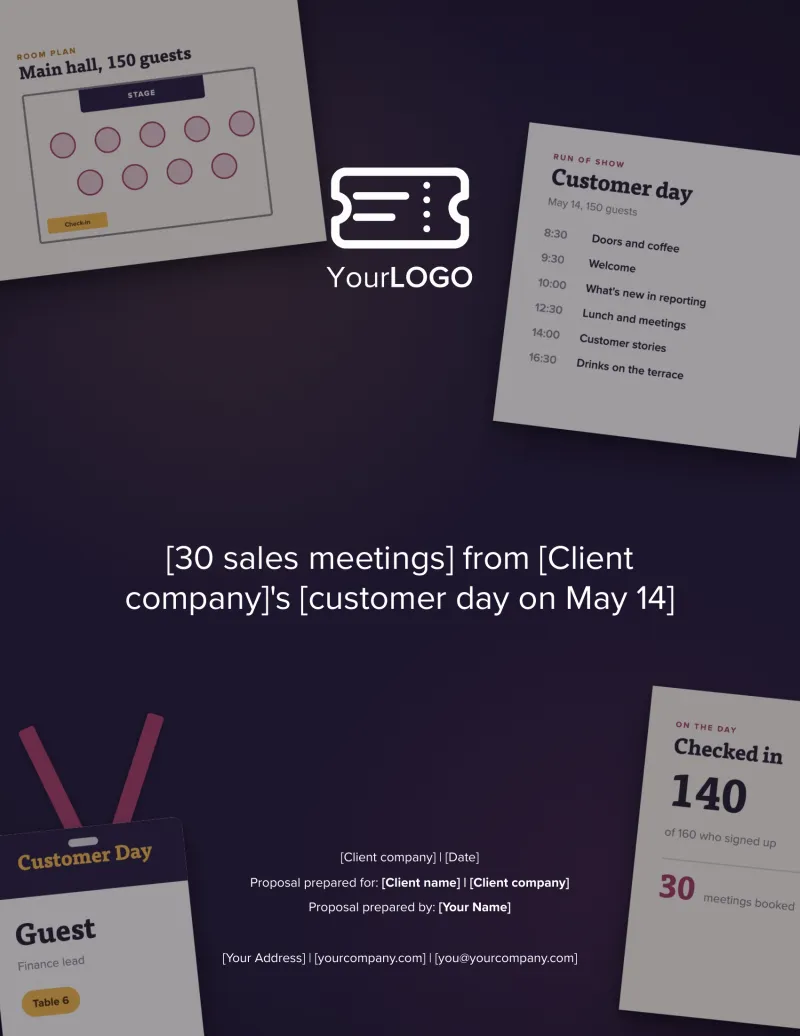
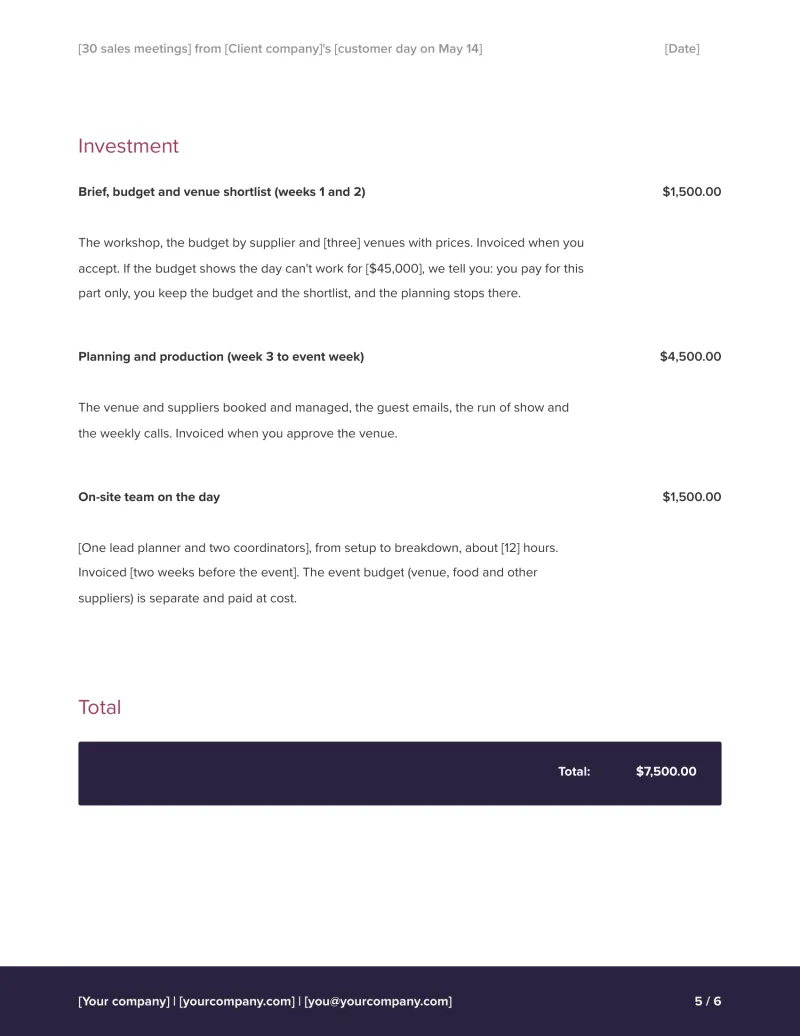
The event proposal template: the cover and the investment page with one planning fee of $7,500 in three parts
Get the Word + PDF
On this page
  1. What to include
  2. The template
  3. A filled-in example
  4. How to write one
  5. See it as your client will
  6. What to charge
  7. The email to send
  8. After you send it
  9. Word and PDF
  10. Questions

What should an event proposal include?

An event proposal is the document an event planner or agency sends a client to win the job: what the event is for, how you'll run it, what it costs and how to say yes. It should repeat what the client told you, the result you'll both count afterwards and what it's worth, the plan from the first workshop to the report after the day, what your fee covers and what the event budget covers, one clear price and the next steps. The template below has a section for each.

  1. 1 IntroductionThe event, the date and the guests in two sentences, and who runs it.
  2. 2 What we heardWhat the client told you, the goal and what the day is worth.
  3. 3 How we'll run itThe plan week by week, with the client's approvals.
  4. 4 Results for clients like yoursShort proof from events like this one.
  5. 5 What's includedWhat the fee covers, the event budget, and a moved or cancelled date.
  6. 6 InvestmentOne planning fee in three parts, with a way out.
  7. 7 Next stepsHow to say yes, and when you'll follow up.

The event proposal template, section by section

Copy one section or the whole thing. Under each section: what it's for, and one thing we've learned from the proposals sent with Nusii.

[Yellow] you write [Green] Nusii fills in when you send it

1. Introduction

The whole plan in two sentences, who you are and who the client deals with. The person who signs (an owner, a marketing director, finance) is often not the one you spoke to, so it has to make sense to someone who wasn't on the call.

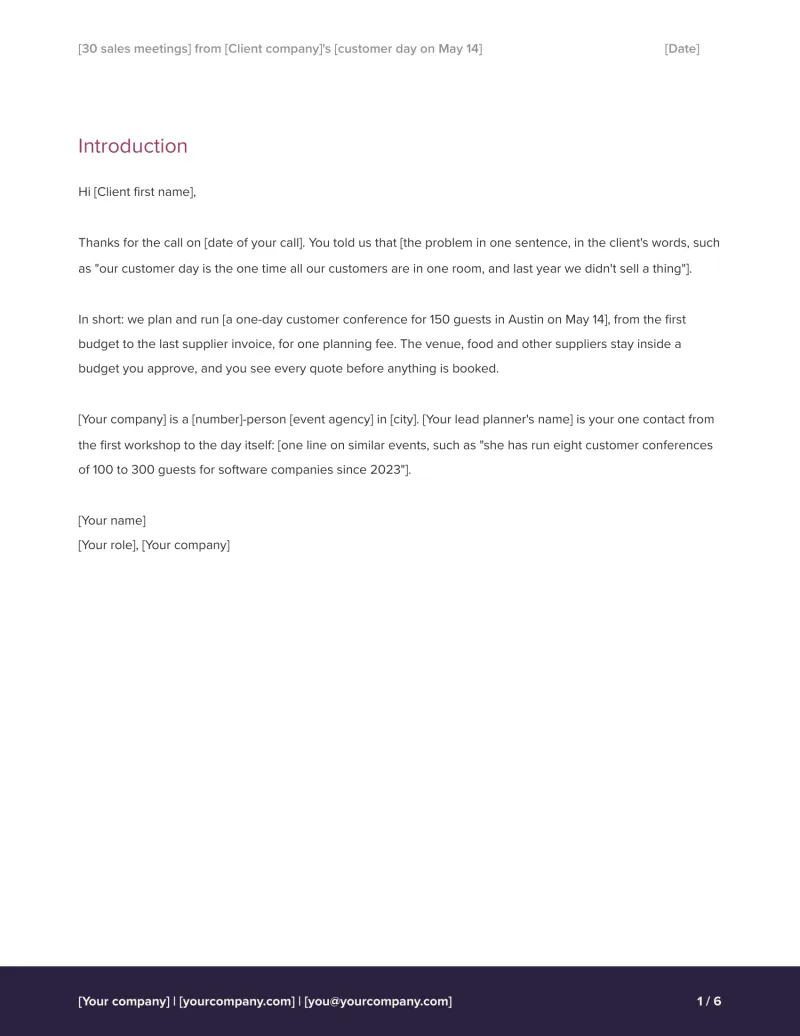
Hi [Client first name],

Thanks for the call on [date of your call]. You told us that [the problem in one sentence, in the client's words, such as "our customer day is the one time all our customers are in one room, and last year we didn't sell a thing"].

In short: we plan and run [a one-day customer conference for 150 guests in Austin on May 14], from the first budget to the last supplier invoice, for one planning fee. The venue, food and other suppliers stay inside a budget you approve, and you see every quote before anything is booked.

[Your company] is a [number]-person [event agency] in [city]. [Your lead planner's name] is your one contact from the first workshop to the day itself: [one line on similar events, such as "she has run eight customer conferences of 100 to 300 guests for software companies since 2023"].

[Your name]
[Your role], [Your company]

Agencies' proposals in Nusii got their first look in a median of 54 minutes (3,782 proposals, November 2025 to October 2026), and about a third of first views are on a phone. Say what the event is, when, and for how many people before you say who you are.
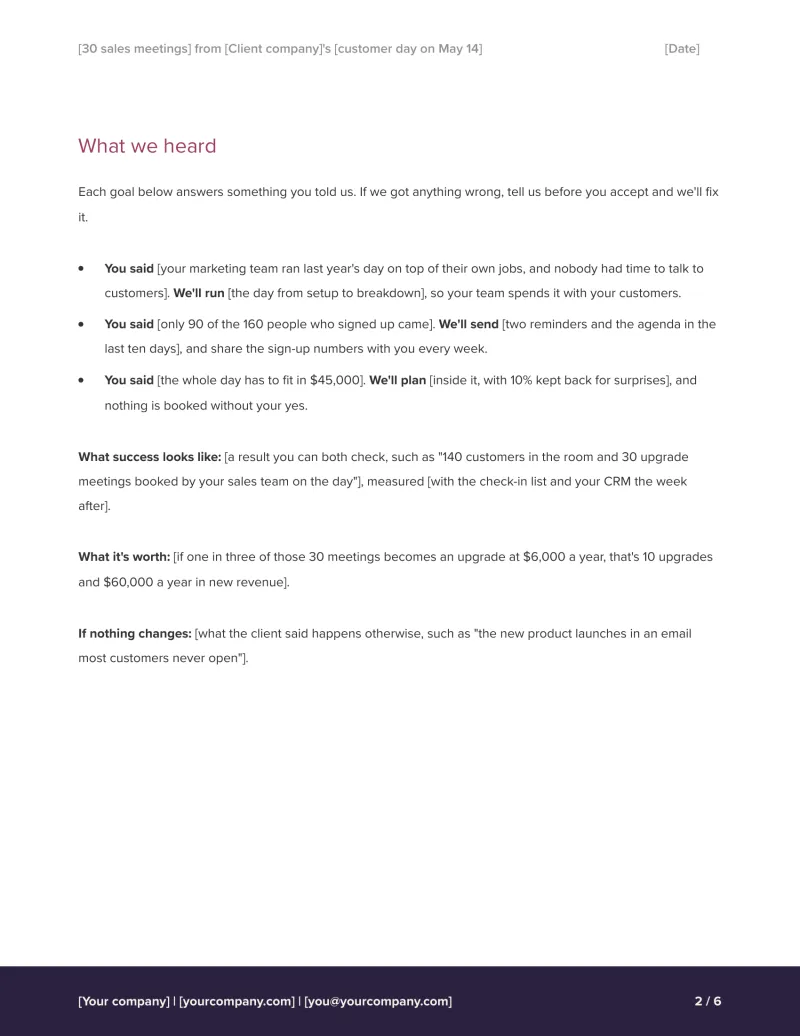
2. What we heard

Shows you listened, turns what the client told you into goals you can both check after the event, and puts a number on what the day is worth. Only you can write this one: replace the examples with your client's words.

Each goal below answers something you told us. If we got anything wrong, tell us before you accept and we'll fix it.

  • You said [your marketing team ran last year's day on top of their own jobs, and nobody had time to talk to customers]. We'll run [the day from setup to breakdown], so your team spends it with your customers.
  • You said [only 90 of the 160 people who signed up came]. We'll send [two reminders and the agenda in the last ten days], and share the sign-up numbers with you every week.
  • You said [the whole day has to fit in $45,000]. We'll plan [inside it, with 10% kept back for surprises], and nothing is booked without your yes.

What success looks like: [a result you can both check, such as "140 customers in the room and 30 upgrade meetings booked by your sales team on the day"], measured [with the check-in list and your CRM the week after].

What it's worth: [if one in three of those 30 meetings becomes an upgrade at $6,000 a year, that's 10 upgrades and $60,000 a year in new revenue].

If nothing changes: [what the client said happens otherwise, such as "the new product launches in an email most customers never open"].

"We need an event" is the client's answer, not their problem. Our 2015 book on proposals calls what clients hand you "the end result of their problem". Ask what the day should change for the business, and how you'd both see it a week later.

3. How we'll run it

The plan from the first workshop to the report after the event, with the points where the client approves before any of their money is spent.

  1. Weeks 1 and 2: brief and budget. A [two-hour] workshop with [you and your sales lead] on the goals, the guests and the agenda. Then a budget split by supplier and [three] venues with prices and dates.
  2. Weeks 3 to 5: venue and suppliers. We book the venue and suppliers ([catering, audio-visual, photos]) as you approve each quote. Invitations and the sign-up page go out [with your marketing team].
  3. Weeks 6 to 11: the details. The agenda and speakers, the room layout, signs, guest emails and the run of show (the minute-by-minute plan for the day). A [30-minute] weekly call and an updated budget sheet.
  4. Event week. A walkthrough at the venue, final numbers to the caterer, and the run of show to everyone working the day.
  5. On the day. Our team on site from setup until the last guest leaves: [one lead planner and two coordinators], one of them only looking after your speakers.
  6. The week after. We check every supplier invoice against its quote and send you a short report: who came, what guests said, and what to change next time.

Timing: the date holds if we book the venue by [the end of week 3]. [Twelve weeks is the shortest we'd plan a day for 150 guests]; with less time, there are fewer venues to choose from.

When you'll see results: [the meetings are booked on the day, the upgrades in the next quarter].

Philip Morgan and Jonathan Stark, in our 2015 book: "If a project does require firm completion dates, call out your assumptions about what will be required to meet those dates." An event has the firmest date there is. Say what has to happen by when.

4. Results for clients like yours

Short proof for the people who weren't on the call: an event like theirs, what you ran and what came of it.

  • [Past client], [kind of event and its size]: [what you ran and what came of it, with a number, such as "a customer day for 120 guests: 112 came, and the client booked 22 demos on the day"].
  • [Past client], [kind of event and its size]: [what you ran and what came of it].

"[A one-line quote from a past client about the day itself.]" [Name, role, company]

Proposals to a repeat client were accepted 62.8% of the time in Nusii, against 46.9% for a first proposal to that client, from the same 122 senders (July to September 2026). Most events come back every year: next year's proposal starts here.

5. What's included

What the fee covers and what it doesn't, where the event budget sits, what you need from the client and what happens if the date moves. Event clients ask the same question every time: what's the fee and what's the budget?

Included

  • The brief workshop, the budget and the venue shortlist
  • Finding, booking and managing the venue and [six] suppliers, with every quote shown to you first
  • The registration page, guest emails and reminders, [written with your marketing team]
  • The run of show, the room plan and the speaker schedule
  • [Three] of our people on site on the day, from setup to breakdown
  • Checking every supplier invoice, and the report the week after

Not included

  • The event budget: the venue, food and drinks, audio-visual, photography, printing, travel and speakers' fees. [It's estimated at $45,000 for 150 guests.] Suppliers bill you directly, or we pass their invoices on at cost, with no markup.
  • Marketing the event beyond the invitations and reminders. [Tell us if you need more and we'll price it.]
  • A guaranteed turnout. [How many customers come also depends on your guest list and your sales team's invitations.] We commit to the plan, the reminders and the weekly numbers, so there are no surprises on the day.

What we need from you: [the guest list by week 4], one person who can approve quotes within [two working days], [your speakers' slides a week before], and [two hours] of your time for the brief workshop.

If the date moves or the event is cancelled: you pay for the planning done until then, plus any supplier cancellation fees you agreed to when you booked them. We show you each supplier's cancellation terms before you sign with them.

What you keep: the guest list, the registrations and the photos are yours. [Say who insures the event.]

Kai Davis, interviewed for our 2015 book: "Proposals are a way to communicate value and reduce risk." In events, most of the risk is someone else's bill: the venue, the caterer, the cancellation terms. Put the line between your fee and the event budget in writing.

6. Investment

One planning fee in three parts, each with when it's invoiced, and a way out after the brief and budget. The event budget is separate. These are example prices; the table further down shows what planners charge.

Brief, budget and venue shortlist (weeks 1 and 2)

$1,500

The workshop, the budget by supplier and [three] venues with prices. Invoiced when you accept. If the budget shows the day can't work for [$45,000], we tell you: you pay for this part only, you keep the budget and the shortlist, and the planning stops there.

Planning and production (week 3 to event week)

$4,500

The venue and suppliers booked and managed, the guest emails, the run of show and the weekly calls. Invoiced when you approve the venue.

On-site team on the day

$1,500

[One lead planner and two coordinators], from setup to breakdown, about [12] hours. Invoiced [two weeks before the event]. The event budget (venue, food and other suppliers) is separate and paid at cost.

Total: $7,500

$7,500 is about 17% of a $45,000 budget. EventPlanning.com puts corporate events at 15 to 20% of the budget ($7,500 to $10,000 for a $50,000 event). Across all industries in Nusii, proposals between $5,000 and $15,000 got a yes about half the time (July to September 2026).

7. Next steps

Tells the client exactly what to do to say yes, what happens after, and when you'll call. No expiry date and no "only one Saturday left".

  1. If the plan works for you, accept and sign this proposal.
  2. We'll send the first invoice ($1,500) and book the brief workshop for [next week].
  3. You send us [last year's guest list and numbers] and [the dates that work for your team].

I'll call you on [a day three working days from now] to answer any questions. Or go through it with me on a 20-minute call: [your booking link].

If you have a question before then, call me on [phone number] or reply to the email this proposal came with.

Agencies' accepted proposals in Nusii got their yes in a median of 3.9 days, and 62.2% of the yeses came within a week (November 2025 to October 2026). A call three working days after you send it lands while the client is still deciding.

An event proposal example, filled in

Two sections of the template above with a client's words in the brackets, so you can see how it reads when it's done. Halverly Payroll is made up, and so are its numbers.

30 sales meetings from Halverly Payroll's customer day on May 14

What we heard

  • You said your marketing team ran last year's day on top of their own jobs, and nobody had time to talk to customers. We'll run the day from setup to breakdown, so your team spends it with your customers.
  • You said only 90 of the 160 people who signed up came. We'll send two reminders and the agenda in the last ten days, and share the sign-up numbers with you every week.
  • You said the whole day has to fit in $45,000. We'll plan inside it, with 10% kept back for surprises, and nothing is booked without your yes.

What success looks like: 140 customers in the room and 30 upgrade meetings booked by your sales team on the day, measured with the check-in list and your CRM the week after.

What it's worth: if one in three of those 30 meetings becomes an upgrade at $6,000 a year, that's 10 upgrades and $60,000 a year in new revenue: more than the whole day costs, fee and budget together ($52,500).

If nothing changes: the new reporting module launches in an email most customers never open.

Investment

Brief, budget and venue shortlist (weeks 1 and 2)

$1,500

Planning and production (week 3 to event week)

$4,500

On-site team on the day

$1,500

Total: $7,500

How to write an event proposal, step by step

Six steps, from the first call to the follow-up. The template above already follows them; here's why each one matters.

  1. Ask what the day should change, not what it should look like

    On the first call, find out why the client wants the event, who has to be in the room, what should be different a week later, who else has to say yes, and the budget. "We need a customer day" is the client's answer; the problem behind it goes in "What we heard". Our 10 questions for the first client call cover it.

  2. Get the budget before you write

    An event proposal without a budget is a guess: the venue alone can be half of it. Ask for the whole figure, then split it into your fee and the event budget the suppliers spend. In our 2015 book on proposals, Nathan Powell calls writing a proposal without knowing the budget "a terrible waste of your time". How to ask about the budget covers the awkward part.

  3. Set a goal you can count the week after

    "A great day" isn't a goal. Pick something the client can count: guests who came, meetings booked, sign-ups, money raised. Say how you'll count it (the check-in list, the CRM) and put a number on what it's worth, so the fee has something to stand next to.

  4. Plan backwards from the date

    Start from the event day and work back: when the venue has to be booked, when the invitations go out, when the final numbers go to the caterer. Write down what the client has to approve and by when. A date that can't move needs its assumptions in writing.

  5. Draw the line between your fee and their budget

    Clients mix up the two, and it's where most arguments start. Show your fee as the total, list the event budget separately, say whether suppliers bill the client directly or through you at cost, and say what a moved or cancelled date costs before anyone signs.

  6. Send one price, then call when you said you would

    Send one fee unless the client asked for choices: in Nusii, proposals where the client could choose between options were accepted less often (38% against 53%, July to September 2026). What to charge has the outside prices.

    Send it with a short email (there's one below) and call when you said you would. Agencies' accepted proposals in Nusii got their yes in a median of 3.9 days, and 62.2% of the yeses came within a week (November 2025 to October 2026).

See it as your client will

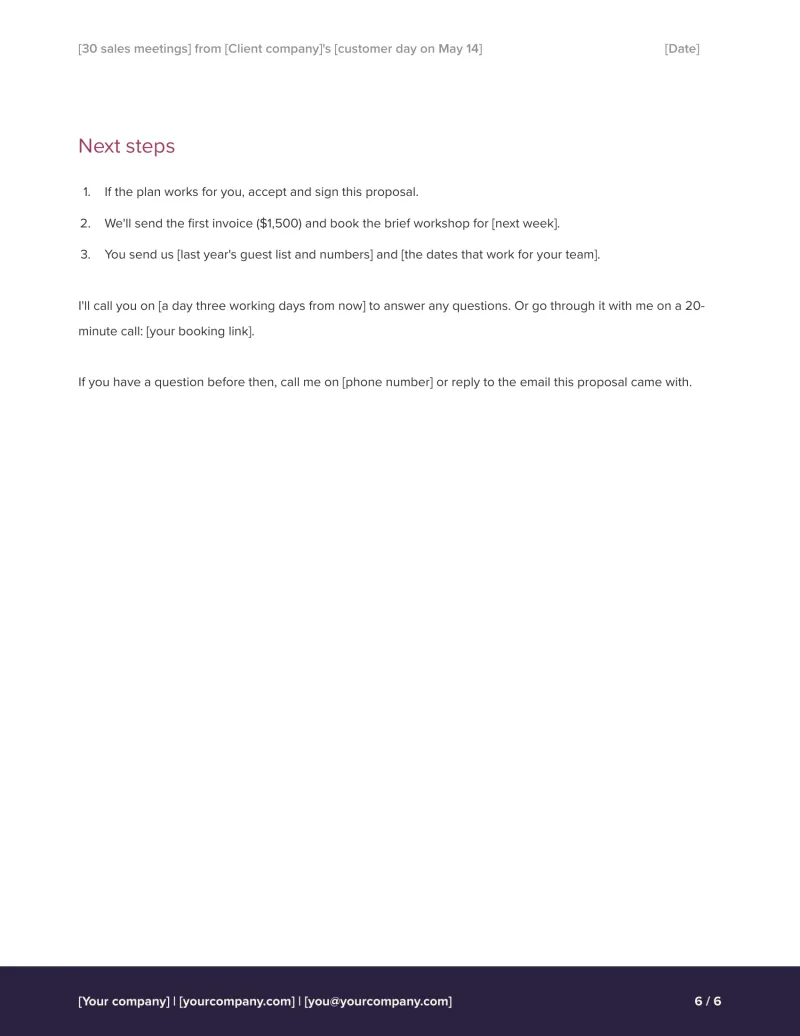
Every page of the PDF, printed by Nusii. Sent as a link, it's one scrolling page on any device: your client accepts with one button and signs with their name.

Open the live preview

The template in Nusii, the way your client will see it. It opens in a new tab.

What to charge for event planning

What planners charge, from the pages we could check at the source. The template's example, a $7,500 planning fee for a one-day event for 150 guests with a $45,000 budget, is about 17% of the budget and at the low end of full-service planning.

What Price
Corporate event, as a share of the budget 15 to 20% of the event budget $7,500 to $10,000 for a $50,000 event EventPlanning.com
Full-service planning $7,500 to $20,000+ often a flat fee plus a percentage for larger budgets Timely
Partial planning $3,000 to $7,500 the client runs part of it Timely
Day-of coordination $1,200 to $3,000 the planner runs the day only Timely
Flat fee, small and mid-size events $2,000 to $10,000+ independent planners, 2026 survey DesignRush
Flat fee, large or multi-day corporate events $10,000 to $50,000+ the same survey DesignRush
Hourly rate $25 to $100+ an hour for small jobs and consulting EventPlanning.com
Deposit 30 to 50% at signing the balance two weeks before the event EventPlanning.com

Sources: EventPlanning.com, how to charge for event planning, June 2025; Timely, event planner rates and packages, September 2025; DesignRush, event planner costs, citing Northstar Meetings Group's 2026 survey. EventPlanning.com sells a course for planners and Timely sells event software; neither says where its numbers come from. DesignRush quotes Northstar Meetings Group's 2026 survey of independent planners. Treat them as a rough guide, and price your own work by the hours it takes.

How often proposals got a yes, by price

Proposals over $15,000 got a yes about a third of the time. Agencies' accepted proposals had a median value of $4,000 (July to September 2026). From 1,713 proposals first sent with Nusii, July to September 2026.

Under $1,000
67.1%
$1,000 to $5,000
50.7%
$5,000 to $15,000
48.9%
$15,000 to $50,000
36.1%
Over $50,000
33.3%

Share accepted, by the total the client saw. Bigger proposals are bigger decisions, so this shows what happened, not that a lower price would win. Method: The State of Proposals 2026.

The email to send it with

The proposal does the explaining, so the email only has to get it opened and say when you'll call. Leave the price out, so your client reads the plan before they judge the number. An event often needs a second yes, from finance or the owner, so say in one line what the day is for: that's the line they'll read. In Nusii this goes in the Send Proposal window, and you can save it as your template for next time.

Subject: [The plan for your customer day on May 14]

Hi [first name],

Here's the proposal we talked about on [day of your call]: [link].

In short: we run the whole day for [150 guests], inside your [$45,000] budget, and you approve every quote before anything is booked.

It's short, and you can accept it right on the page. If anything's off, reply to this email and I'll change it.

I'll call you on [a day three to five days from now] to answer any questions.

[Your name]

What happens after you send it

From 3,782 proposals first sent with Nusii by marketing, web, advertising and video agencies from November 2025 to October 2026.

48.9%
were accepted
54 minutes
median time to the client's first look
3.9 days
median time to a yes
62.2%
of the yeses came within a week

Clients rarely say no. Of all proposals sent with Nusii from July to September 2026, 6.5% were rejected and 45.2% got no answer either way. Silence is the usual no, so a follow-up is worth sending.

Follow up after a week. Most yeses come within seven days. In Nusii you see when the proposal was opened and get an email when it's accepted, so you can follow up when they've read it, not when you guess they have.

More numbers and the method: The State of Proposals 2026.

Get the Word and PDF files

The same template as a Word file you can edit (it opens in Google Docs too) and a PDF printed by Nusii. We'll email you both, plus a few emails with proposal tips. Unsubscribe any time.

Or send it with Nusii

This template is in the gallery of every Nusii account. Send it as a link: you get an email when your client opens it, and they accept and sign online, on any device.

Just this week, I sent a large proposal to a new client who said, ‘I don’t know what proposal software you’re using, but this is amazing and so easy to review.’

Sophie Haines
Sophie Haines
Account Executive, Buildout

I use Nusii all the time when I send proposals to clients. They find it easy to use so I never have to explain anything how to accept the proposals.

Yos William
Yos William
Director, Infinite Ace
Start your free trial

14-day trial · 60-day money-back guarantee

Questions about event proposals

What is an event proposal?

A document an event planner or agency sends a client to win the job: what the event is for, how it will be run, what it costs and how to say yes. Proposing an event to your own manager or school is a different case: see the question about that below.

What should an event proposal include?

What the client told you and the goal that follows from it, the plan week by week, short proof from similar events, what your fee covers and what the event budget covers, one clear price, and the next steps. That’s seven sections, the same as the template on this page.

How do you write an event proposal?

Start from what the day should change for the client, get the budget, set a goal you can count afterwards, plan back from the date, keep your fee apart from the event budget, and send one price. The six steps above go through it.

How much should an event planner charge for a corporate event?

EventPlanning.com puts corporate events at 15 to 20% of the event budget ($7,500 to $10,000 for a $50,000 event), and Timely puts full-service planning at $7,500 to $20,000 or more. This template uses a $7,500 planning fee for a one-day event for 150 guests with a $45,000 budget.

Should I charge a flat fee or a percentage of the event budget?

A flat fee gives the client a number to sign; a percentage is only known once the budget is spent, and it grows when the client adds things. This template uses a flat fee and keeps the event budget separate, at cost. If you charge a percentage, write the amount it comes to on the estimated budget.

Should the event budget be part of the proposal total?

Not in this template. The total is your fee; the event budget (venue, food, audio-visual) goes in “What’s included” with its estimate, and suppliers bill the client directly or through you at cost. That way the client sees what your work costs and what the day costs.

Can I use this template for a virtual or hybrid event?

Yes. Swap the venue for the event platform, the audio-visual supplier for the streaming crew, and the check-in list for who logged in. The plan, the fee and the budget line stay the same.

Can I use this to propose an event to my manager or school?

Yes, with three changes. Turn the price section into a budget request with what it pays for, replace “Results for clients like yours” with why this event and why now, and make “What it’s worth” the case for whoever holds the budget. Asking a company to sponsor your event is a different document: a sponsorship proposal sells exposure for their brand, and this template doesn’t cover it.

How do I answer a request for proposals for an event?

Follow the client’s format first: a request for proposals is scored against its own questions, and a missing section can rule you out. Use this template for what the request leaves open, such as the goals, the plan week by week and what your fee covers.

Should I offer several event packages?

Only if the client asked for choices. In Nusii, proposals where the client could choose between options were accepted less often (40.3% against 51.5% for the same senders, July to September 2026). This template has one planning fee; offer a bigger event next year in a new proposal.

More templates and guides

Send your next event proposal as a link, and see when it's opened

Try Nusii free for 14 days

Cancel anytime · 60-day money-back guarantee