A free content marketing proposal template in seven sections, from what your client told you to a paid content audit, a 90-day plan, monthly articles and the next steps. Read it here or get it as a Word file and a PDF.
A content marketing proposal should say what the client told you, the result you'll both measure, what it's worth to them, how you'll work (usually an audit and a plan, then monthly articles), who writes them, what's included, who owns the work, the price and how to say yes. The template below has a section for each.
The content marketing proposal template, section by section
Copy one section or the whole thing. Under each section: what it's for, and one thing we've learned from the proposals sent with Nusii.
[Yellow] you write[Green] Nusii fills in when you send it
1. Introduction
The whole plan in two sentences, and who you are. Partners and colleagues read it too, often without having been on the call. Working on your own? Write "I" instead of "we".
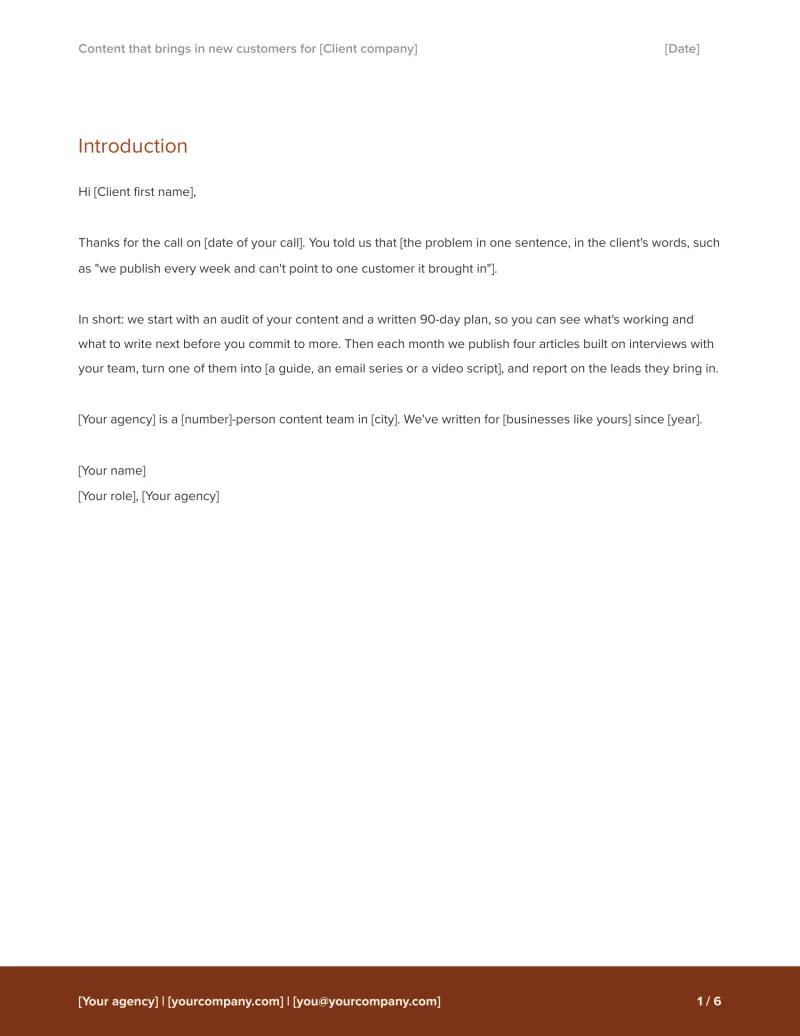
Hi [Client first name],
Thanks for the call on [date of your call]. You told us that [the problem in one sentence, in the client's words, such as "we publish every week and can't point to one customer it brought in"].
In short: we start with an audit of your content and a written 90-day plan, so you can see what's working and what to write next before you commit to more. Then each month we publish four articles built on interviews with your team, turn one of them into [a guide, an email series or a video script], and report on the leads they bring in.
[Your agency] is a [number]-person content team in [city]. We've written for [businesses like yours] since [year].
[Your name] [Your role], [Your agency]
Agencies' proposals in Nusii got their first look in a median of 54 minutes (3,782 proposals, November 2025 to October 2026), and about a third of first views are on a phone. So keep this short, and save how long you've been writing for one line at the end.
2. What we heard
Shows you listened, turns what the client told you into goals you can both check later, and puts a number on what the work is worth to them. Only you can write this one: replace the examples with your client's words.
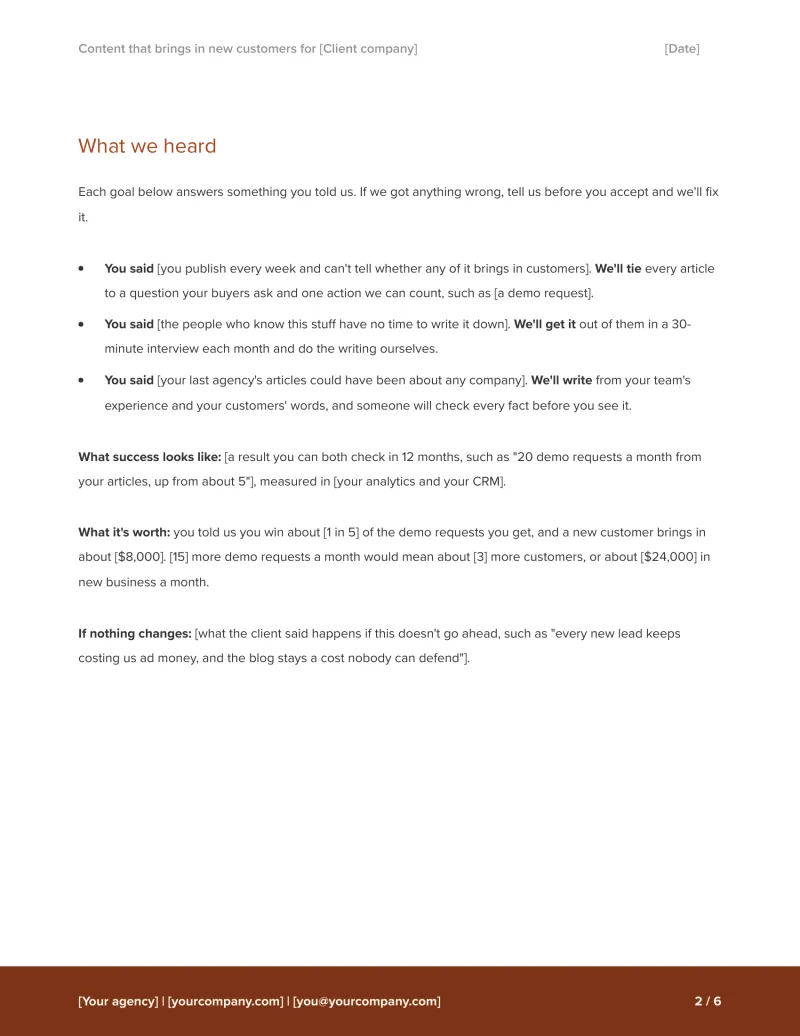
Each goal below answers something you told us. If we got anything wrong, tell us before you accept and we'll fix it.
You said[you publish every week and can't tell whether any of it brings in customers]. We'll tie every article to a question your buyers ask and one action we can count, such as [a demo request].
You said[the people who know this stuff have no time to write it down]. We'll get it out of them in a 30-minute interview each month and do the writing ourselves.
You said[your last agency's articles could have been about any company]. We'll write from your team's experience and your customers' words, and someone will check every fact before you see it.
What success looks like:[a result you can both check in 12 months, such as "20 demo requests a month from your articles, up from about 5"], measured in [your analytics and your CRM].
What it's worth: you told us you win about [1 in 5] of the demo requests you get, and a new customer brings in about [$8,000]. [15] more demo requests a month would mean about [3] more customers, or about [$24,000] in new business a month.
If nothing changes:[what the client said happens if this doesn't go ahead, such as "every new lead keeps costing us ad money, and the blog stays a cost nobody can defend"].
Three questions on the call fill this in: how many leads they win, what a new customer is worth, and "Why start this now vs six months ago or six months from now?", as Kurt Elster puts it in our 2015 book on proposals. The numbers should be your client's, not yours.
3. How we'll work
The plan step by step: what happens first, what the client approves, who writes and checks the articles, and when to expect results.
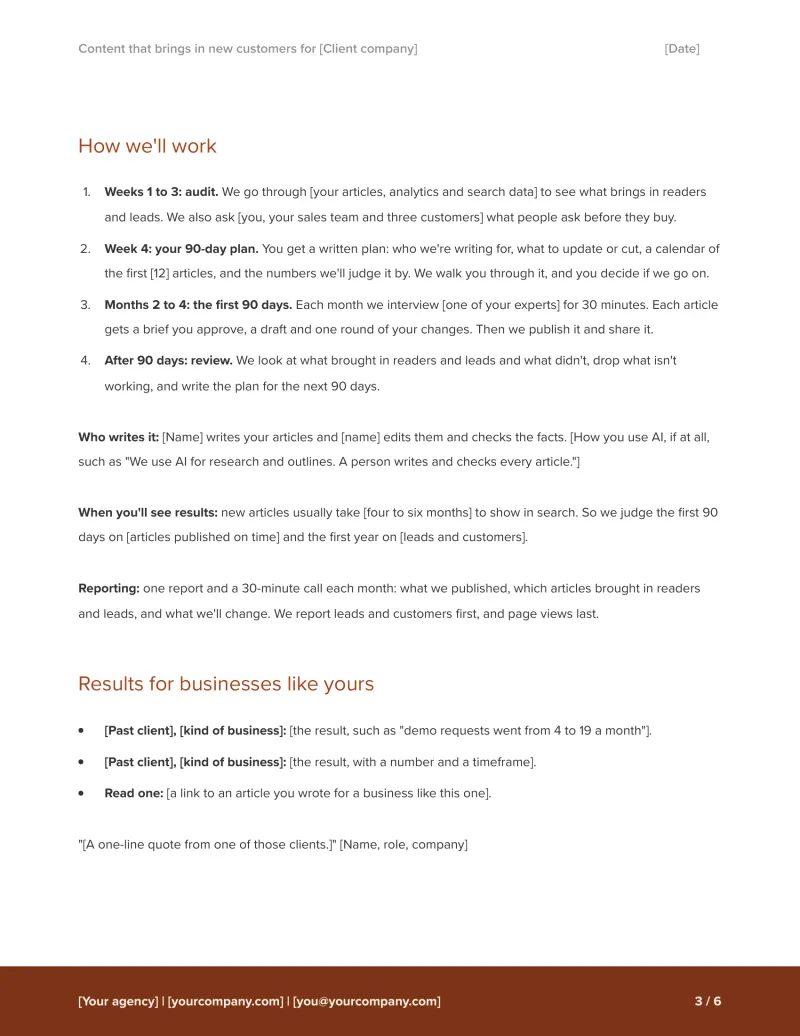
Weeks 1 to 3: audit. We go through [your articles, analytics and search data] to see what brings in readers and leads. We also ask [you, your sales team and three customers] what people ask before they buy.
Week 4: your 90-day plan. You get a written plan: who we're writing for, what to update or cut, a calendar of the first [12] articles, and the numbers we'll judge it by. We walk you through it, and you decide if we go on.
Months 2 to 4: the first 90 days. Each month we interview [one of your experts] for 30 minutes. Each article gets a brief you approve, a draft and one round of your changes. Then we publish it and share it.
After 90 days: review. We look at what brought in readers and leads and what didn't, drop what isn't working, and write the plan for the next 90 days.
Who writes it:[Name] writes your articles and [name] edits them and checks the facts. [How you use AI, if at all, such as "We use AI for research and outlines. A person writes and checks every article."]
When you'll see results: new articles usually take [four to six months] to show in search. So we judge the first 90 days on [articles published on time] and the first year on [leads and customers].
Reporting: one report and a 30-minute call each month: what we published, which articles brought in readers and leads, and what we'll change. We report leads and customers first, and page views last.
Most content proposals list the formats before anyone has seen the client's numbers. "Diagnose before you prescribe," as Philip Morgan and Jonathan Stark put it in our 2015 book. A paid audit lets you do that and get paid for it. Accepted proposals in Nusii had a median of 7 sections, the rest 9 (1,713 proposals, July to September 2026), so the topic detail belongs in the plan.
4. Results for businesses like yours
Short proof for the people who weren't on the call: what happened for businesses like this one, and one article they can read. Use real numbers from a real client, or leave this section out.
[Past client], [kind of business]:[the result, such as "demo requests went from 4 to 19 a month"].
[Past client], [kind of business]:[the result, with a number and a timeframe].
Read one:[a link to an article you wrote for a business like this one].
"[A one-line quote from one of those clients.]" [Name, role, company]
Proposals to a client who had accepted one before were accepted 63% of the time in Nusii, against 46% for a first proposal from the same senders (July to September 2026). A new client hasn't read your work yet. Link to one article instead of pasting samples in: proposals with images were accepted less often (42% against 54% for the same senders).
5. What's included
Draws the line between what you'll do and what you won't, says what you need from the client, who owns the articles and what happens if a date slips. Delete the last line if you don't want to offer it.
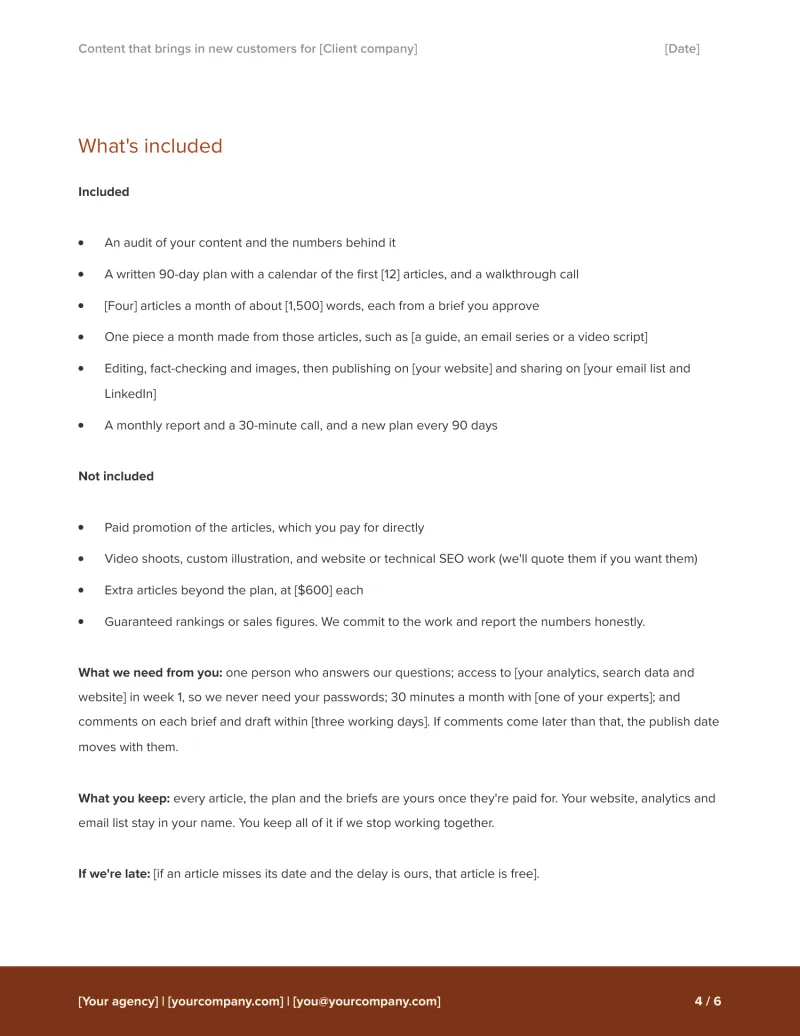
Included
An audit of your content and the numbers behind it
A written 90-day plan with a calendar of the first [12] articles, and a walkthrough call
[Four] articles a month of about [1,500] words, each from a brief you approve
One piece a month made from those articles, such as [a guide, an email series or a video script]
Editing, fact-checking and images, then publishing on [your website] and sharing on [your email list and LinkedIn]
A monthly report and a 30-minute call, and a new plan every 90 days
Not included
Paid promotion of the articles, which you pay for directly
Video shoots, custom illustration, and website or technical SEO work (we'll quote them if you want them)
Extra articles beyond the plan, at [$600] each
Guaranteed rankings or sales figures. We commit to the work and report the numbers honestly.
What we need from you: one person who answers our questions; access to [your analytics, search data and website] in week 1, so we never need your passwords; 30 minutes a month with [one of your experts]; and comments on each brief and draft within [three working days]. If comments come later than that, the publish date moves with them.
What you keep: every article, the plan and the briefs are yours once they're paid for. Your website, analytics and email list stay in your name. You keep all of it if we stop working together.
If we're late:[if an article misses its date and the delay is ours, that article is free].
As Philip Morgan and Jonathan Stark wrote in our 2015 book, "You will almost never be the only party responsible for the outcome of a project." In content work that usually means comments on drafts, so say how long the client has and what happens to the date if they take longer.
6. Investment
One price to start, for the audit and the plan, then a monthly fee, each with when it's invoiced, and a way out before the monthly work begins. These are example prices; the table further down shows what content work costs.
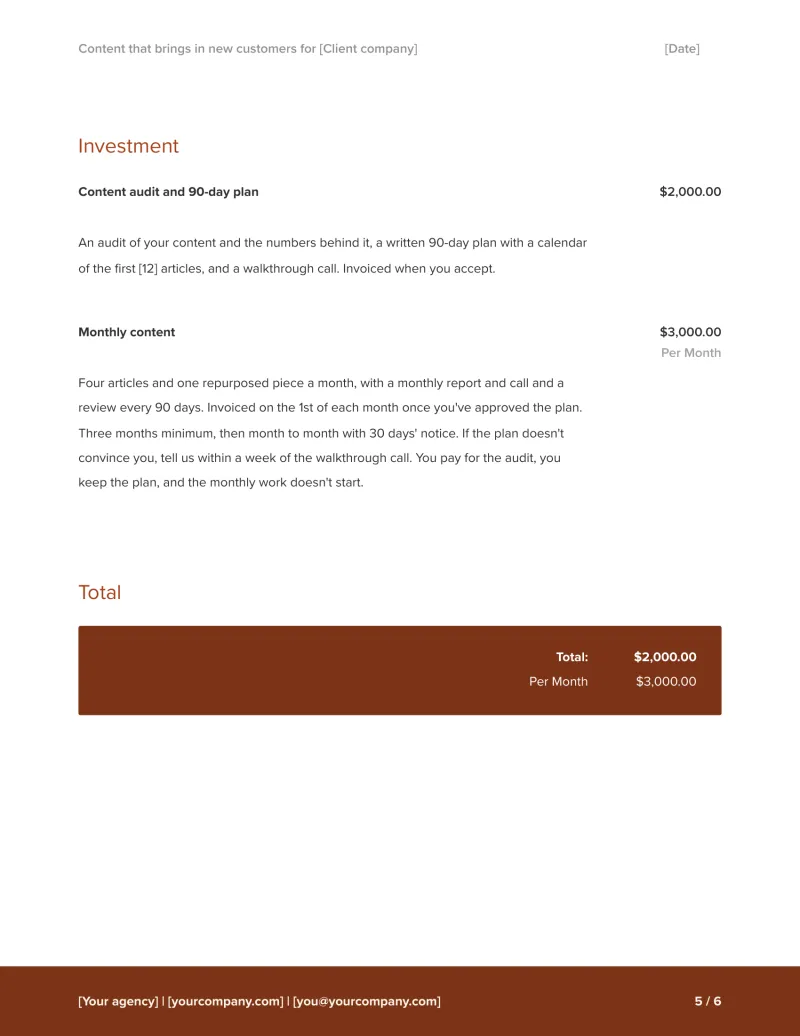
Content audit and 90-day plan
$2,000
An audit of your content and the numbers behind it, a written 90-day plan with a calendar of the first [12] articles, and a walkthrough call. Invoiced when you accept.
Monthly content
$3,000 a month
Four articles and one repurposed piece a month, with a monthly report and call and a review every 90 days. Invoiced on the 1st of each month once you've approved the plan. Three months minimum, then month to month with 30 days' notice. If the plan doesn't convince you, tell us within a week of the walkthrough call. You pay for the audit, you keep the plan, and the monthly work doesn't start.
Total: $2,000then $3,000 a month
In Nusii, proposals with a recurring fee were accepted less often than one-off ones (40% against 55% for the same senders, July to September 2026). A monthly fee is a bigger decision. The audit gives the client a first step with a clear end.
7. Next steps
Tells the client exactly what to do to say yes, what happens after, and when you'll call.
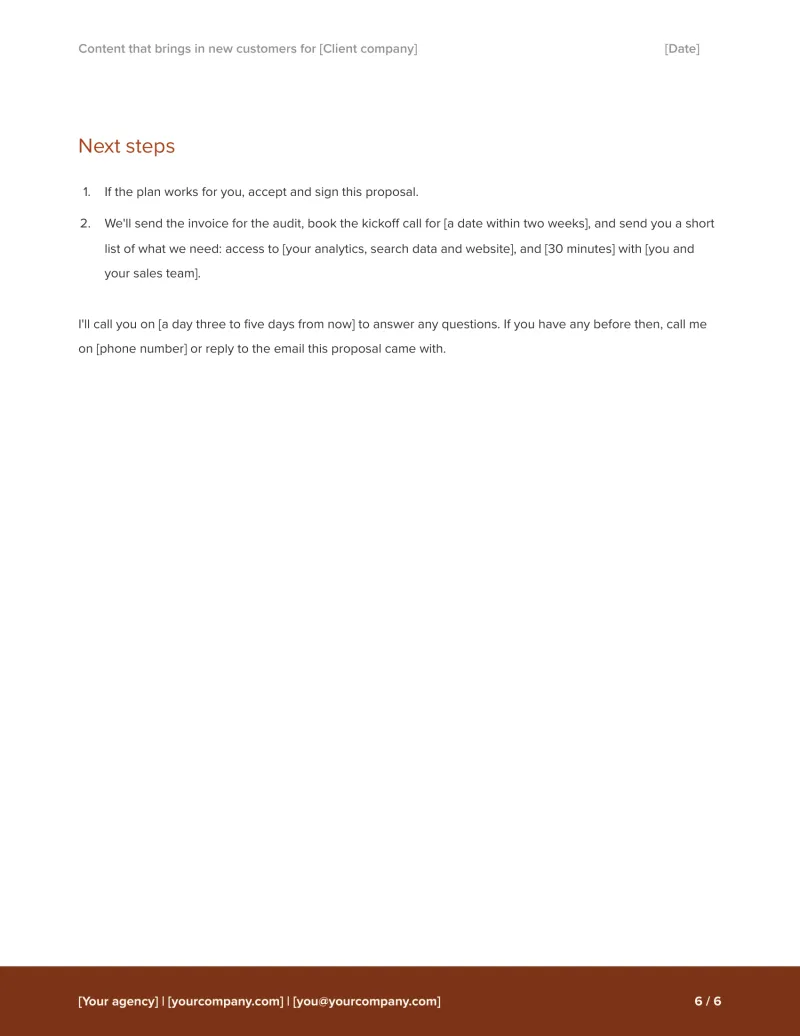
If the plan works for you, accept and sign this proposal.
We'll send the invoice for the audit, book the kickoff call for [a date within two weeks], and send you a short list of what we need: access to [your analytics, search data and website], and [30 minutes] with [you and your sales team].
I'll call you on [a day three to five days from now] to answer any questions. If you have any before then, call me on [phone number] or reply to the email this proposal came with.
Agencies' accepted proposals in Nusii got their yes in a median of 3.9 days, and 62% of them within a week (November 2025 to October 2026). A call three to five days after you send it lands while most clients are still deciding.
Four things a content proposal should put in writing
Content work goes wrong in the same few places. Of the templates we could read for this search in November 2026, only one covered review times and who owns the work, and none said how AI is used. So this one does:
Who owns the articles. The client, once they're paid for. Don't leave it to chance: the default terms in at least one popular template hand the intellectual property to the agency, which your client may not expect.
Who writes them, and what AI does. In Orbit Media's 2026 survey of 1,042 content marketers, 92.4% use AI for blogging, and they were no more likely to report strong results than the rest. Your client will wonder, so name who writes, who edits and what AI does.
How fast the client has to comment. Every content calendar depends on it. The template gives them [three working days] and says the publish date moves if they take longer, so a slow review doesn't turn into your missed deadline.
What you'll count. In the same survey, 18% said they don't know if their blog delivers results, and 13.9% reported strong results, an all-time low. So the template reports leads and customers first, and page views last.
A content marketing proposal example, filled in
Two sections of the template above with a client's words in the brackets, so you can see how it reads when it's done. Corvane Scheduling is made up, and so are its numbers.
Content that brings in new customers for Corvane Scheduling
What we heard
You said you publish every week and can't tell whether any of it brings in customers. We'll tie every article to a question your buyers ask and one action we can count, such as a demo request.
You said the people who know this stuff have no time to write it down. We'll get it out of them in a 30-minute interview each month and do the writing ourselves.
You said your last agency's articles could have been about any company. We'll write from your team's experience and your customers' words, and someone will check every fact before you see it.
What success looks like: 20 demo requests a month from your articles within 12 months, up from about 5, measured in your analytics and your CRM.
What it's worth: you told us you win about 1 in 5 of the demo requests you get, and a new customer brings in about $8,000. Fifteen more demo requests a month would mean about 3 more customers, or about $24,000 in new business a month.
If nothing changes: every new lead keeps costing you ad money, and the blog stays a cost nobody can defend.
Investment
Content audit and 90-day plan
$2,000
Monthly content
$3,000 a month
Total: $2,000then $3,000 a month
See it as your client will
Every page of the PDF, printed by Nusii. Sent as a link, it's one scrolling page on any device: your client accepts with one button and signs with their name.
The template in Nusii, the way your client will see it. It opens in a new tab.
How much content marketing costs
What content work costs, from sources we could check. The template's example prices, $2,000 to start and $3,000 a month for five pieces, work out at the same $600 a piece as WebFX's published plans. In Nusii, agencies' accepted proposals had a median value of $4,000, monthly fees left out (253 accepted proposals, July to September 2026).
What
Price
Source
Monthly content, by published plan
$1,800 to $6,000 a monthfor 3 to 10 content assets, about $600 eachWebFX
Sources: WebFX, content marketing pricing page, read November 2026; Column Five, content marketing agency pricing guide, read November 2026; SparkToro, State of Digital Agencies survey with Paddy Moogan, 376 respondents, fall 2025. WebFX and Column Five both sell content marketing, so read them as price lists and not as surveys. SparkToro's survey covers all kinds of digital agency, and it doesn't say how many answered each question.
How often proposals got a yes, by price
Proposals over $15,000 got a yes about a third of the time. Agencies' accepted proposals had a median value of $4,000. From 1,713 proposals first sent with Nusii, July to September 2026.
Under $1,000
67.1%
$1,000 to $5,000
50.7%
$5,000 to $15,000
48.9%
$15,000 to $50,000
36.1%
Over $50,000
33.3%
Share accepted, by the total the client saw. Bigger proposals are bigger decisions, so this shows what happened, not that a lower price would win. Method: The State of Proposals 2026.
What happens after you send it
From 3,782 proposals first sent with Nusii by marketing, web, advertising and video agencies from November 2025 to October 2026.
48.9%
were accepted
54 minutes
median time to the client's first look
3.9 days
median time to a yes
62.2%
of the yeses came within a week
Clients rarely say no. Of all proposals sent with Nusii from July to September 2026, 6.5% were rejected and 45.2% got no answer either way. Silence is the usual no, so a follow-up is worth sending.
Follow up after a week. Most yeses come within seven days. In Nusii you see when the proposal was opened and get an email when it's accepted, so you can follow up when they've read it, not when you guess they have.
The same template as a Word file you can edit (it opens in Google Docs too) and a PDF printed by Nusii. We'll email you both, plus a few emails with proposal tips. Unsubscribe any time.
Or send it with Nusii
This template is in the gallery of every Nusii account. Send it as a link: you get an email when your client opens it, and they accept and sign online, on any device.
“I can put together a polished proposal quickly without fighting the software, and my clients can review and sign it electronically, which makes it easier for them to say yes and get started.”
Janelle Hardin
Founder, Dingo Integrated Marketing
“I’ve built a library of reusable sections and proposal templates, so I can pull together a tailored proposal without starting from scratch every time.”
A document that tells a prospective client what content you’ll produce, why, what it costs and how to start. It usually covers their goals, your plan, what’s included and what isn’t, the price (often a first phase, then a monthly fee) and how you’ll report results.
What should a content marketing proposal include?
What the client told you and the goals that follow from it, how you’ll work, short proof from similar clients, what’s included and what isn’t, who owns the work, the price, and the next steps. That’s seven sections, the same as the template on this page.
How do you write a content marketing proposal?
Start from a call with the client, not from your services. Write down their problem in their words, turn it into a goal you can both measure, and work out what reaching it is worth to them. Then say how you’ll do it, what you need from them and what it costs.
Is this content marketing proposal template free?
Yes. The whole template is on this page, and you can copy it section by section. Leave your email to get it as a Word file and a PDF. In Nusii it’s in the template gallery of every account, ready to send as a link.
Does this work for content creation or content strategy proposals?
Yes. For content creation only, drop the audit if the client already has a plan and start at the monthly work. For strategy only, keep the audit and the 90-day plan and remove the monthly line item. The way out and the “What you keep” paragraph work the same in both.
How much should I charge for content marketing?
WebFX publishes $1,800 to $6,000 a month for 3 to 10 pieces, about $600 each. Column Five, another agency, puts production-only work at $2,000 to $5,000 a month and strategy with it at $5,000 to $15,000. This template uses $2,000 to start and $3,000 a month as example prices.
Should I charge per article or a monthly retainer?
A monthly fee suits ongoing work, because results depend on publishing steadily. In Nusii, though, proposals with a recurring fee were accepted less often (40% against 55% for the same senders, July to September 2026). So the template starts with a fixed audit, and gives extra articles a per-piece price.
Should I charge for a content audit?
Yes, if it produces something the client can use without you. Here it’s a written 90-day plan they keep either way. It also lets you see what’s already working before you name topics, and it shows the client what working with you is like before they commit to a monthly fee.
Should a proposal say how we use AI?
Yes. In Orbit Media’s 2026 survey of 1,042 content marketers, 92.4% used AI for blogging, so your client will wonder. Say who writes each article, who edits it and what AI does, in a sentence. The template has a line for it.
Who owns the content?
Your client should, once it’s paid for, and the proposal should say so. The template says the articles, the plan and the briefs are theirs, and that their website and analytics stay in their name. Check any contract you attach says the same thing.
What results should I promise in a content marketing proposal?
Promise the work and measure the result, but don’t guarantee rankings or sales. Set a goal in your client’s numbers, such as demo requests a month from articles, and report on it every month. Their offer, prices and how fast they answer new leads decide how many become customers.
How long does content marketing take to work?
Usually months, not weeks, and the proposal should say so. The template leaves the number in brackets, because it depends on the client’s site and how competitive their topics are. It judges the first 90 days on what got published and the first year on leads and customers.
How long should a content marketing proposal be?
About seven sections. Accepted proposals in Nusii had a median of 7 sections and the rest 9 (1,713 proposals, July to September 2026), and about a third of first views are on a phone. Keep the topic list for the written plan.
Can I use this template as a freelance writer?
Yes. Write “I” instead of “we”, describe yourself in the introduction, and set the number of articles to what you can deliver on your own. Everything else, from the goals to the way out after the audit, works the same.
Should I offer several packages?
Offer them only if the client asked about choices. In Nusii, proposals where the client could choose between options were accepted less often (40% against 51% for the same senders, July to September 2026). This template has one clear price; add an optional section for an extra the client asked about.
Do I need a contract as well?
Attach your own agreement if you use one. This template covers the scope, the price, who owns what and how to end the work in plain words, and it isn’t legal advice.
Can my client accept and sign the proposal online?
Yes, if you send it as an online proposal. In Nusii, your client opens a link, accepts with one button and signs with their typed name, on any device, and you get an email when they do. The Word file and the PDF need signing the old way.