A free digital marketing proposal template in seven sections, for an agency that runs a client's ads, social media and email as one plan: what the client told you, a setup month, one monthly fee and the next steps. Read it here or get it as a Word file and a PDF.
A digital marketing proposal is the document an agency sends to win a client's online marketing: the ads, social media, email or search work it will run, the result it will measure, and the price. It should say what the client told you, one goal across all the channels, what each channel is for, what's included and who pays for ads, one price (usually a setup fee, then a monthly fee) and how to say yes. The template below has a section for each.
The digital marketing proposal template, section by section
Copy one section or the whole thing. Under each section: what it's for, and one thing we've learned from the proposals sent with Nusii.
[Yellow] you write[Green] Nusii fills in when you send it
1. Introduction
The whole plan in two sentences, and who you are. Partners and colleagues read it too, often without having been on the call. Working on your own? Write "I" instead of "we".
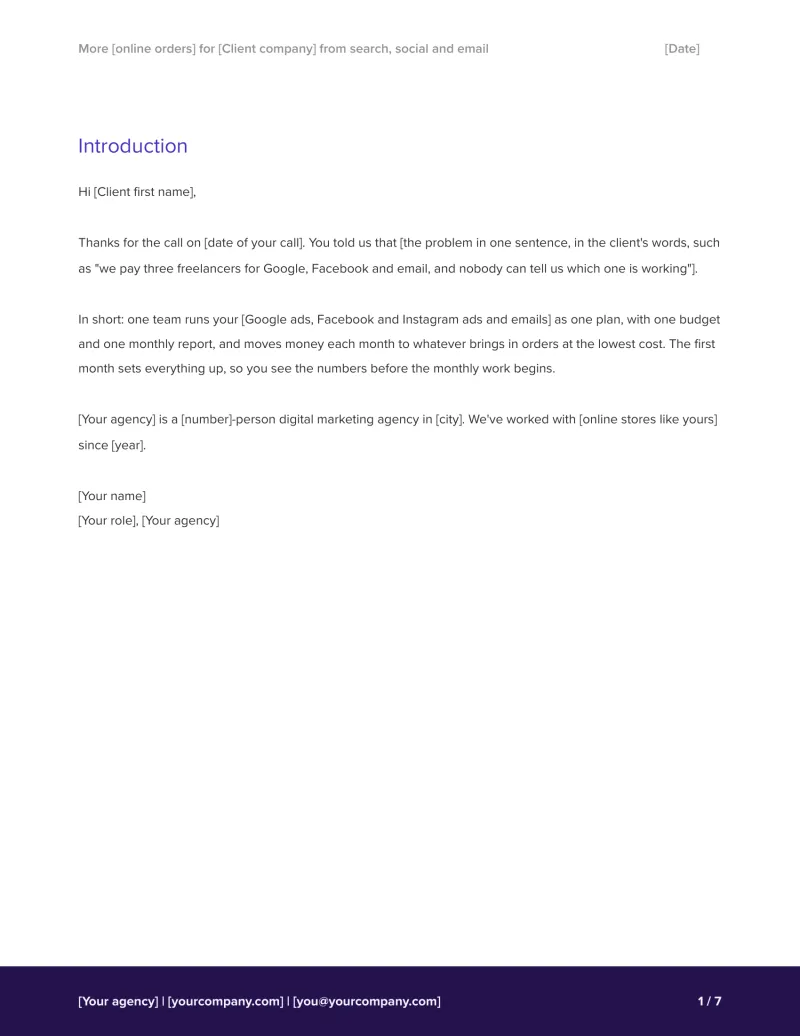
Hi [Client first name],
Thanks for the call on [date of your call]. You told us that [the problem in one sentence, in the client's words, such as "we pay three freelancers for Google, Facebook and email, and nobody can tell us which one is working"].
In short: one team runs your [Google ads, Facebook and Instagram ads and emails] as one plan, with one budget and one monthly report, and moves money each month to whatever brings in orders at the lowest cost. The first month sets everything up, so you see the numbers before the monthly work begins.
[Your agency] is a [number]-person digital marketing agency in [city]. We've worked with [online stores like yours] since [year].
[Your name] [Your role], [Your agency]
Digital marketing proposals in Nusii got their first look in a median of 72 minutes (about 470 proposals, November 2025 to October 2026), and about a third of first views are on a phone. So the plan has to fit in the first screen: what you'll run, how it's judged, and what happens first.
2. What we heard
Shows you listened, turns what the client told you into goals you can both check later, and puts a number on what the work is worth to them. Only you can write this one: replace the examples with your client's words.
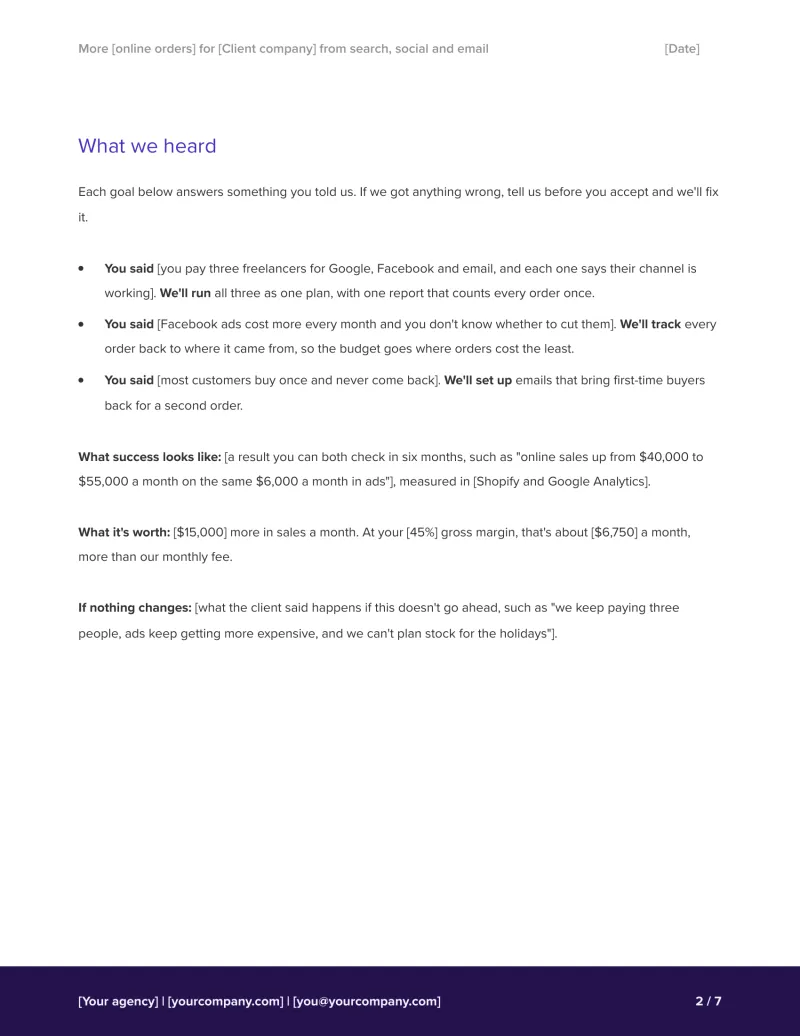
Each goal below answers something you told us. If we got anything wrong, tell us before you accept and we'll fix it.
You said[you pay three freelancers for Google, Facebook and email, and each one says their channel is working]. We'll run all three as one plan, with one report that counts every order once.
You said[Facebook ads cost more every month and you don't know whether to cut them]. We'll track every order back to where it came from, so the budget goes where orders cost the least.
You said[most customers buy once and never come back]. We'll set up emails that bring first-time buyers back for a second order.
What success looks like:[a result you can both check in six months, such as "online sales up from $40,000 to $55,000 a month on the same $6,000 a month in ads"], measured in [Shopify and Google Analytics].
What it's worth:[$15,000] more in sales a month. At your [45%] gross margin, that's about [$6,750] a month, more than our monthly fee.
If nothing changes:[what the client said happens if this doesn't go ahead, such as "we keep paying three people, ads keep getting more expensive, and we can't plan stock for the holidays"].
Ask what they spend now and with whom, what a customer is worth, and their gross margin. Philip Morgan's first money question in our 2015 book on proposals works well here: "How does your business make money?" The margin turns "more sales" into money they keep, which is what your fee gets compared with.
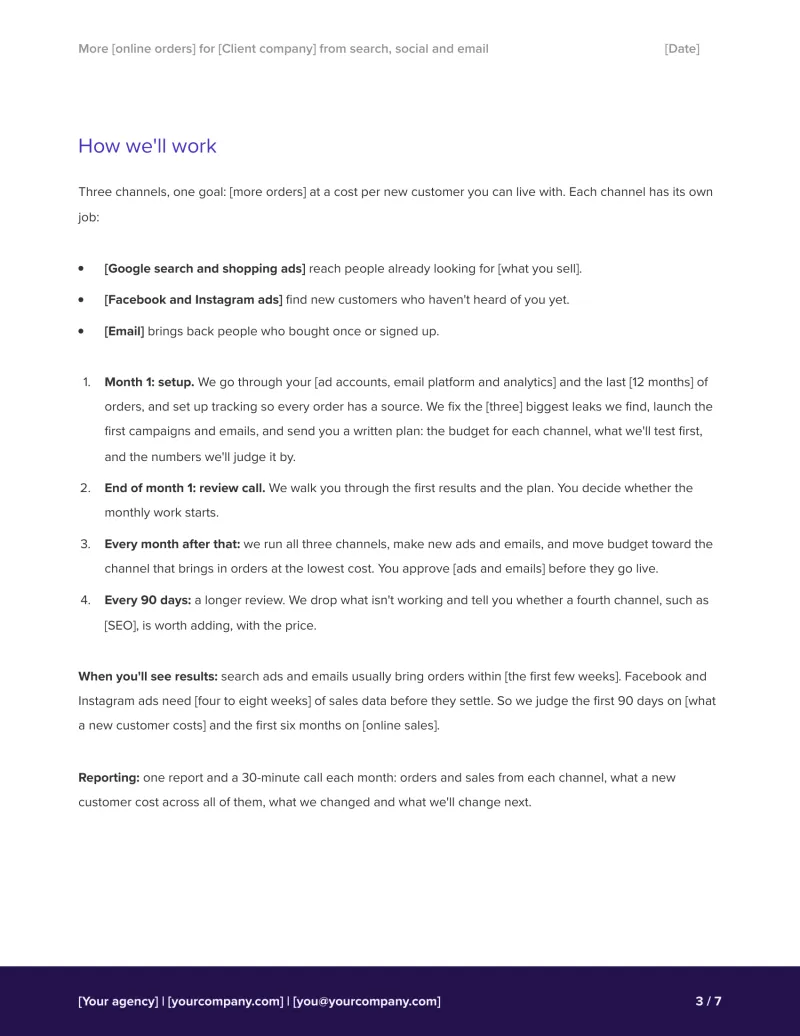
3. How we'll work
What each channel is for, what happens in the first month, and how the budget moves after that. This is what a digital marketing proposal sells that a single-channel one doesn't: one goal across all of them.
Three channels, one goal: [more orders] at a cost per new customer you can live with. Each channel has its own job:
[Google search and shopping ads] reach people already looking for [what you sell].
[Facebook and Instagram ads] find new customers who haven't heard of you yet.
[Email] brings back people who bought once or signed up.
Month 1: setup. We go through your [ad accounts, email platform and analytics] and the last [12 months] of orders, and set up tracking so every order has a source. We fix the [three] biggest leaks we find, launch the first campaigns and emails, and send you a written plan: the budget for each channel, what we'll test first, and the numbers we'll judge it by.
End of month 1: review call. We walk you through the first results and the plan. You decide whether the monthly work starts.
Every month after that: we run all three channels, make new ads and emails, and move budget toward the channel that brings in orders at the lowest cost. You approve [ads and emails] before they go live.
Every 90 days: a longer review. We drop what isn't working and tell you whether a fourth channel, such as [SEO], is worth adding, with the price.
When you'll see results: search ads and emails usually bring orders within [the first few weeks]. Facebook and Instagram ads need [four to eight weeks] of sales data before they settle. So we judge the first 90 days on [what a new customer costs] and the first six months on [online sales].
Reporting: one report and a 30-minute call each month: orders and sales from each channel, what a new customer cost across all of them, what we changed and what we'll change next.
Most digital marketing proposals list every service the agency offers. "Clients rarely care about the tools you use," as Nathan Powell wrote in our 2015 book; they care about the result. Name the two or three channels that fit this client, say what each one is for, and leave the rest out. Accepted proposals in Nusii had a median of 7 sections, the rest 9 (1,713 proposals, July to September 2026).
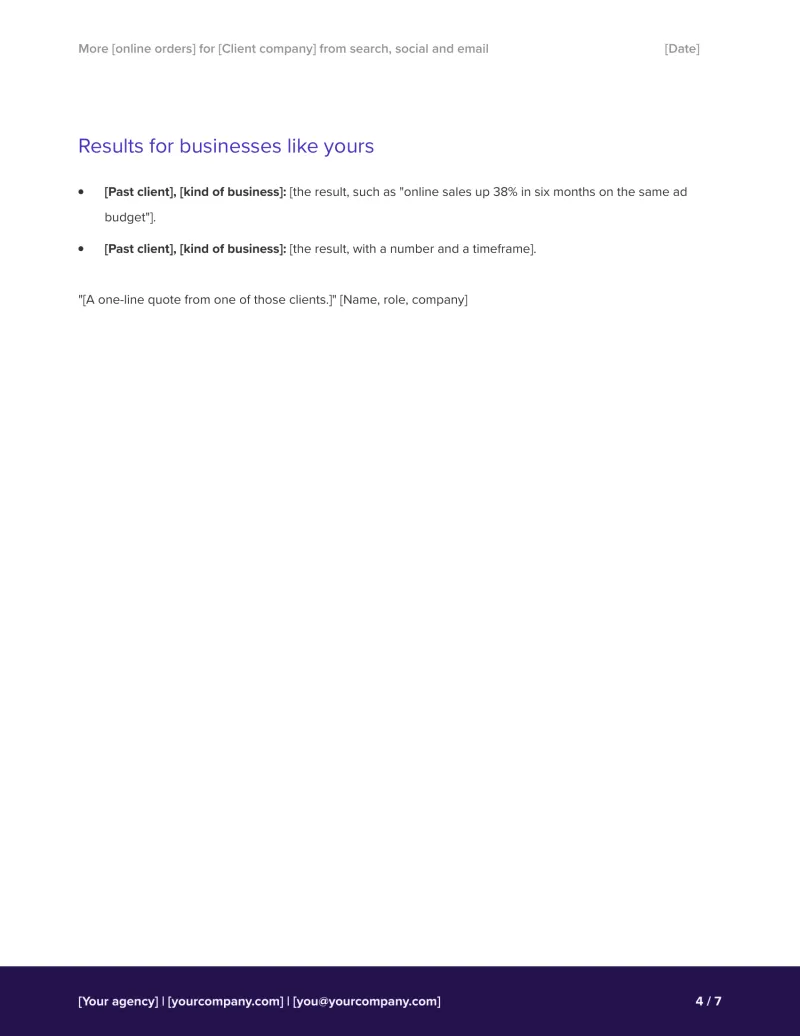
4. Results for businesses like yours
Short proof for the people who weren't on the call: what happened for businesses like this one. Use real numbers from a real client, or leave this section out.
[Past client], [kind of business]:[the result, such as "online sales up 38% in six months on the same ad budget"].
[Past client], [kind of business]:[the result, with a number and a timeframe].
"[A one-line quote from one of those clients.]" [Name, role, company]
Proposals to a client who had accepted one before were accepted 63% of the time in Nusii, against 47% for a first proposal from the same senders (July to September 2026). A new client hasn't seen your work yet, so one result from a business like theirs has to do that job.
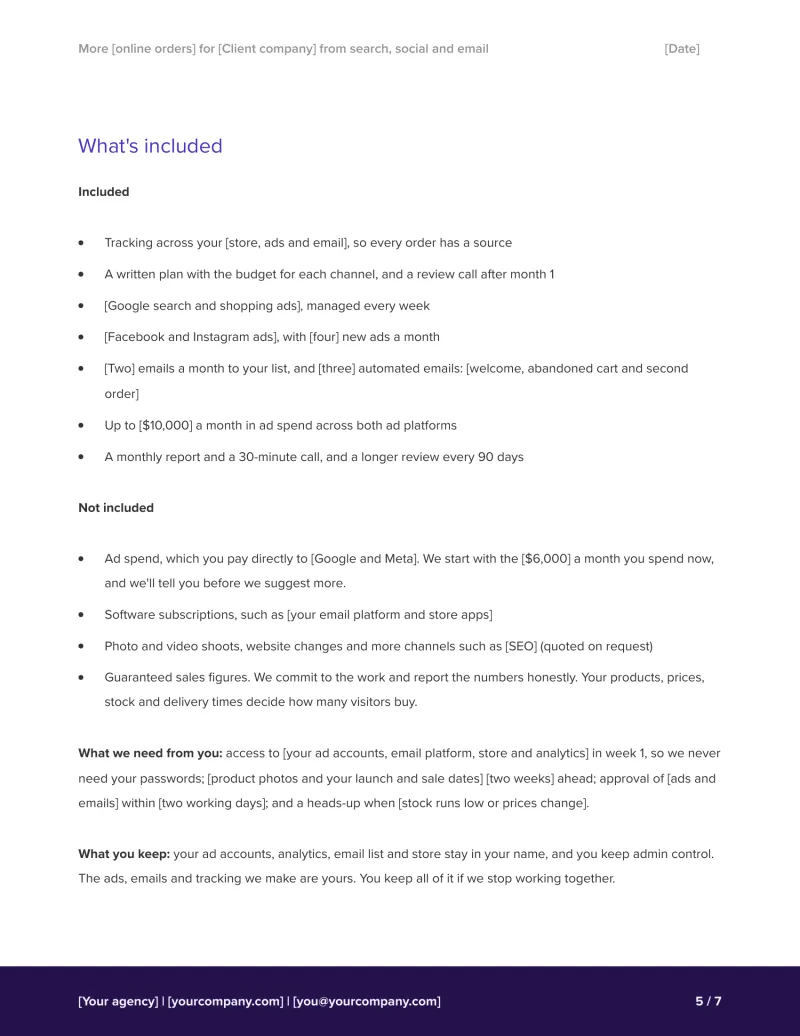
5. What's included
Draws the line between what you'll do and what you won't, says who pays for ads, what you need from the client, and what they keep.
Included
Tracking across your [store, ads and email], so every order has a source
A written plan with the budget for each channel, and a review call after month 1
[Google search and shopping ads], managed every week
[Facebook and Instagram ads], with [four] new ads a month
[Two] emails a month to your list, and [three] automated emails: [welcome, abandoned cart and second order]
Up to [$10,000] a month in ad spend across both ad platforms
A monthly report and a 30-minute call, and a longer review every 90 days
Not included
Ad spend, which you pay directly to [Google and Meta]. We start with the [$6,000] a month you spend now, and we'll tell you before we suggest more.
Software subscriptions, such as [your email platform and store apps]
Photo and video shoots, website changes and more channels such as [SEO] (quoted on request)
Guaranteed sales figures. We commit to the work and report the numbers honestly. Your products, prices, stock and delivery times decide how many visitors buy.
What we need from you: access to [your ad accounts, email platform, store and analytics] in week 1, so we never need your passwords; [product photos and your launch and sale dates][two weeks] ahead; approval of [ads and emails] within [two working days]; and a heads-up when [stock runs low or prices change].
What you keep: your ad accounts, analytics, email list and store stay in your name, and you keep admin control. The ads, emails and tracking we make are yours. You keep all of it if we stop working together.
As Philip Morgan and Jonathan Stark wrote in our 2015 book, "You will almost never be the only party responsible for the outcome of a project." Ads can't sell what's out of stock, so ask for launch dates and stock levels up front.
6. Investment
One price to start, for the setup month, then one monthly fee for all the channels, each with when it's invoiced, and a way out before the monthly fee begins. These are example prices; the table further down shows what agencies charge.
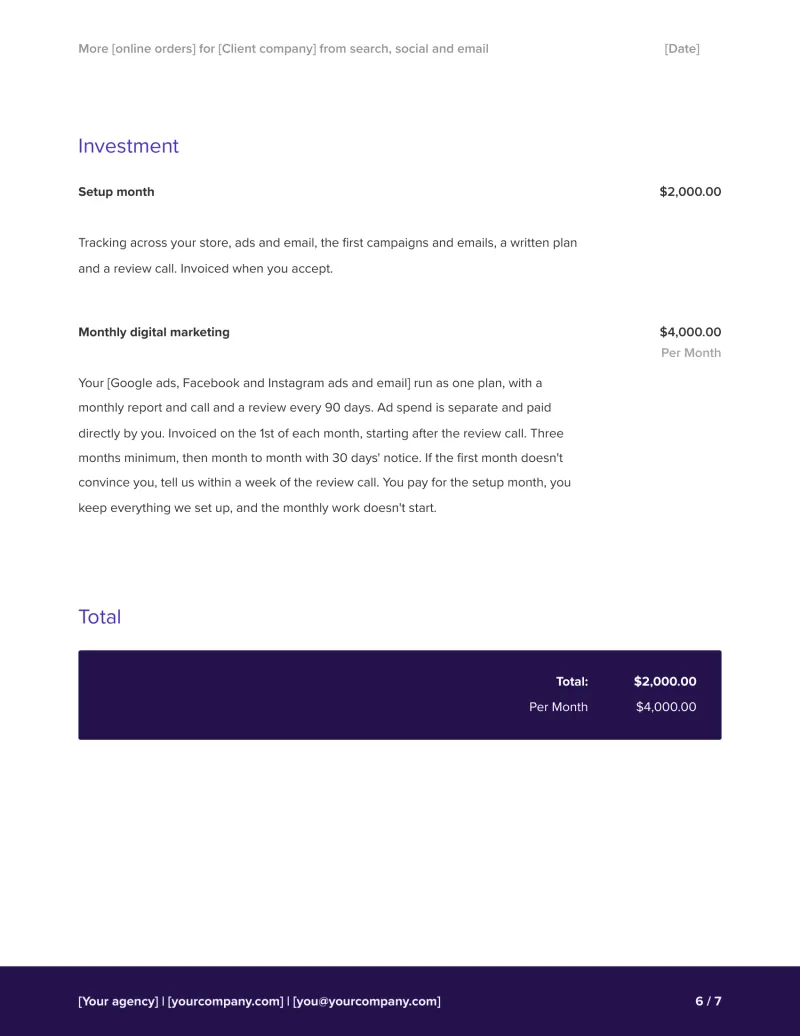
Setup month
$2,000
Tracking across your store, ads and email, the first campaigns and emails, a written plan and a review call. Invoiced when you accept.
Monthly digital marketing
$4,000 a month
Your [Google ads, Facebook and Instagram ads and email] run as one plan, with a monthly report and call and a review every 90 days. Ad spend is separate and paid directly by you. Invoiced on the 1st of each month, starting after the review call. Three months minimum, then month to month with 30 days' notice. If the first month doesn't convince you, tell us within a week of the review call. You pay for the setup month, you keep everything we set up, and the monthly work doesn't start.
Total: $2,000then $4,000 a month
Nine in ten digital marketing proposals in Nusii had a monthly fee (November 2025 to October 2026), and across all proposals a monthly fee went with fewer yeses: 40% against 55% for the same senders (July to September 2026). The setup month gives the client a first step with a clear end.
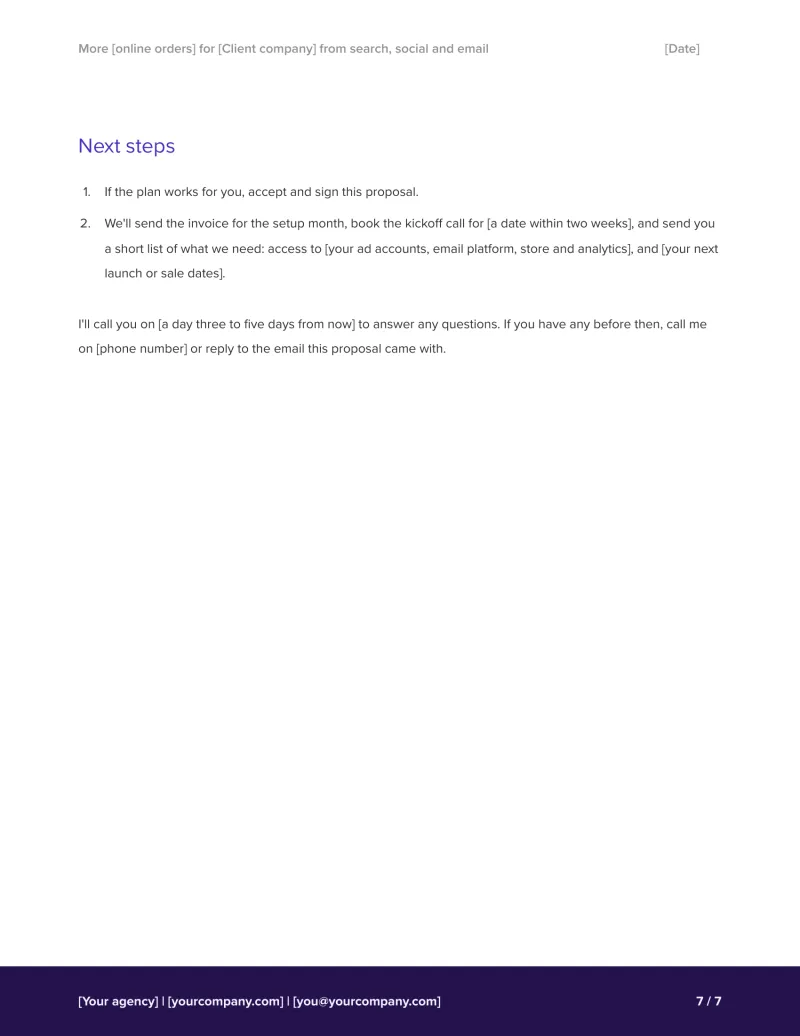
7. Next steps
Tells the client exactly what to do to say yes, what happens after, and when you'll call.
If the plan works for you, accept and sign this proposal.
We'll send the invoice for the setup month, book the kickoff call for [a date within two weeks], and send you a short list of what we need: access to [your ad accounts, email platform, store and analytics], and [your next launch or sale dates].
I'll call you on [a day three to five days from now] to answer any questions. If you have any before then, call me on [phone number] or reply to the email this proposal came with.
Digital marketing proposals in Nusii got their yes in a median of 4 days, and 39% of the yeses came after the first week (November 2025 to October 2026). A call three to five days after you send it lands while most clients are still deciding.
What a digital marketing proposal can and can't promise
Promise the work, the report and when you'll look at the results together. Don't promise what the ad platforms or the client's customers will do.
Sales and return on ad spend. A guaranteed return reads as a warning sign to anyone who has hired an agency before. Set the goal in the client's numbers, such as online sales or what a new customer costs, and show it in every report.
The price of ads. Google and Meta sell ads in auctions, so the cost of a click moves with the competition. Say that you'll report what each new customer costs, and what you'll do when it rises.
Timing. Say what happens in the first month (the setup and the first campaigns) and when each channel usually shows results. The template gives a bracket for social ads to settle: put in what you see with your own clients.
A digital marketing proposal example, filled in
Two sections of the template above with a client's words in the brackets, so you can see how it reads when it's done. Larkwell Ceramics is a made-up online store, and so are its numbers.
More online orders for Larkwell Ceramics from search, social and email
What we heard
You said you pay three freelancers for Google, Facebook and email, and each one says their channel is working. We'll run all three as one plan, with one report that counts every order once.
You said Facebook ads cost more every month and you don't know whether to cut them. We'll track every order back to where it came from, so the budget goes where orders cost the least.
You said most customers buy once and never come back. We'll set up emails that bring first-time buyers back for a second order.
What success looks like: online sales up from $40,000 to $55,000 a month within six months, on the same $6,000 a month in ads, measured in Shopify and Google Analytics.
What it's worth: $15,000 more in sales a month. At your 45% gross margin, that's about $6,750 a month, more than our monthly fee.
If nothing changes: you keep paying three people, ads keep getting more expensive, and you can't plan stock for the holidays.
Investment
Setup month
$2,000
Monthly digital marketing
$4,000 a month
Total: $2,000then $4,000 a month
How to write a digital marketing proposal, step by step
Seven steps, from the first call to the follow-up. The template above already follows them; here's why each one matters.
1
Ask what they spend now, and with whom
On the first call, find out what the client sells online, what a customer is worth, who runs their ads and email today, what it costs them, their gross margin, and what happens if nothing changes. Write the answers down in their words: they become the "What we heard" section. Our 10 questions for the first client call cover it, and how to ask about the budget covers the hardest one.
2
Look at their accounts before you name channels
Ask for read-only access to their ad accounts, email platform and analytics, and spend an hour, not a week. Where do orders come from today, and what does each one cost? Three findings make the case. The full setup and the fixes are the first paid step, so don't give them away in the proposal.
3
Set one goal across all the channels
"Online sales up from $40,000 to $55,000 a month on the same ad budget" is something the client can picture and you can report on. Clicks, likes and opens per channel aren't. One goal also lets you move money between channels without arguing about whose numbers count.
4
Pick two or three channels and say what each is for
Search ads catch people already looking, social ads find new ones, and email brings them back. Name the channels that fit this client and leave out the rest of your service list: a client who reads ten services wonders which ones they're paying for.
5
Send one price: a setup month, then a monthly fee
Nine in ten digital marketing proposals in Nusii had a monthly fee, and across all proposals a monthly fee went with fewer yeses (40% against 55% for the same senders, July to September 2026). A paid setup month with a way out gives the client a first step with a clear end. Send one clear price unless the client asked for choices: proposals where the client could choose between options were accepted less often (40% against 52%, same period). What to charge has the survey ranges.
6
Keep it short enough to read on a phone
Accepted proposals in Nusii had a median of 7 sections, against 9 for the rest, and about a third of first views were on a phone (July to September 2026). Keep the channel detail for the written plan in month 1.
7
Send it as a link, then follow up for two weeks
Send it with a short email (there's one below) and call when you said you would. Digital marketing proposals took a median of 4 days to get a yes in Nusii, and 39% of the yeses came after the first week (November 2025 to October 2026).
If two weeks pass in silence, send one last line, from Blair Enns via our 2015 book on proposals: "I haven't heard back from you on the marketing plan, so I'm going to assume you've gone in a different direction or your priorities have changed."
See it as your client will
Every page of the PDF, printed by Nusii. Sent as a link, it's one scrolling page on any device: your client accepts with one button and signs with their name.
The template in Nusii, the way your client will see it. It opens in a new tab.
How much digital marketing agencies charge
What digital marketing agencies charge, from the two surveys we could check at the source. The template's example prices, $2,000 for the setup month and $4,000 a month for three channels, sit inside the most common ranges. In Nusii, accepted digital marketing proposals had a median value of about $1,750 with monthly fees left out, which is roughly a setup fee (November 2025 to October 2026).
What
Price
Source
Monthly retainer, the most common range
$1,000 to $5,000 a monthwhat 49% of agencies average per clientSparkToro
Sources: SparkToro, State of Digital Agencies survey with Paddy Moogan, fall 2025; Credo, survey of PPC agencies with Teamwork, page updated June 2022; Credo, survey of digital marketing agencies, page updated July 2022. Most of SparkToro's respondents run agencies of up to 50 people, and the survey doesn't say how many answered each question. Credo is a directory of agencies, and its numbers are a few years old: read them as a floor.
How often proposals got a yes, by price
Proposals over $15,000 got a yes about a third of the time. Agencies' accepted proposals had a median value of $4,000. From 1,713 proposals first sent with Nusii, July to September 2026.
Under $1,000
67.1%
$1,000 to $5,000
50.7%
$5,000 to $15,000
48.9%
$15,000 to $50,000
36.1%
Over $50,000
33.3%
Share accepted, by the total the client saw. Bigger proposals are bigger decisions, so this shows what happened, not that a lower price would win. Method: The State of Proposals 2026.
The email to send it with
The proposal does the explaining, so the email only has to get it opened and say when you'll call. Leave the price out, so your client reads the plan before they judge the number. In Nusii this goes in the Send Proposal window, and you can save it as your template for next time.
Subject:[The plan for more online orders]
Hi [first name],
Here's the proposal we talked about on [day of your call]: [link].
In short: one team runs your ads and emails as one plan, starting with a setup month so you see the numbers before the monthly work begins.
It's short, and you can accept it right on the page. If anything's off, reply to this email and I'll change it.
I'll call you on [a day three to five days from now] to answer any questions.
[Your name]
What happens after you send it
Of About 470 digital marketing proposals first sent with Nusii from November 2025 to October 2026 (digital marketing in the proposal's name or a section title), 47% were accepted, with a median of 4 days to a yes.
47%
were accepted
72 minutes
median time to the client's first look
4 days
median time to a yes
61%
of the yeses came within a week
Clients rarely say no. Of all proposals sent with Nusii from July to September 2026, 6.5% were rejected and 45.2% got no answer either way. Silence is the usual no, so a follow-up is worth sending.
Nine in ten had a monthly fee, and they still did about as well as agencies' proposals overall. Across all proposals a monthly fee went with fewer yeses (40% against 55% for the same senders, July to September 2026), so a clear first step matters. Follow up over two weeks: 39% of the yeses came after the first week. In Nusii you see when the proposal was opened, so you can call once they've read it.
The same template as a Word file you can edit (it opens in Google Docs too) and a PDF printed by Nusii. We'll email you both, plus a few emails with proposal tips. Unsubscribe any time.
Or send it with Nusii
This template is in the gallery of every Nusii account. Send it as a link: you get an email when your client opens it, and they accept and sign online, on any device.
“I’ve built a library of reusable sections and proposal templates, so I can pull together a tailored proposal without starting from scratch every time.”
Russell Brown
Owner & Director, Digital Stream
“I can put together a polished proposal quickly without fighting the software, and my clients can review and sign it electronically, which makes it easier for them to say yes and get started.”
A document an agency or freelancer sends to win a client’s online marketing. It says what the client told you, the result you’ll measure, which channels you’ll run (ads, social media, email or search), what’s included, the price and how to say yes.
What should a digital marketing proposal include?
What the client told you and the goal that follows from it, what each channel is for, how the first month works, short proof from similar clients, what’s included and who pays for ads, the price and the next steps. That’s seven sections, the same as the template on this page.
Is this digital marketing proposal template free?
Yes. The whole template is on this page, and you can copy it section by section. Leave your email to get it as a Word file and a PDF. In Nusii it’s in the template gallery of every account, ready to send as a link.
How much do digital marketing agencies charge?
Most charge between $1,000 and $10,000 a month per client. In SparkToro’s State of Digital Agencies survey, 49% of agencies averaged $1,000 to $5,000 a month and 31% averaged $5,000 to $10,000. This template uses $2,000 for a setup month and $4,000 a month for three channels as example prices.
What’s the difference between a digital marketing proposal and a marketing proposal?
A digital marketing proposal sells channels the client already knows they want, run online and measured every month. Our marketing proposal template is for a client who isn’t sure where to start: it sells an audit first, and the audit picks the channels.
Can I add SEO to a digital marketing proposal?
Yes. Add it as a channel in “How we’ll work”, with what it’s for (people who search for what the client sells, months from now), and raise the monthly fee. For SEO on its own, use our SEO proposal template, which starts with an audit.
Who pays for the ads?
Your client, directly to Google and Meta, and the proposal should say so. The template keeps ad spend out of your fee, says what the client spends now, caps the ad spend your fee covers, and keeps the ad accounts in the client’s name.
Should I charge a setup fee?
Yes. The first month is the most work: tracking, account fixes and the first campaigns. In Credo’s survey of ads agencies, setup fees ran from $1,000 to $2,500. Here the setup month also gives the client a way out before the monthly fee starts.
Should I offer several packages?
Only if the client asked about choices. In Nusii, proposals where the client could choose between options were accepted less often (40% against 52% for the same senders, July to September 2026). This template has one clear price for the channels the client needs.
How long should a digital marketing proposal be?
About seven sections. Accepted proposals in Nusii had a median of 7 sections and the rest 9 (1,713 proposals, July to September 2026), and about a third of first views are on a phone. Keep the channel detail for the written plan in month 1.
Can I use this template as a freelance digital marketer?
Yes. Write “I” instead of “we”, describe yourself in the introduction, and keep to the channels you can run on your own. Everything else, from the goals to the way out after the setup month, works the same.
How do I answer a digital marketing RFP?
Follow its format exactly, because a missed requirement can rule you out. Where the RFP lets you, use this template’s sections: what you heard, one goal, what each channel is for, and one price. Ask for a call before you write; a buyer who won’t take one has often chosen already.
Can my client accept and sign the proposal online?
Yes, if you send it as an online proposal. In Nusii, your client opens a link, accepts with one button and signs with their typed name, on any device, and you get an email when they do. The Word file and the PDF need signing the old way.