A free executive and business coaching proposal in seven sections, from what the client and the leader told you to a paid start, six months of coaching at one price, and the next steps. For coaches selling to a company. Read it here or get it as a Word file and a PDF.
A coaching proposal is the document that turns a first conversation into an agreed engagement: what the company and the leader told you, the change other people should notice, how the sessions and reviews work, who hears what, the price and how to say yes. For executive and business coaching it should have these seven parts:
The executive coaching proposal template, section by section
Copy one section or the whole thing. Under each section: what it's for, and one thing we've learned from the proposals sent with Nusii.
[Yellow] you write[Green] Nusii fills in when you send it
1. Introduction
The whole engagement in two sentences, with the length and the price, and who you are. The person who pays, the leader you'll coach and often HR all read it, and not all of them were on the call. Part of a coaching firm? Write "we" instead of "I".
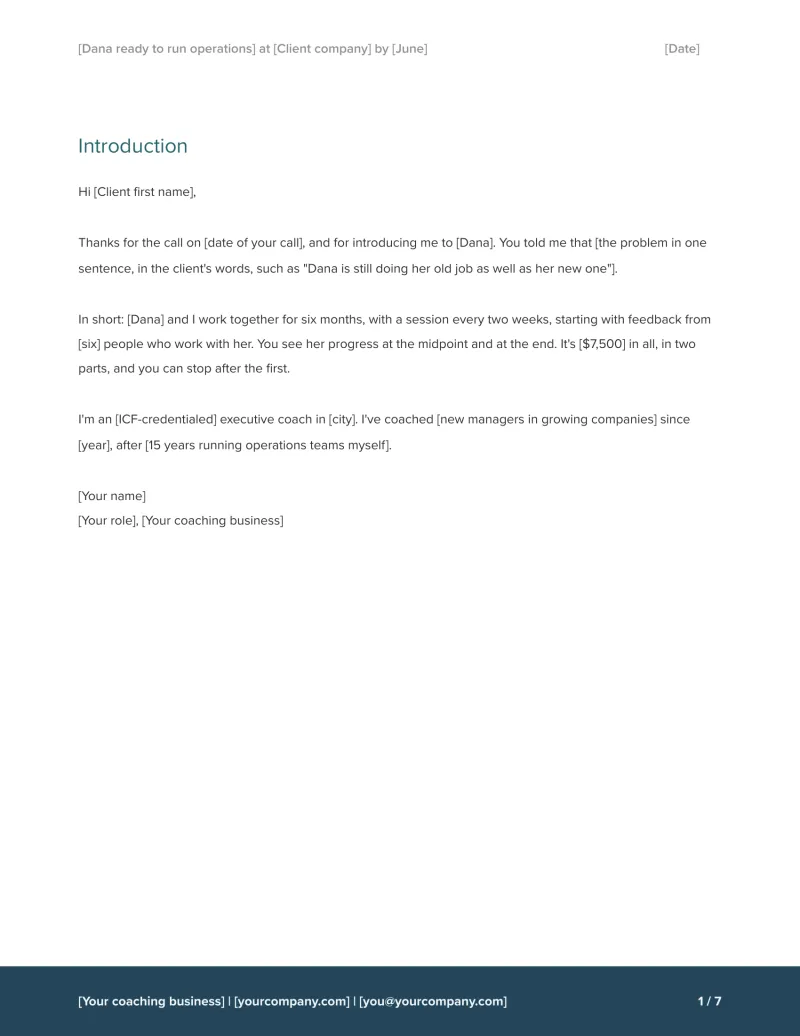
Hi [Client first name],
Thanks for the call on [date of your call], and for introducing me to [Dana]. You told me that [the problem in one sentence, in the client's words, such as "Dana is still doing her old job as well as her new one"].
In short: [Dana] and I work together for six months, with a session every two weeks, starting with feedback from [six] people who work with her. You see her progress at the midpoint and at the end. It's [$7,500] in all, in two parts, and you can stop after the first.
I'm an [ICF-credentialed] executive coach in [city]. I've coached [new managers in growing companies] since [year], after [15 years running operations teams myself].
[Your name] [Your role], [Your coaching business]
Consultants' proposals in Nusii got their first look in a median of 36 minutes (789 proposals, November 2025 to October 2026), and about a third of all first views are on a phone. The length and the price belong on the first screen.
2. What we heard
Shows you listened to both of them, turns "she needs coaching" into goals other people will notice, and puts a number on what's at stake. Only you can write this one: replace the examples with their words.
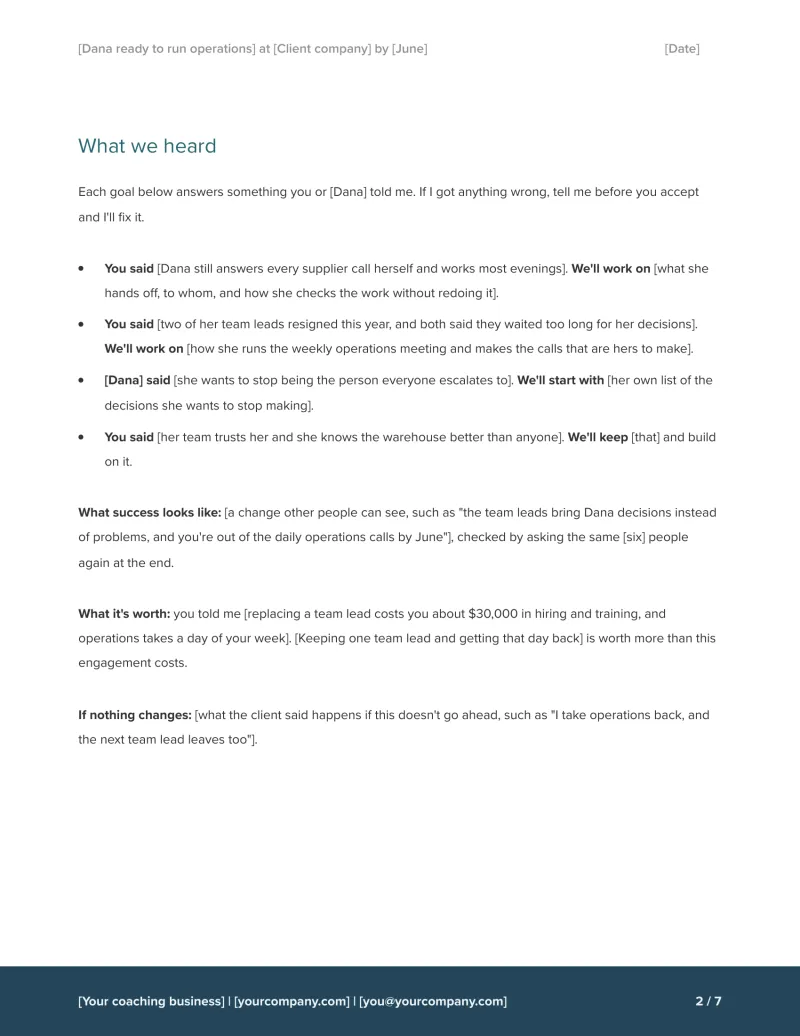
Each goal below answers something you or [Dana] told me. If I got anything wrong, tell me before you accept and I'll fix it.
You said[Dana still answers every supplier call herself and works most evenings]. We'll work on[what she hands off, to whom, and how she checks the work without redoing it].
You said[two of her team leads resigned this year, and both said they waited too long for her decisions]. We'll work on[how she runs the weekly operations meeting and makes the calls that are hers to make].
[Dana] said[she wants to stop being the person everyone escalates to]. We'll start with[her own list of the decisions she wants to stop making].
You said[her team trusts her and she knows the warehouse better than anyone]. We'll keep[that] and build on it.
What success looks like:[a change other people can see, such as "the team leads bring Dana decisions instead of problems, and you're out of the daily operations calls by June"], checked by asking the same [six] people again at the end.
What it's worth: you told me [replacing a team lead costs you about $30,000 in hiring and training, and operations takes a day of your week]. [Keeping one team lead and getting that day back] is worth more than this engagement costs.
If nothing changes:[what the client said happens if this doesn't go ahead, such as "I take operations back, and the next team lead leaves too"].
Ask the person who pays and the person you'll coach separately. Philip Morgan and Jonathan Stark, in our 2015 book on proposals: "employees will usually have very different 'home runs scenarios' than the owner of a business will." Both answers go here, so neither is surprised at the first meeting.
3. How we'll work
The engagement step by step, who is in which meeting, and what the person paying will and won't hear. That last part is what a sponsor asks about most, so it goes up front.
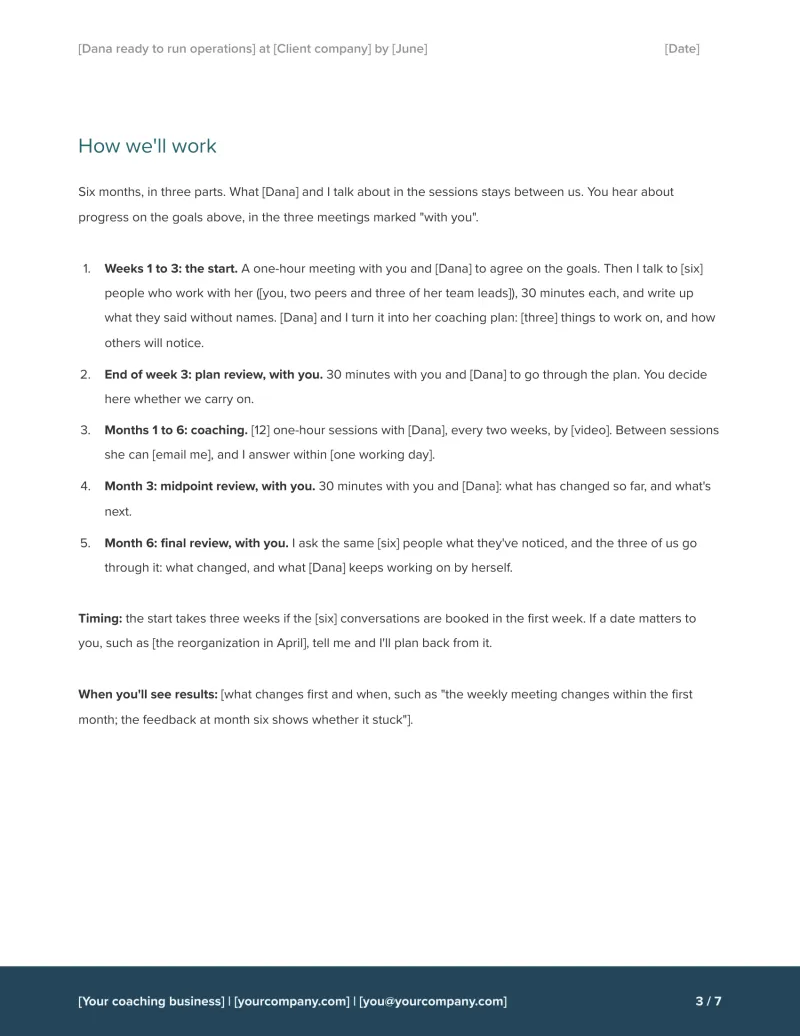
Six months, in three parts. What [Dana] and I talk about in the sessions stays between us. You hear about progress on the goals above, in the three meetings marked "with you".
Weeks 1 to 3: the start. A one-hour meeting with you and [Dana] to agree on the goals. Then I talk to [six] people who work with her ([you, two peers and three of her team leads]), 30 minutes each, and write up what they said without names. [Dana] and I turn it into her coaching plan: [three] things to work on, and how others will notice.
End of week 3: plan review, with you. 30 minutes with you and [Dana] to go through the plan. You decide here whether we carry on.
Months 1 to 6: coaching.[12] one-hour sessions with [Dana], every two weeks, by [video]. Between sessions she can [email me], and I answer within [one working day].
Month 3: midpoint review, with you. 30 minutes with you and [Dana]: what has changed so far, and what's next.
Month 6: final review, with you. I ask the same [six] people what they've noticed, and the three of us go through it: what changed, and what [Dana] keeps working on by herself.
Timing: the start takes three weeks if the [six] conversations are booked in the first week. If a date matters to you, such as [the reorganization in April], tell me and I'll plan back from it.
When you'll see results:[what changes first and when, such as "the weekly meeting changes within the first month; the feedback at month six shows whether it stuck"].
The ICF Code of Ethics asks coaches to "have a clear agreement about what information is exchanged and how it is exchanged among all parties involved during all coaching engagements." Say in the proposal what the sponsor will hear, before anyone asks.
4. Results for leaders like yours
Short proof for the people who weren't on the call: what changed for leaders in a similar spot, as the people around them saw it.
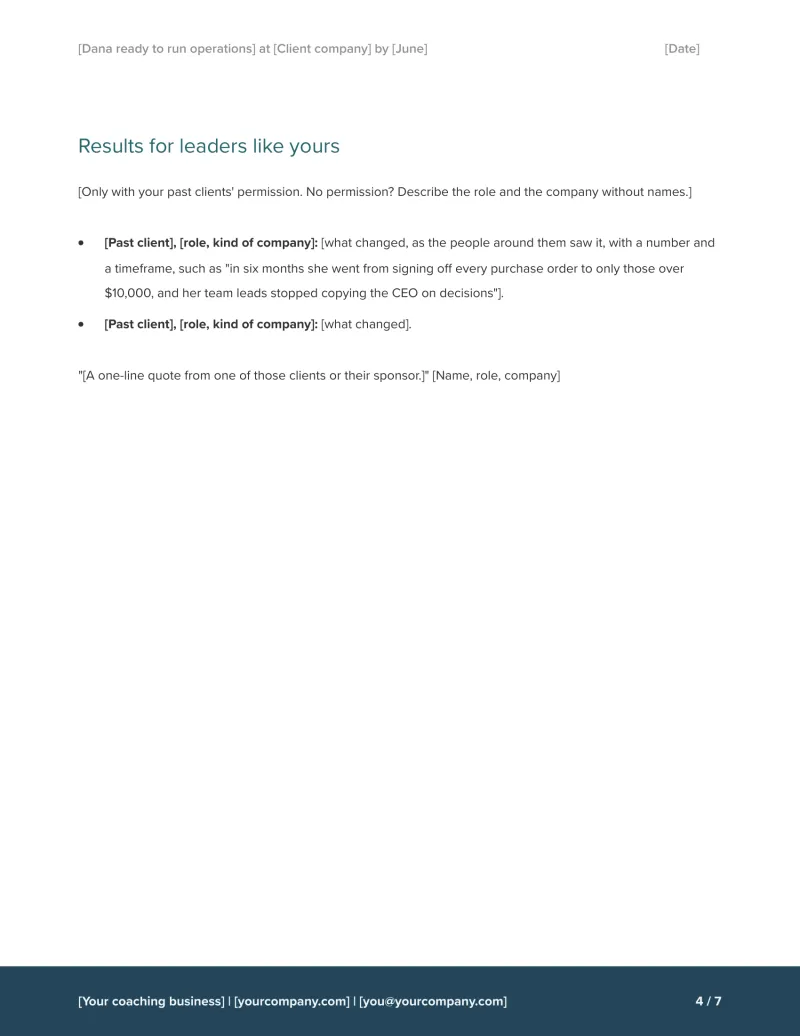
[Only with your past clients' permission. No permission? Describe the role and the company without names.]
[Past client], [role, kind of company]:[what changed, as the people around them saw it, with a number and a timeframe, such as "in six months she went from signing off every purchase order to only those over $10,000, and her team leads stopped copying the CEO on decisions"].
[Past client], [role, kind of company]:[what changed].
"[A one-line quote from one of those clients or their sponsor.]" [Name, role, company]
Proposals to a repeat client were accepted 62.8% of the time in Nusii, against 46.9% for a first proposal from the same 122 accounts (July to September 2026). A second six months for the same leader, or a first one for a colleague, is a repeat-client proposal: ask for it at the final review.
5. What's included
Draws the line between coaching and everything it isn't, says what each person has to do, and what happens to missed sessions and to the feedback.
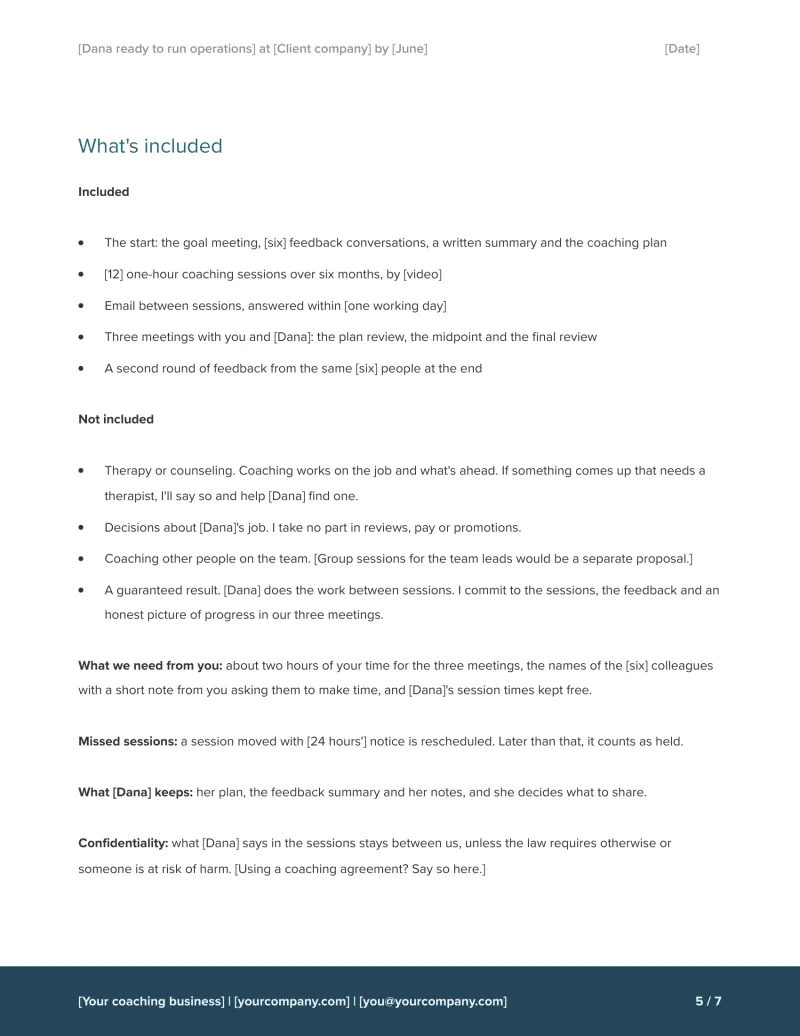
Included
The start: the goal meeting, [six] feedback conversations, a written summary and the coaching plan
[12] one-hour coaching sessions over six months, by [video]
Email between sessions, answered within [one working day]
Three meetings with you and [Dana]: the plan review, the midpoint and the final review
A second round of feedback from the same [six] people at the end
Not included
Therapy or counseling. Coaching works on the job and what's ahead. If something comes up that needs a therapist, I'll say so and help [Dana] find one.
Decisions about [Dana]'s job. I take no part in reviews, pay or promotions.
Coaching other people on the team. [Group sessions for the team leads would be a separate proposal.]
A guaranteed result. [Dana] does the work between sessions. I commit to the sessions, the feedback and an honest picture of progress in our three meetings.
What we need from you: about two hours of your time for the three meetings, the names of the [six] colleagues with a short note from you asking them to make time, and [Dana]'s session times kept free.
Missed sessions: a session moved with [24 hours'] notice is rescheduled. Later than that, it counts as held.
What [Dana] keeps: her plan, the feedback summary and her notes, and she decides what to share.
Confidentiality: what [Dana] says in the sessions stays between us, unless the law requires otherwise or someone is at risk of harm. [Using a coaching agreement? Say so here.]
Philip Morgan and Jonathan Stark, in our 2015 book: "You will almost never be the only party responsible for the outcome of a project." In coaching, the leader does the work between sessions and the sponsor makes room for it, so both parts are written down here.
6. Investment
One price for the whole engagement in two parts, each with when it's invoiced, and a way out after the start. These are example prices; the table further down shows what coaches charge.
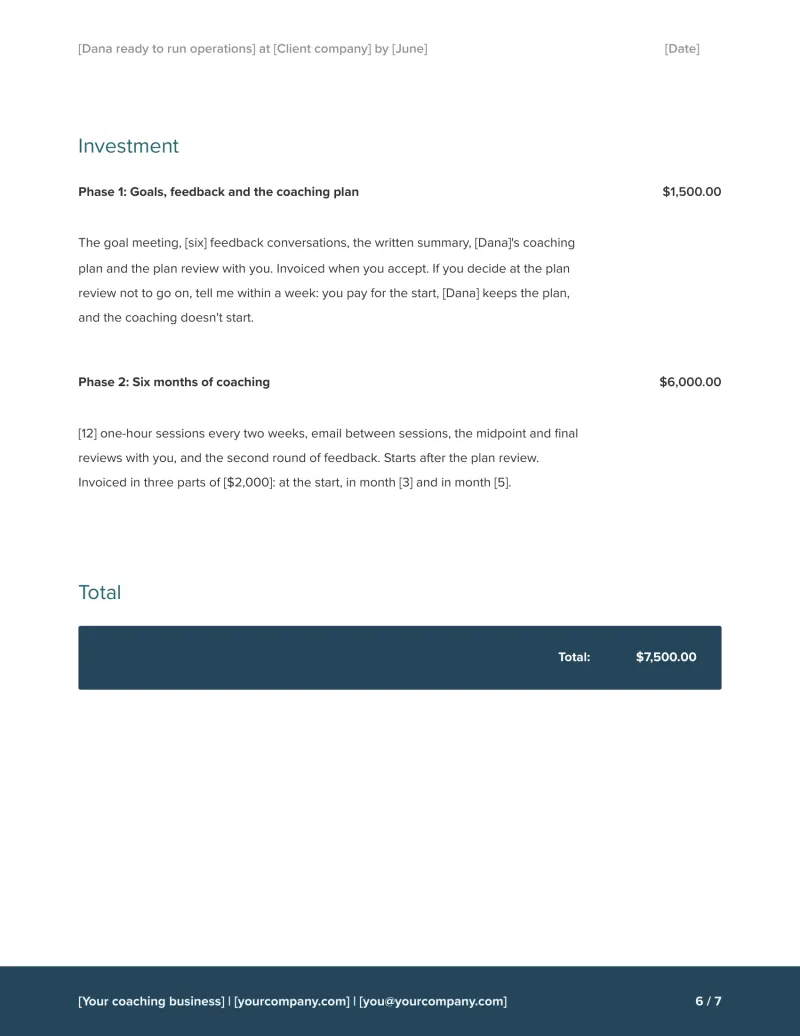
Phase 1: Goals, feedback and the coaching plan
$1,500
The goal meeting, [six] feedback conversations, the written summary, [Dana]'s coaching plan and the plan review with you. Invoiced when you accept. If you decide at the plan review not to go on, tell me within a week: you pay for the start, [Dana] keeps the plan, and the coaching doesn't start.
Phase 2: Six months of coaching
$6,000
[12] one-hour sessions every two weeks, email between sessions, the midpoint and final reviews with you, and the second round of feedback. Starts after the plan review. Invoiced in three parts of [$2,000]: at the start, in month [3] and in month [5].
Total: $7,500
The ICF's 2023 Global Coaching Study puts the average fee for a one-hour session at $272 in North America (2022). Twelve sessions at that rate are $3,264 before the feedback conversations, the three meetings and the email. A fixed price for the engagement keeps the conversation on the goals, not on the hours.
7. Next steps
Tells the sponsor exactly what to do to say yes, what happens after, and when you'll call. No expiry date, no "limited availability".
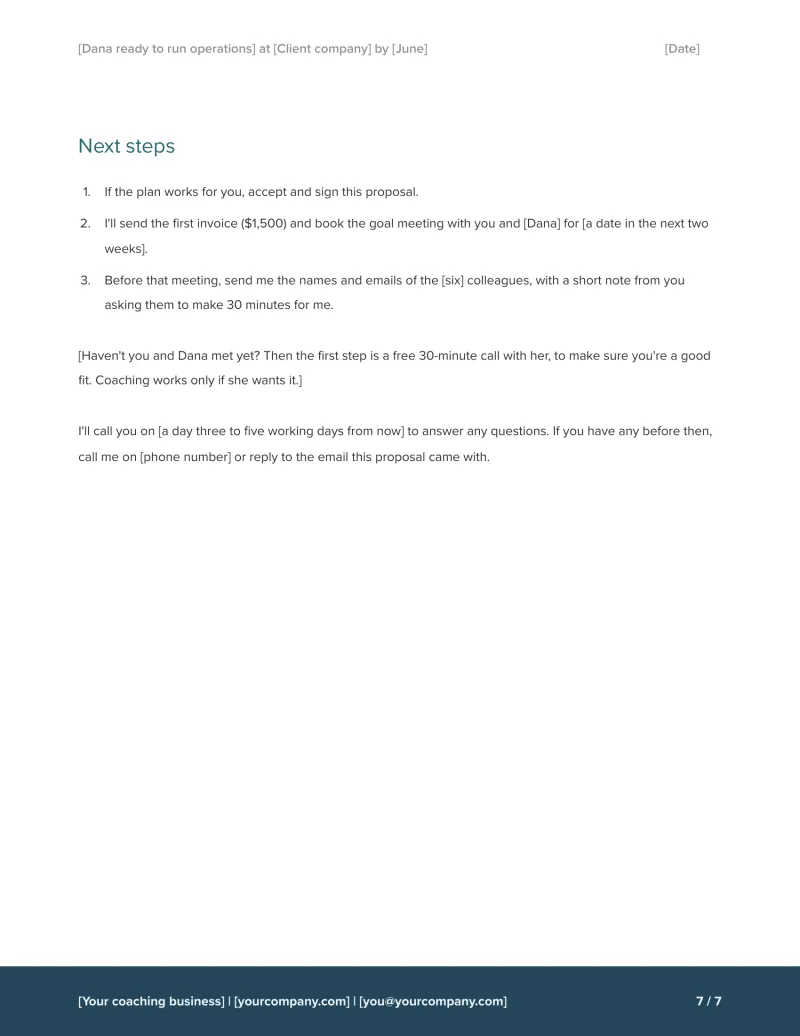
If the plan works for you, accept and sign this proposal.
I'll send the first invoice ($1,500) and book the goal meeting with you and [Dana] for [a date in the next two weeks].
Before that meeting, send me the names and emails of the [six] colleagues, with a short note from you asking them to make 30 minutes for me.
[Haven't you and Dana met yet? Then the first step is a free 30-minute call with her, to make sure you're a good fit. Coaching works only if she wants it.]
I'll call you on [a day three to five working days from now] to answer any questions. If you have any before then, call me on [phone number] or reply to the email this proposal came with.
Consultants' accepted proposals in Nusii got their yes in a median of 2.3 days (November 2025 to October 2026). Marcus Blankenship, a management coach interviewed for our 2015 book, walks every client through the proposal on a call: offer one in the email too.
An executive coaching proposal example, filled in
Two sections of the template above with the client's words in the brackets, so you can see how it reads when it's done. Kinmore Distribution, a 70-person wholesale distributor, and Dana, its new operations director, are made up, and so are the numbers.
Dana ready to run operations at Kinmore Distribution by June
What we heard
You said Dana still answers every supplier call herself and works most evenings. We'll work on what she hands off, to whom, and how she checks the work without redoing it.
You said two of her team leads resigned this year, and both said they waited too long for her decisions. We'll work on how she runs the Monday operations meeting and makes the calls that are hers to make.
Dana said she wants to stop being the person everyone escalates to. We'll start with her own list of the decisions she wants to stop making.
You said her team trusts her and she knows the warehouse better than anyone. We'll keep that and build on it.
What success looks like: the team leads bring Dana decisions instead of problems, and you're out of the daily operations calls by June, checked by asking the same six people again at the end.
What it's worth: you told me replacing a team lead costs you about $30,000 in hiring and training, and operations takes a day of your week. Keeping one team lead is worth four times what this engagement costs, before you count the day you get back.
If nothing changes: you take operations back, and the next team lead leaves too.
Investment
Phase 1: Goals, feedback and the coaching plan
$1,500
Phase 2: Six months of coaching
$6,000
Total: $7,500
How to write a coaching proposal, step by step
Six steps, from the first calls to the follow-up. The template above already follows them; here's why each one matters.
1
Talk to the person who pays and the leader separately
The sponsor tells you why they're paying for coaching now, what they'd like to see change and what it's worth to them. The leader tells you what they want from it, and whether they want it at all. Write both down in their words: they become "What we heard". Our 10 questions for the first client call cover the sponsor, and how to ask about the budget covers the hardest one.
2
Turn “needs coaching” into changes other people will notice
"Better leadership" can't be checked. "Her team leads bring her decisions instead of problems" can, by asking the same people at the start and the end. Philip Morgan and Jonathan Stark make the point in our 2015 book on proposals: things that seem unmeasurable usually can be measured, just not like a revenue figure.
3
Put a number on what’s at stake
Ask the sponsor what happens if nothing changes. A team lead who leaves, a founder who takes operations back, a promotion that has to be undone: each has a cost the sponsor can name. One line on what the change is worth makes the price easier to judge.
4
Say who hears what, before anyone asks
The sponsor pays, but the sessions belong to the leader. The ICF Code of Ethics asks coaches to "have a clear agreement about what information is exchanged and how it is exchanged among all parties involved during all coaching engagements." The template puts it in "How we'll work": the sessions stay private, and progress on the goals is shared in three meetings with the sponsor.
5
Price the engagement, not the hour
Price a paid start (the goal meeting, the feedback and the plan) and the six months of coaching as two fixed amounts, with a way out after the start. One clear price works better than three packages: in Nusii, proposals where the client could choose between options were accepted less often (40.3% against 51.5% for the same 91 accounts, July to September 2026). What to charge has the fee survey.
6
Send it as a link, then walk them through it
Send it with a short email (there's one below), offer a call to go through it and call when you said you would. Proposals that were sent again more than an hour after the first send were accepted 59.2% of the time, against 47.5% for the same 100 accounts (July to September 2026), though an interested client may be why they were sent again.
If two weeks pass in silence, send one last line, from Blair Enns via our 2015 book: “I haven't heard back from you on the coaching plan, so I'm going to assume you've gone in a different direction or your priorities have changed.”
See it as your client will
Every page of the PDF, printed by Nusii. Sent as a link, it's one scrolling page on any device: your client accepts with one button and signs with their name.
The template in Nusii, the way your client will see it. It opens in a new tab.
What coaches charge
What coaches charge per session, from the International Coaching Federation's survey of 14,591 coaches and leaders who coach. In the template's example, the six months of coaching cost $6,000: $500 for each of the 12 sessions, with the reviews with the sponsor, the second round of feedback and the email between sessions included. The start, $1,500, comes before them. Coaches who mainly work with executives charge the most. Before you name your price, find out what the client has in mind: how eight freelancers and agency owners ask about the budget.
Sources: International Coaching Federation, 2023 Global Coaching Study, 14,591 responses from 157 countries (2022 data). These are averages coaches reported for 2022, across every kind of coaching, so executive coaching usually costs more. Treat them as a floor, not a price list.
How often proposals got a yes, by price
Proposals over $15,000 got a yes about a third of the time. The template's example total, $7,500, is in the $5,000 to $15,000 band. From 1,713 proposals first sent with Nusii, July to September 2026.
Under $1,000
67.1%
$1,000 to $5,000
50.7%
$5,000 to $15,000
48.9%
$15,000 to $50,000
36.1%
Over $50,000
33.3%
Share accepted, by the total the client saw. Bigger proposals are bigger decisions, so this shows what happened, not that a lower price would win. Method: The State of Proposals 2026.
The email to send it with
The proposal does the explaining, so the email only has to get it opened and say when you'll call. Leave the price out, so the sponsor reads the plan before they judge the number. Copy the leader in, so nobody hears about it second-hand. In Nusii this goes in the Send Proposal window, and you can save it as your template for next time.
Subject:[Coaching for Dana: the plan]
Hi [first name],
Here's the proposal we talked about on [day of your call]: [link]. I've copied [Dana], so she sees the same plan.
In short: we start with feedback from six people who work with her and a coaching plan, then six months of sessions every two weeks. You and I meet three times to look at progress.
It's short, and you can accept it right on the page. If you'd like to go through it together, pick a time here: [your booking link].
I'll call you on [a day three to five days from now] to answer any questions.
[Your name]
What happens after you send it
From 789 proposals first sent with Nusii by IT, marketing and sales consultants from November 2025 to October 2026; across all industries, 49.9% were accepted.
44.9%
were accepted
36 minutes
median time to the client's first look
2.3 days
median time to a yes
68.6%
of the yeses came within a week
Clients rarely say no. Of all proposals sent with Nusii from July to September 2026, 6.5% were rejected and 45.2% got no answer either way. Silence is the usual no, so a follow-up is worth sending.
Follow up within the week. Consultants' accepted proposals got their yes in a median of 2.3 days. Proposals that were sent again more than an hour after the first send were accepted more often (59.2% against 47.5% for the same accounts, July to September 2026), though an interested client may be why they were sent again. In Nusii you see when the proposal was opened, so you can call once the sponsor has read it.
The same template as a Word file you can edit (it opens in Google Docs too) and a PDF printed by Nusii. We'll email you both, plus a few emails with proposal tips. Unsubscribe any time.
Or send it with Nusii
This template is in the gallery of every Nusii account. Send it as a link: you get an email when your client opens it, and they accept and sign online, on any device.
“I’ve closed over $400K in new business since becoming a user and I plan to stick with the small team behind it for years to come.”
Jay Turner
Owner & Consultant, LibraryHR
“Sending proposals through Nusii saved us an average of 2 hours per proposal, and increased closed/won deal conversion rate by 41%.”
A document that tells a company, or a person, what coaching you’ll provide, what should change because of it, how the sessions and reviews work, what it costs and how to start. For executive coaching, it usually goes to the person who pays, with the leader being coached in copy.
What should a coaching proposal include?
What the sponsor and the leader told you, the change other people should notice, what it’s worth, how the start, the sessions and the reviews work, what stays confidential, what’s included and what isn’t, the price and the next steps. That’s seven sections, the same as the template on this page.
How much does executive coaching cost?
In the ICF’s 2023 Global Coaching Study, a one-hour coaching session cost $272 on average in North America and $244 worldwide (2022), and coaches who mainly work with executives charged the most. This template uses $1,500 for the start and $6,000 for six months of sessions as example prices: $500 for each of the 12 sessions, with the reviews and the email between sessions included.
How long should a coaching engagement be?
Long enough for the people around the leader to notice a change and say so. This template uses six months with a session every two weeks, plus three weeks to start. If the sponsor wants more after that, a second engagement is a new proposal, with the final review as its starting point.
Who should a coaching proposal be addressed to?
To the person who pays, usually the CEO, a director or HR, and the leader being coached should see the same proposal. The ICF calls the payer the sponsor: “the entity (including its representatives) or individual paying for and/or arranging or defining the coaching services to be provided.” In Nusii you can send it to both of them at once.
What stays confidential in executive coaching?
What the leader says in the sessions. The sponsor hears what you’ve all agreed to share, usually progress on the goals, in set meetings. The ICF Code of Ethics asks coaches to agree on what information is exchanged, and how, with everyone involved before the coaching starts. This template puts that agreement in “How we’ll work”.
Should I charge per session, per month or for the whole engagement?
For coaching paid by a company, a fixed price for the engagement is the simplest to approve. This template splits it into a paid start and six months of coaching, invoiced in parts. In Nusii, proposals with a monthly fee were accepted less often (39.7% against 54.5% for the same 84 accounts, July to September 2026). That’s a correlation, not a rule.
Should I offer coaching packages?
Offer them only if the sponsor asked about choices. In Nusii, proposals where the client could choose between options were accepted 40.3% of the time, against 51.5% without, for the same 91 accounts (July to September 2026). A longer engagement can be the next proposal.
Can I use this template for life coaching?
Yes, with fewer parts. When the client pays for their own coaching, drop the sponsor meetings and the feedback from colleagues, write “You said” for the client alone, and keep the goals, the sessions, what’s not included and the price. Many life coaches sell packages instead of sending proposals, so keep it short.
Can I use it for team, group or agile coaching?
Yes. Name the team instead of one leader, ask the team and its manager for the goals, and replace the twelve one-to-one sessions with your team sessions. Keep the start, the reviews with the sponsor and what stays confidential: they matter even more with a group.
Do I need a coaching agreement as well as a proposal?
Many coaches use one. The proposal says what you’ll do, when, for how much and how to start. A coaching agreement covers the working rules in detail: confidentiality and its limits, cancellations and how either side can end it. Say in the proposal that one comes with the first invoice, and have a lawyer check it.
Can my client accept and sign the proposal online?
Yes, if you send it as an online proposal. In Nusii, your client opens a link, accepts with one button and signs with their typed name, on any device, and you get an email when they do. The Word file and the PDF need signing the old way.