A training proposal template for selling a course or a series of workshops to a client's team, in seven short sections: what they told you, how the sessions run, what's included, one fixed price and the next steps. For agencies, consultants and trainers. Read it here or get it as a Word file and a PDF.
A training proposal is the document that tells a client how you'll train their team, what will change afterwards, what it costs and how to start. It should repeat what the client told you, the result you'll both measure and what it's worth, how the sessions run, what's included and what isn't (the room, travel, dates and who owns the materials), one clear price and how to say yes. The template below has a section for each.
The training proposal template, section by section
Copy one section or the whole thing. Under each section: what it's for, and one thing we've learned from the proposals sent with Nusii.
[Yellow] you write[Green] Nusii fills in when you send it
1. Introduction
The whole plan in two sentences, who you are and who runs the sessions. The person who signs (an owner, HR or finance) is often not the one you spoke to, so it has to make sense to someone who wasn't on the call.
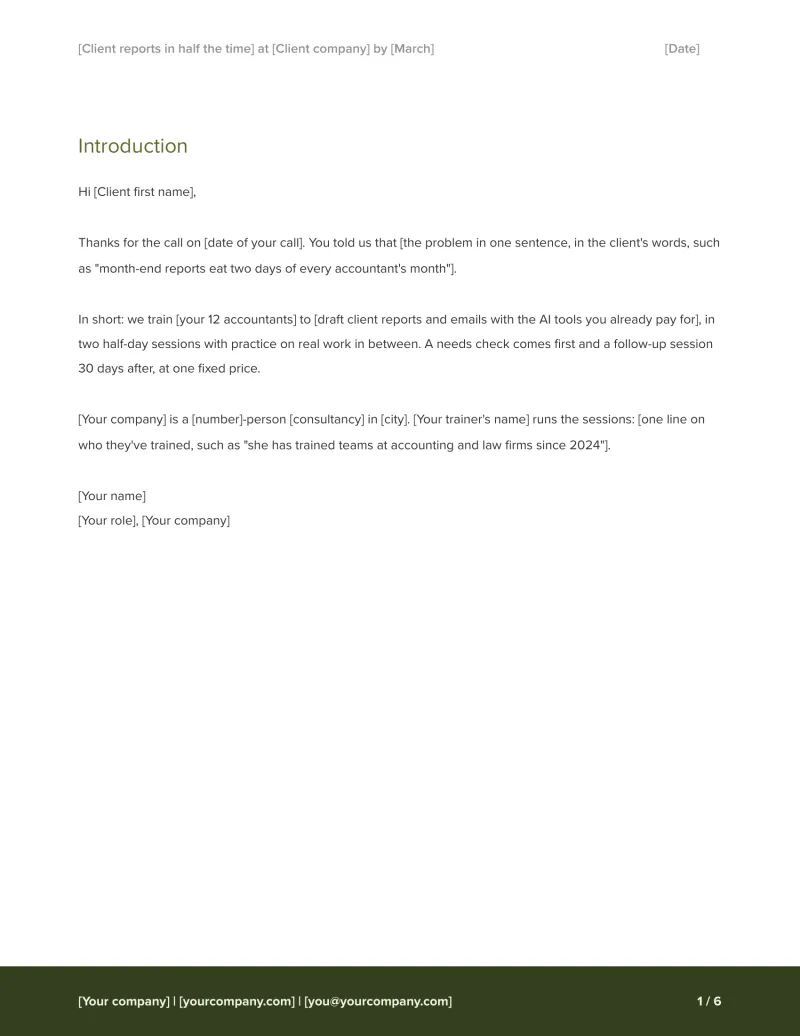
Hi [Client first name],
Thanks for the call on [date of your call]. You told us that [the problem in one sentence, in the client's words, such as "month-end reports eat two days of every accountant's month"].
In short: we train [your 12 accountants] to [draft client reports and emails with the AI tools you already pay for], in two half-day sessions with practice on real work in between. A needs check comes first and a follow-up session 30 days after, at one fixed price.
[Your company] is a [number]-person [consultancy] in [city]. [Your trainer's name] runs the sessions: [one line on who they've trained, such as "she has trained teams at accounting and law firms since 2024"].
[Your name] [Your role], [Your company]
Agencies' proposals in Nusii got their first look in a median of 54 minutes (3,782 proposals, November 2025 to October 2026), and about a third of first views are on a phone. Say what the training is and what it changes before you say who you are.
2. What we heard
Shows you listened, turns what the client told you into goals you can both check after the training, and puts a number on what it's worth. Only you can write this one: replace the examples with your client's words.
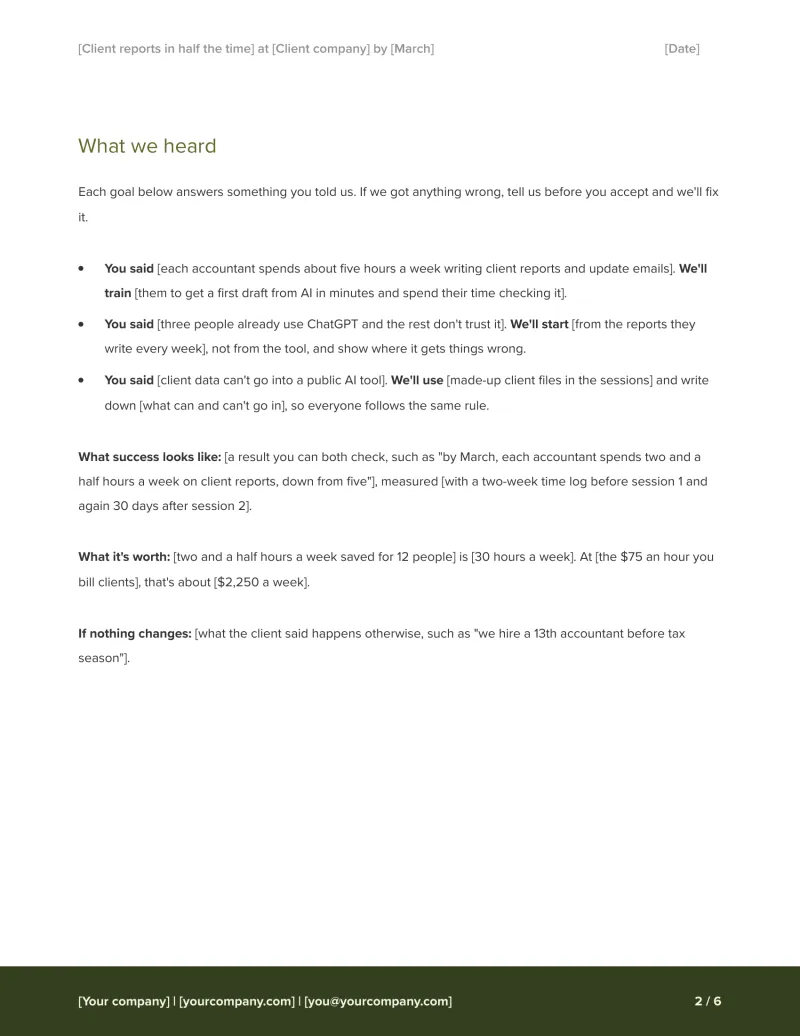
Each goal below answers something you told us. If we got anything wrong, tell us before you accept and we'll fix it.
You said[each accountant spends about five hours a week writing client reports and update emails]. We'll train[them to get a first draft from AI in minutes and spend their time checking it].
You said[three people already use ChatGPT and the rest don't trust it]. We'll start[from the reports they write every week], not from the tool, and show where it gets things wrong.
You said[client data can't go into a public AI tool]. We'll use[made-up client files in the sessions] and write down [what can and can't go in], so everyone follows the same rule.
What success looks like:[a result you can both check, such as "by March, each accountant spends two and a half hours a week on client reports, down from five"], measured [with a two-week time log before session 1 and again 30 days after session 2].
What it's worth:[two and a half hours a week saved for 12 people] is [30 hours a week]. At [the $75 an hour you bill clients], that's about [$2,250 a week].
If nothing changes:[what the client said happens otherwise, such as "we hire a 13th accountant before tax season"].
A request for training is often the client's answer, not their problem. Our 2015 book on proposals calls what clients hand you "the end result of their problem". Ask what the team should do differently afterwards, and how you'd both see it. If nobody can say, the training isn't ready to sell yet.
3. How the training works
The plan from the needs check to the follow-up, so the client knows what the team does when, and where they can decide not to go on.
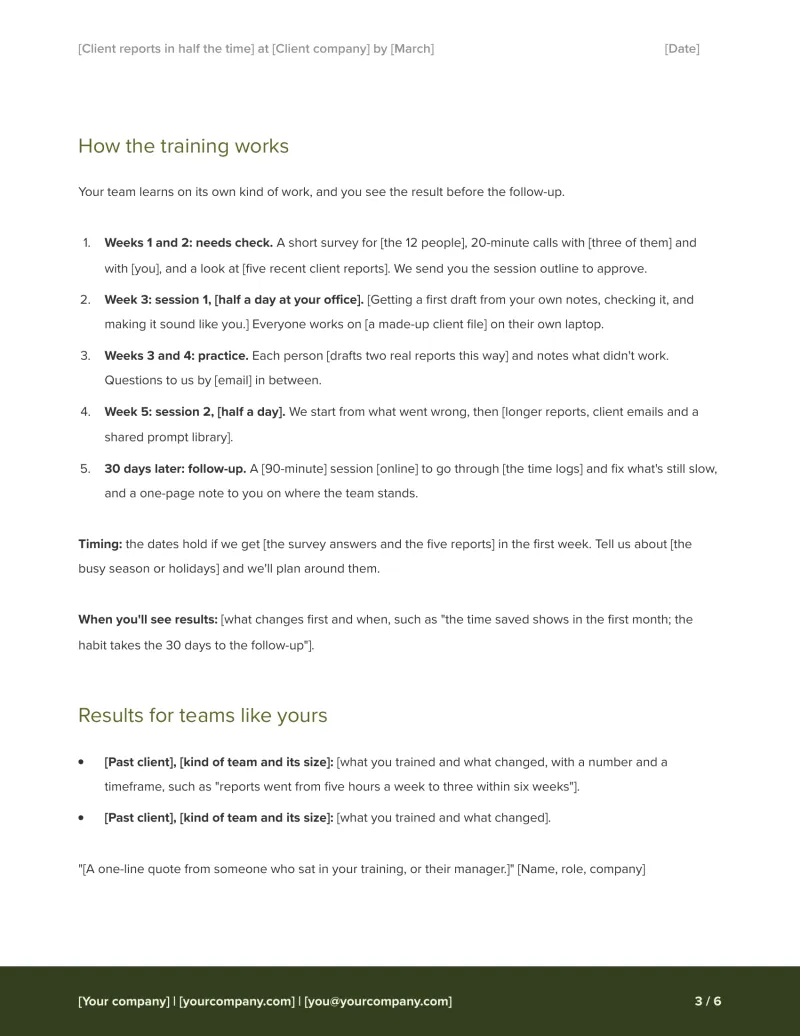
Your team learns on its own kind of work, and you see the result before the follow-up.
Weeks 1 and 2: needs check. A short survey for [the 12 people], 20-minute calls with [three of them] and with [you], and a look at [five recent client reports]. We send you the session outline to approve.
Week 3: session 1, [half a day at your office].[Getting a first draft from your own notes, checking it, and making it sound like you.] Everyone works on [a made-up client file] on their own laptop.
Weeks 3 and 4: practice. Each person [drafts two real reports this way] and notes what didn't work. Questions to us by [email] in between.
Week 5: session 2, [half a day]. We start from what went wrong, then [longer reports, client emails and a shared prompt library].
30 days later: follow-up. A [90-minute] session [online] to go through [the time logs] and fix what's still slow, and a one-page note to you on where the team stands.
Timing: the dates hold if we get [the survey answers and the five reports] in the first week. Tell us about [the busy season or holidays] and we'll plan around them.
When you'll see results:[what changes first and when, such as "the time saved shows in the first month; the habit takes the 30 days to the follow-up"].
Philip Morgan and Jonathan Stark, in our 2015 book: "diagnose before you prescribe." The needs check is where you find out whether training is the fix at all, and the way out in the price keeps that honest.
4. Results for teams like yours
Short proof for the people who weren't on the call: a team like theirs, what you trained and what changed.
[Past client], [kind of team and its size]:[what you trained and what changed, with a number and a timeframe, such as "reports went from five hours a week to three within six weeks"].
[Past client], [kind of team and its size]:[what you trained and what changed].
"[A one-line quote from someone who sat in your training, or their manager.]" [Name, role, company]
Proposals to a repeat client were accepted 62.7% of the time in Nusii, against 43.3% for a first proposal to that client (July to September 2026). A new client hasn't seen you teach yet: one result from a team like theirs does more here than a list of past clients.
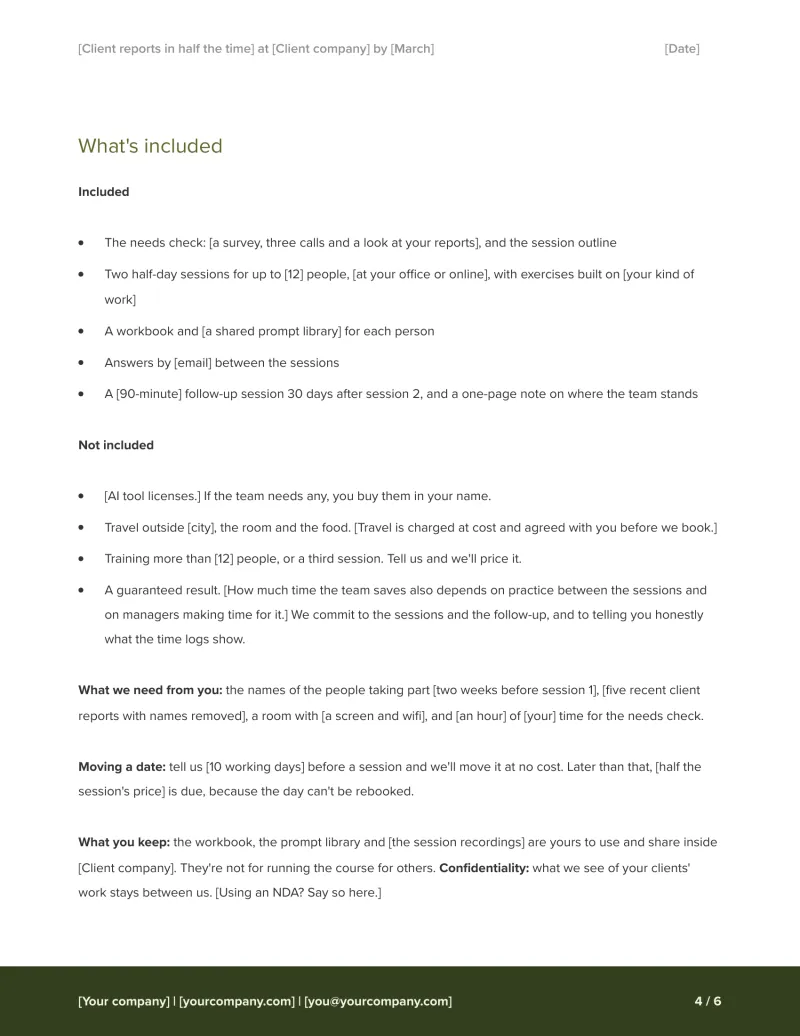
5. What's included
What the price covers and what it doesn't, what you need from the client, who owns the materials and what happens when a date moves. Training goes wrong in the same few places: the room, the people, the dates and the slides.
Included
The needs check: [a survey, three calls and a look at your reports], and the session outline
Two half-day sessions for up to [12] people, [at your office or online], with exercises built on [your kind of work]
A workbook and [a shared prompt library] for each person
Answers by [email] between the sessions
A [90-minute] follow-up session 30 days after session 2, and a one-page note on where the team stands
Not included
[AI tool licenses.] If the team needs any, you buy them in your name.
Travel outside [city], the room and the food. [Travel is charged at cost and agreed with you before we book.]
Training more than [12] people, or a third session. Tell us and we'll price it.
A guaranteed result. [How much time the team saves also depends on practice between the sessions and on managers making time for it.] We commit to the sessions and the follow-up, and to telling you honestly what the time logs show.
What we need from you: the names of the people taking part [two weeks before session 1], [five recent client reports with names removed], a room with [a screen and wifi], and [an hour] of [your] time for the needs check.
Moving a date: tell us [10 working days] before a session and we'll move it at no cost. Later than that, [half the session's price] is due, because the day can't be rebooked.
What you keep: the workbook, the prompt library and [the session recordings] are yours to use and share inside [Client company]. They're not for running the course for others. Confidentiality: what we see of your clients' work stays between us. [Using an NDA? Say so here.]
Marcus Blankenship, interviewed for our 2015 book, lists among the reasons proposals get turned down: "Client makes assumptions about the proposal, and rejects for the wrong reasons." In training those assumptions are about the room, the laptops and whether the slides are theirs to reuse. Write them down.
6. Investment
One fixed price in three parts, each with when it's invoiced, and a way out after the needs check. These are example prices; the table further down shows what trainers charge.
Needs check and session design
$1,000
[The survey, the calls and the look at your reports], and the session outline. Invoiced when you accept. If the needs check shows training isn't what will fix this, we tell you: you pay for this part only, you keep what we found, and the sessions don't go ahead.
Two half-day sessions for up to [12] people
$4,000
[At your office in (city), or online], with the workbook and the prompt library. Invoiced when you approve the session outline.
Follow-up session and note, 30 days after session 2
$1,000
The [90-minute] session [online] and the one-page note. Invoiced after the follow-up.
Total: $6,000
That's $500 a person for a group of 12. US companies spent $874 per learner on training in 2025, small companies $1,091 (Training magazine, companies with 100 or more employees). Across all industries in Nusii, proposals between $1,000 and $15,000 got a yes about half the time (July to September 2026).
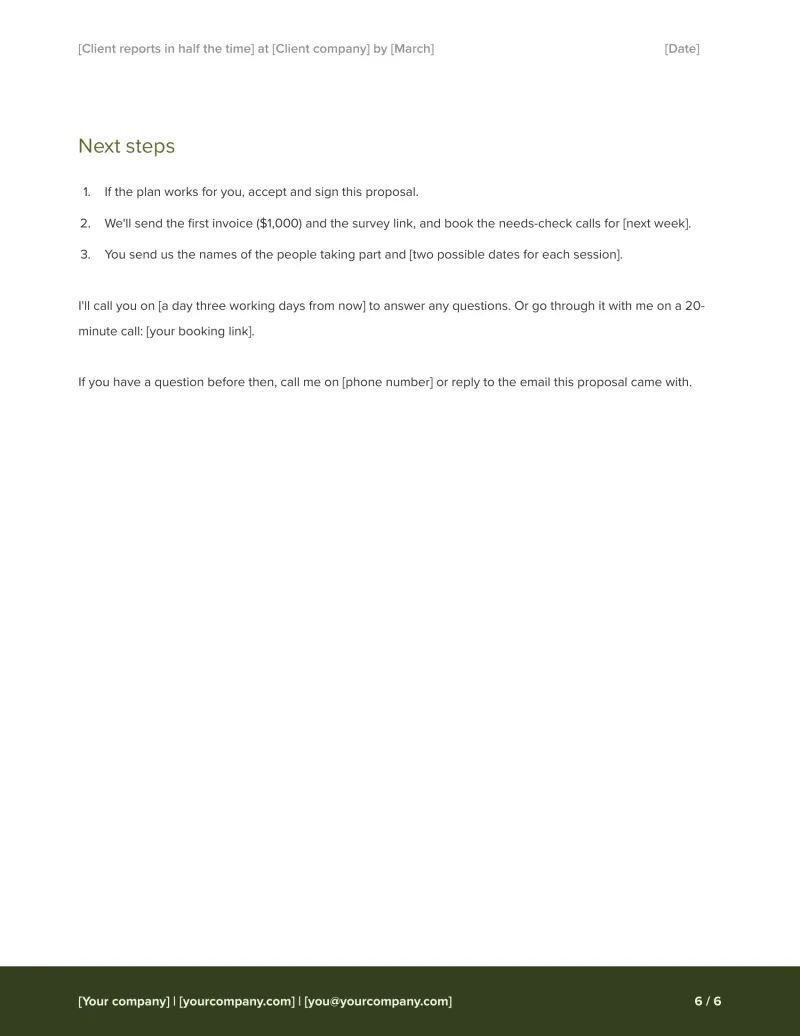
7. Next steps
Tells the client exactly what to do to say yes, what happens after, and when you'll call. No expiry date and no "only two dates left".
If the plan works for you, accept and sign this proposal.
We'll send the first invoice ($1,000) and the survey link, and book the needs-check calls for [next week].
You send us the names of the people taking part and [two possible dates for each session].
I'll call you on [a day three working days from now] to answer any questions. Or go through it with me on a 20-minute call: [your booking link].
If you have a question before then, call me on [phone number] or reply to the email this proposal came with.
Agencies' accepted proposals in Nusii got their yes in a median of 3.9 days, and 62.2% of the yeses came within a week (November 2025 to October 2026). A call three working days after you send it lands while the client is still deciding.
Using this as a workshop proposal template
Selling one workshop, not a training program? The same seven sections work, with less in them. Here's what changes:
The title: keep the result. "[Client reports in half the time] at [Client company]" says more than "Workshop proposal".
How the training works: swap the needs check for a one-hour call and a short outline you agree on by email, and run one session, half a day or a full day. Keep one task for the week after, so the client sees something change.
What's included: keep the room, the dates, travel and who owns the materials exactly as they are. A one-day workshop needs them as much as a program does.
The price: two lines, the preparation call and outline ($500) and a full day for up to 12 people ($4,000). One training company lists $5,800 for a full day (the table below).
The follow-up: offer it in a second proposal after the day, once the client has seen the workshop work.
Proposing a workshop to a conference or a university is a different document: their form asks for learning objectives, a session description and your bio, and there's no price. Use the form they give you.
A training proposal example, filled in
Two sections of the template above with a client's words in the brackets, so you can see how it reads when it's done. Tallowmere Accounting is made up, and so are its numbers.
Client reports in half the time at Tallowmere Accounting by March
What we heard
You said each of your 12 accountants spends about five hours a week writing client reports and update emails. We'll train them to get a first draft from AI in minutes and spend their time checking it.
You said three people already use ChatGPT and the rest don't trust it. We'll start from the month-end reports they write every week, not from the tool, and show where it gets things wrong.
You said client data can't go into a public AI tool. We'll use made-up client files in the sessions and write down what can and can't go in, so everyone follows the same rule.
What success looks like: by March, each accountant spends two and a half hours a week on client reports, down from five, measured with a two-week time log before session 1 and again 30 days after session 2.
What it's worth: two and a half hours a week saved for 12 people is 30 hours a week. At the $75 an hour you bill clients, that's about $2,250 a week: the training costs less than three weeks of it.
If nothing changes: you hire a 13th accountant before tax season.
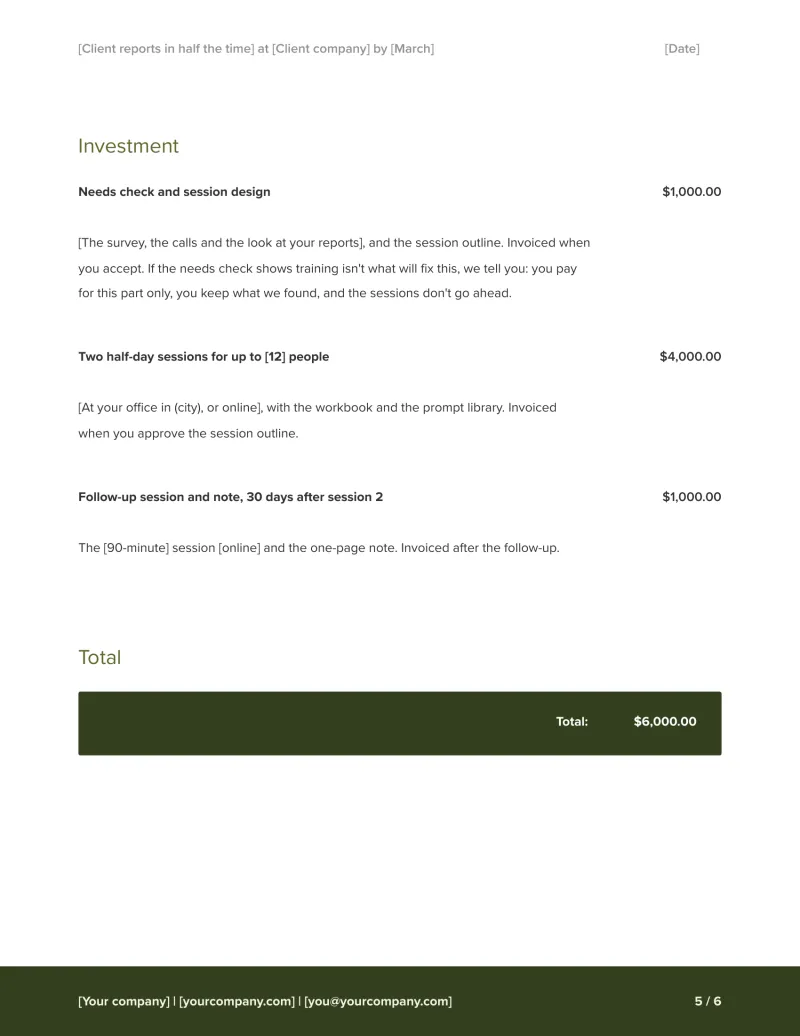
Investment
Needs check and session design
$1,000
Two half-day sessions for up to 12 people
$4,000
Follow-up session and note, 30 days after session 2
$1,000
Total: $6,000
How to write a training proposal, step by step
Six steps, from the first call to the follow-up. The template above already follows them; here's why each one matters.
1
Ask what should change, not which course they want
On the first call, find out what the team should do differently afterwards, how you'd both see it, what that's worth to the client, who else has to say yes and the budget they have in mind. "We need training on AI" is the client's answer; the problem behind it goes in "What we heard". Our 10 questions for the first client call cover it, and how to ask about the budget covers the hardest one.
2
Check whether training is the fix
Talk to two or three of the people who'll be in the room before you write. If the real problem is a missing process, a tool or a manager, a course won't fix it, and it's better to say so now. Philip Morgan and Jonathan Stark put it this way in our 2015 book on proposals: "diagnose before you prescribe." The template makes this a paid needs check with a way out.
3
Set a goal you can check a month later
"Everyone enjoyed it" isn't a goal. Pick something the client can measure after the training: hours spent on a task, mistakes, or how many people can do it without help. Measure it before the first session too, so there's something to compare.
4
Plan sessions with practice in between
Two shorter sessions with real work in between let people try it and come back with questions, and a follow-up a month later shows the client whether it stuck. Say how many people, where, for how long, and what they need to bring.
5
Put the room, the dates and the materials in writing
This is where training goes wrong: who books the room, who pays for travel, what happens when a date moves, and whether the client may reuse your slides and recordings. One line each under "What's included" saves an awkward email later.
6
Send one price, then call when you said you would
Price in-house training by the session and the group, not by the head, and send one price unless the client asked for choices: in Nusii, proposals where the client could choose between options were accepted less often (38% against 53%, July to September 2026). What to charge has the outside prices.
Send it with a short email (there's one below) and call when you said you would. Agencies' accepted proposals in Nusii got their yes in a median of 3.9 days, and 62.2% of the yeses came within a week (November 2025 to October 2026).
See it as your client will
Every page of the PDF, printed by Nusii. Sent as a link, it's one scrolling page on any device: your client accepts with one button and signs with their name.
The template in Nusii, the way your client will see it. It opens in a new tab.
What to charge for training
What trainers charge for in-house sessions, from the pages we could check at the source. The template's example, $2,000 a half-day session plus a needs check and a follow-up, $6,000 for a group of 12, sits below one training company's price list and inside the day rates a facilitation guide gives. It comes to $500 a person.
Sources: Business Training Works, onsite training fees, no date given; Online Facilitation Skills, how to price a workshop, September 2026; Training magazine, 2025 Training Industry Report. Business Training Works sells its own ready-made courses, and its fees don't include owning the content. Online Facilitation Skills says its day rates are estimates from work with trainers, not survey data. Training magazine surveys companies with 100 or more employees. Treat them as a rough guide.
How often proposals got a yes, by price
Proposals over $15,000 got a yes about a third of the time. Agencies' accepted proposals had a median value of $4,000 (July to September 2026). From 1,713 proposals first sent with Nusii, July to September 2026.
Under $1,000
67.1%
$1,000 to $5,000
50.7%
$5,000 to $15,000
48.9%
$15,000 to $50,000
36.1%
Over $50,000
33.3%
Share accepted, by the total the client saw. Bigger proposals are bigger decisions, so this shows what happened, not that a lower price would win. Method: The State of Proposals 2026.
The email to send it with
The proposal does the explaining, so the email only has to get it opened and say when you'll call. Leave the price out, so your client reads the plan before they judge the number. Training often needs a second yes, from HR, finance or the owner, so say in one line what the training changes: that's the line they'll read. In Nusii this goes in the Send Proposal window, and you can save it as your template for next time.
Subject:[The plan for client reports in half the time]
Hi [first name],
Here's the proposal we talked about on [day of your call]: [link].
In short: a needs check first, then two half-day sessions for [your accountants] with practice in between, and a follow-up a month later.
It's short, and you can accept it right on the page. If anything's off, reply to this email and I'll change it.
I'll call you on [a day three to five days from now] to answer any questions.
[Your name]
What happens after you send it
From 3,782 proposals first sent with Nusii by marketing, web, advertising and video agencies from November 2025 to October 2026.
48.9%
were accepted
54 minutes
median time to the client's first look
3.9 days
median time to a yes
62.2%
of the yeses came within a week
Clients rarely say no. Of all proposals sent with Nusii from July to September 2026, 6.5% were rejected and 45.2% got no answer either way. Silence is the usual no, so a follow-up is worth sending.
Follow up after a week. Most yeses come within seven days. In Nusii you see when the proposal was opened and get an email when it's accepted, so you can follow up when they've read it, not when you guess they have.
The same template as a Word file you can edit (it opens in Google Docs too) and a PDF printed by Nusii. We'll email you both, plus a few emails with proposal tips. Unsubscribe any time.
Or send it with Nusii
This template is in the gallery of every Nusii account. Send it as a link: you get an email when your client opens it, and they accept and sign online, on any device.
“For the first couple of years, we struggled to send, format, and track proposals. We tried a few options, then happily settled on Nusii.”
Colin Gillespie
CTO, Jumping Rivers
“In the past I used a less than ideal combination of Word templates, PDFs and email. Since using Nusii I’ve found that 75% of my proposals are done within 5 minutes of creating a new one!”
A document that tells a client how you’ll train their team, what will change afterwards, what it costs and how to start. Trainers, consultants and agencies send one to a client company. Asking your own employer to pay for training is a different case: see the question about your manager below.
What should a training proposal include?
What the client told you and the goal that follows from it, how the sessions run, short proof from similar teams, what’s included and what isn’t (the room, travel, dates and who owns the materials), one clear price, and the next steps. That’s seven sections, the same as the template on this page.
How do you write a training proposal?
Start from what the team should do differently afterwards, not from the course outline. Then check that training is the fix, set a goal you can measure, plan the sessions, write down the practical terms, give one price and say how to say yes. The six steps above go through it.
How much should I charge for a corporate training session?
One training company lists $4,800 for a half day and $5,800 for a full day for up to 12 people. A facilitation guide puts independent trainers’ day rates at $1,500 to $3,000 for professional skills and $3,500 to $8,000 for executive and sales topics. This template uses $2,000 a half-day session, plus a needs check and a follow-up: $6,000 for 12 people.
Should I price training per person or per session?
Per session, for training at a client’s company: the work is the same for 8 people or 12, and one training company’s price list only goes up in steps of six people. Price per person for an open course, where people book seats one by one. The template’s sessions are for “up to 12 people” and say that more people cost more.
Can I use this template for a one-day workshop?
Yes. Run one session instead of two, swap the needs check for a preparation call, and keep the terms for the room, the dates and the materials. Using this as a workshop proposal template lists what changes, with an example price of $4,500.
Can I use this to propose training to my own manager?
Yes, with three changes. Turn the price section into a budget line with what it includes, replace “Results for teams like yours” with what the training provider has done for teams like yours, and make “What it’s worth” the case for whoever holds the budget: hours saved, mistakes avoided or people kept. The goals and how you’ll measure them work as they are.
How do I answer a request for training proposals?
Follow the buyer’s format first: a request for proposals is scored against its own questions, and a missing section can rule you out. Use this template for what the request leaves open, such as the goals, how the sessions run and what’s included.
Who owns the training materials?
Say it in the proposal. In this template the client can use and share the workbook, the prompt library and the recordings inside their company, but not to run the course for others. If the client wants to own the course and run it themselves, price that separately: it’s a different job.
Can the training be online?
Yes. Write “online” where the template asks where the sessions run, keep the group small enough for everyone to practice, and say which video tool you’ll use and who sends the invitations. The follow-up session in the template is online already.
Should I offer several training packages?
Only if the client asked for choices. In Nusii, proposals where the client could choose between options were accepted less often (40.3% against 51.5% for the same senders, July to September 2026). This template has one clear price; send a second proposal for the next group once the first one is trained.