A logo design proposal in seven sections, from what your client told you to three concepts, two rounds of changes, who owns the logo and one clear price. For design studios, small agencies and freelance designers. Read it here, or get it as a Word file and a PDF.
A logo design proposal is the document that wins a logo job before you draw anything: what the client told you, where the logo has to work, how many concepts and rounds of changes they get, what a round is, who owns the logo, the price and how to say yes. The template below has a section for each.
The logo design proposal template, section by section
Copy one section or the whole thing. Under each section: what it's for, and one thing we've learned from the proposals sent with Nusii.
[Yellow] you write[Green] Nusii fills in when you send it
1. Introduction
The whole plan in two sentences, with the time and the price, and who you are. A business partner or a co-founder often reads it without having been on the call. Working on your own? Write "I" instead of "we".
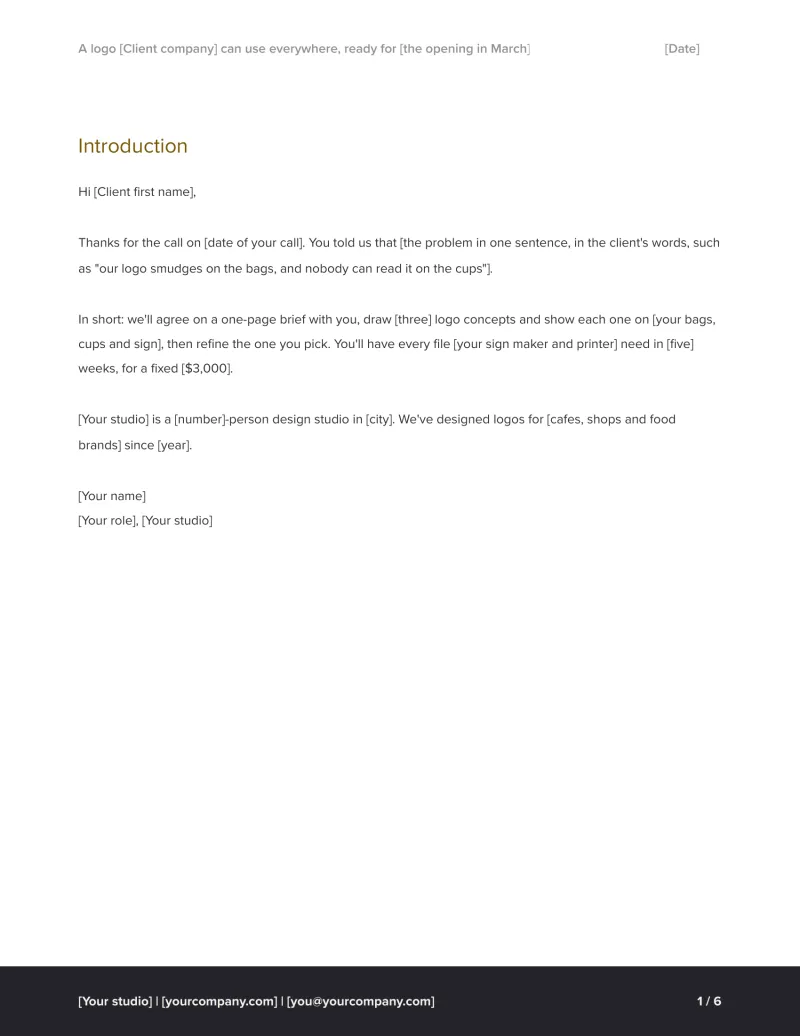
Hi [Client first name],
Thanks for the call on [date of your call]. You told us that [the problem in one sentence, in the client's words, such as "our logo smudges on the bags, and nobody can read it on the cups"].
In short: we'll agree on a one-page brief with you, draw [three] logo concepts and show each one on [your bags, cups and sign], then refine the one you pick. You'll have every file [your sign maker and printer] need in [five] weeks, for a fixed [$3,000].
[Your studio] is a [number]-person design studio in [city]. We've designed logos for [cafes, shops and food brands] since [year].
[Your name] [Your role], [Your studio]
Agencies' proposals in Nusii got their first look in a median of 54 minutes (3,782 proposals, November 2025 to October 2026), and about a third of first views are on a phone. So the time and the price go on the first screen, not on page five.
2. What we heard
Shows you listened, turns what the client told you into a result you can both check, and puts a number on what the logo is worth to them. Only you can write this one: replace the examples with your client's words.
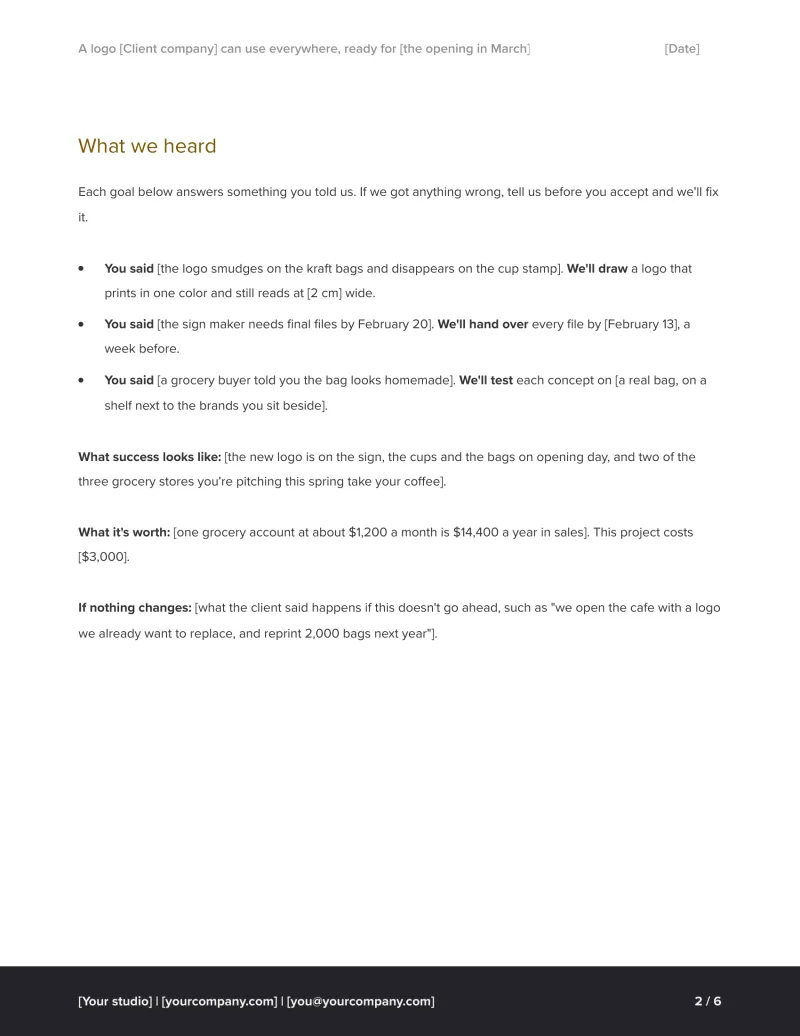
Each goal below answers something you told us. If we got anything wrong, tell us before you accept and we'll fix it.
You said[the logo smudges on the kraft bags and disappears on the cup stamp]. We'll draw a logo that prints in one color and still reads at [2 cm] wide.
You said[the sign maker needs final files by February 20]. We'll hand over every file by [February 13], a week before.
You said[a grocery buyer told you the bag looks homemade]. We'll test each concept on [a real bag, on a shelf next to the brands you sit beside].
What success looks like:[the new logo is on the sign, the cups and the bags on opening day, and two of the three grocery stores you're pitching this spring take your coffee].
What it's worth:[one grocery account at about $1,200 a month is $14,400 a year in sales]. This project costs [$3,000].
If nothing changes:[what the client said happens if this doesn't go ahead, such as "we open the cafe with a logo we already want to replace, and reprint 2,000 bags next year"].
"You can't measure art," designers say. Our 2015 book on proposals answers that you can measure what it does: whether the logo is on the sign by opening day, whether a buyer takes the bag seriously. Ask the client what a home run would look like, and write their answer here. Without it, taste is all that's left to judge the concepts by.
3. How we'll work
The plan step by step, so the client knows what happens when, what they approve and what you need from them. The concepts come in step two, after the yes: the proposal promises them, it doesn't show them.
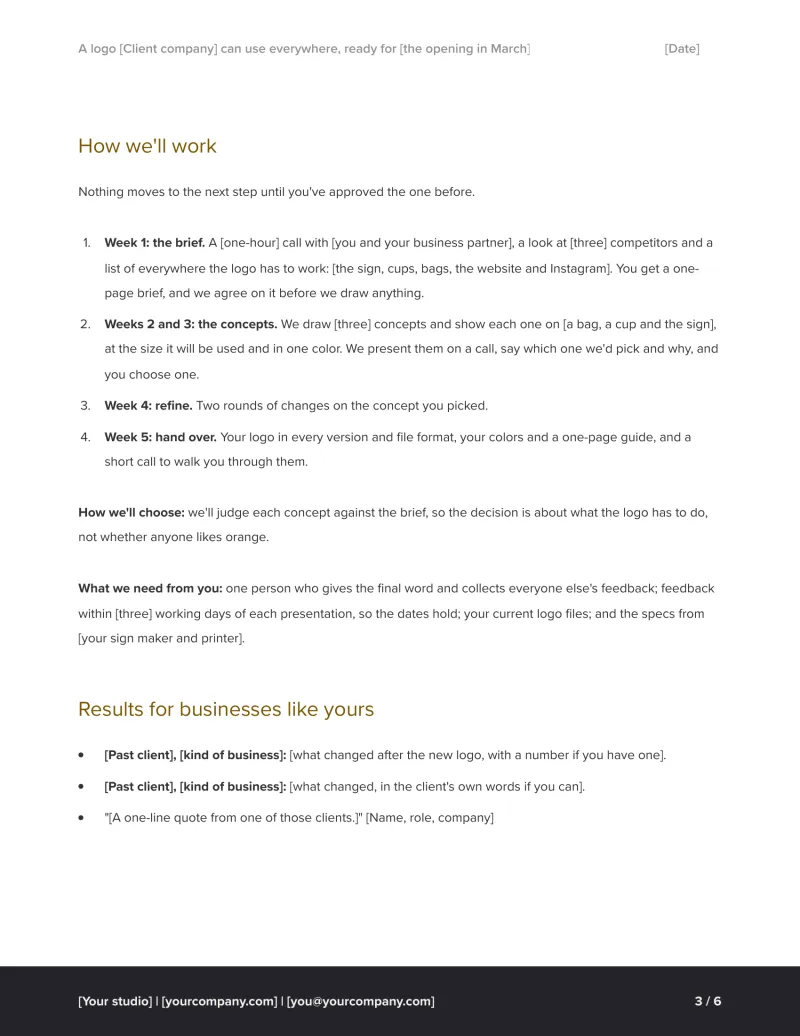
Nothing moves to the next step until you've approved the one before.
Week 1: the brief. A [one-hour] call with [you and your business partner], a look at [three] competitors and a list of everywhere the logo has to work: [the sign, cups, bags, the website and Instagram]. You get a one-page brief, and we agree on it before we draw anything.
Weeks 2 and 3: the concepts. We draw [three] concepts and show each one on [a bag, a cup and the sign], at the size it will be used and in one color. We present them on a call, say which one we'd pick and why, and you choose one.
Week 4: refine. Two rounds of changes on the concept you picked.
Week 5: hand over. Your logo in every version and file format, your colors and a one-page guide, and a short call to walk you through them.
How we'll choose: we'll judge each concept against the brief, so the decision is about what the logo has to do, not whether anyone likes orange.
What we need from you: one person who gives the final word and collects everyone else's feedback; feedback within [three] working days of each presentation, so the dates hold; your current logo files; and the specs from [your sign maker and printer].
Ask what's worth keeping before you draw. Our 2015 book tells of a designer who made a product look fantastic and lost half its users, because nobody asked what already worked. A color or a shape customers know the business by belongs in the brief.
4. Results for businesses like yours
Short proof for the people who weren't on the call. Use real results from real clients, such as "the new mark went on 12 vans and 3 shopfronts without a single reprint", or leave this section out.
[Past client], [kind of business]:[what changed after the new logo, with a number if you have one].
[Past client], [kind of business]:[what changed, in the client's own words if you can].
"[A one-line quote from one of those clients.]" [Name, role, company]
You'll want to fill this with logos. In Nusii, proposals with images were accepted less often than those without (42% against 55% for the same senders, July to September 2026). That doesn't prove the images were the reason, but your client has probably seen your portfolio already. Link to it, and keep this section to what changed.
5. What's included
Draws the line between what you'll do and what you won't, says what a round of changes is, and says what the client keeps. Most logo projects that go over budget go over in the rounds.
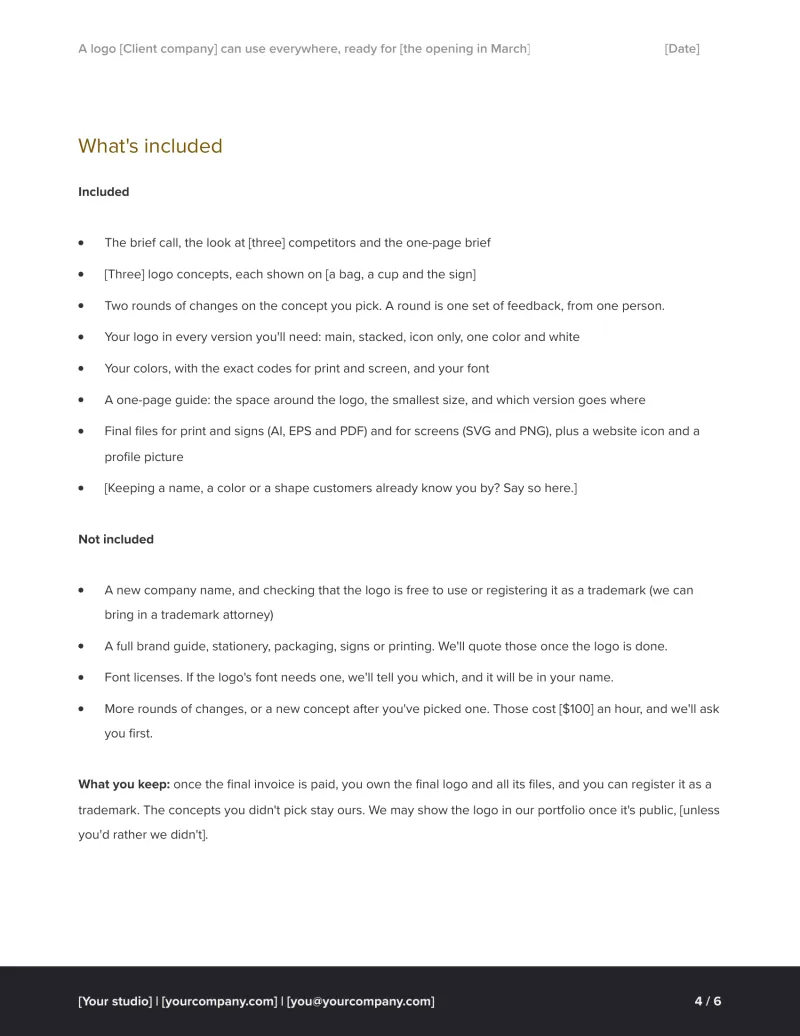
Included
The brief call, the look at [three] competitors and the one-page brief
[Three] logo concepts, each shown on [a bag, a cup and the sign]
Two rounds of changes on the concept you pick. A round is one set of feedback, from one person.
Your logo in every version you'll need: main, stacked, icon only, one color and white
Your colors, with the exact codes for print and screen, and your font
A one-page guide: the space around the logo, the smallest size, and which version goes where
Final files for print and signs (AI, EPS and PDF) and for screens (SVG and PNG), plus a website icon and a profile picture
[Keeping a name, a color or a shape customers already know you by? Say so here.]
Not included
A new company name, and checking that the logo is free to use or registering it as a trademark (we can bring in a trademark attorney)
A full brand guide, stationery, packaging, signs or printing. We'll quote those once the logo is done.
Font licenses. If the logo's font needs one, we'll tell you which, and it will be in your name.
More rounds of changes, or a new concept after you've picked one. Those cost [$100] an hour, and we'll ask you first.
What you keep: once the final invoice is paid, you own the final logo and all its files, and you can register it as a trademark. The concepts you didn't pick stay ours. We may show the logo in our portfolio once it's public, [unless you'd rather we didn't].
Of the logo proposal templates we could read in full for this page, only Plutio's says what a round of changes is, and a free one that ranks on Google promises unlimited changes. Write down the number and the rule. One set of feedback from one person is what keeps a logo at the price you quoted.
6. Investment
One price for the whole project, in three parts so the client can see what each is for, with when it's invoiced and what happens if the concepts miss. These are example prices; the table further down shows what others charge.
Brief and research
$600
The brief call, the look at [three] competitors and the one-page brief. We invoice half of the total, [$1,500], when you accept.
Logo concepts
$1,500
[Three] concepts, each shown on [a bag, a cup and the sign], presented on a call. If none of them is close, we go back to the brief with you and draw [two] new ones, once, at no extra cost. If those miss too, you can stop there and pay only for the brief and the concepts.
Refinement and final files
$900
Two rounds of changes, the logo in every version and file format, your colors and the one-page guide. We invoice the other half, [$1,500], at handover, and send the files when it's paid.
Total: $3,000
In Nusii, proposals where the client could choose between options were accepted less often (40% against 52% for the same senders, July to September 2026). That doesn't prove the options were the reason, but it's why this template has one price instead of bronze, silver and gold packages.
7. Next steps
Tells the client exactly what to do to say yes, what happens after, and when you'll call.
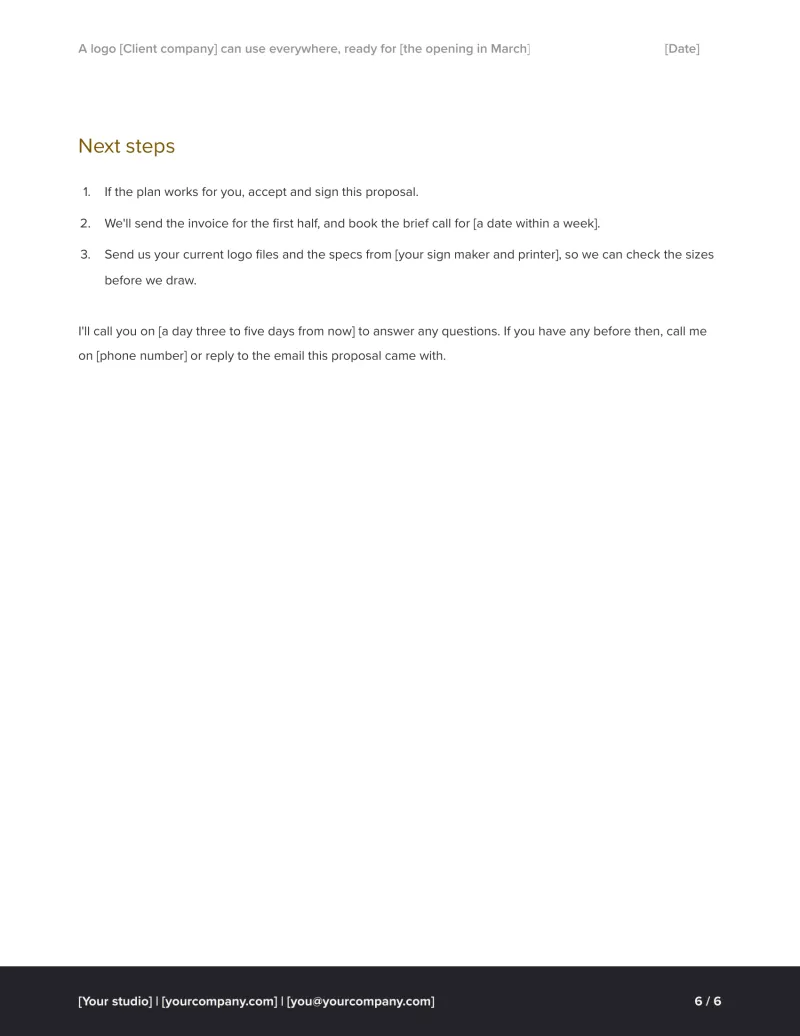
If the plan works for you, accept and sign this proposal.
We'll send the invoice for the first half, and book the brief call for [a date within a week].
Send us your current logo files and the specs from [your sign maker and printer], so we can check the sizes before we draw.
I'll call you on [a day three to five days from now] to answer any questions. If you have any before then, call me on [phone number] or reply to the email this proposal came with.
Accepted agency proposals in Nusii got their yes in a median of 3.9 days, and 62% of them within a week (November 2025 to October 2026). A call three to five days after you send it lands while most clients are still deciding.
Logo proposal or logo presentation?
Search for "logo proposal" and half of what comes up are concept presentations: finished logos on mockups, on Behance and Dribbble. That's the second document. The proposal comes first: it wins the job, fixes the number of concepts and rounds, and says what it costs. Our 2015 book on proposals is plain about it: your ideas "should not appear for the first time in your proposal." Concepts drawn before anyone has said yes are free work, and they usually miss, because nobody has agreed on a brief yet.
When you do present the concepts (step two of the template), keep the decision on the brief:
Show each concept where it will live, at the size it will be used: the bag, the cup and the sign in the template. Show it in one color and at icon size too, so a logo that only works big shows itself early.
Give each concept one page, with two or three sentences that tie it back to the brief.
Present on a call, not by email, and say which one you'd pick and why.
Ask for feedback against the brief, from the one person who gives the final word. That's what a round of changes is in the template.
A logo design proposal example, filled in
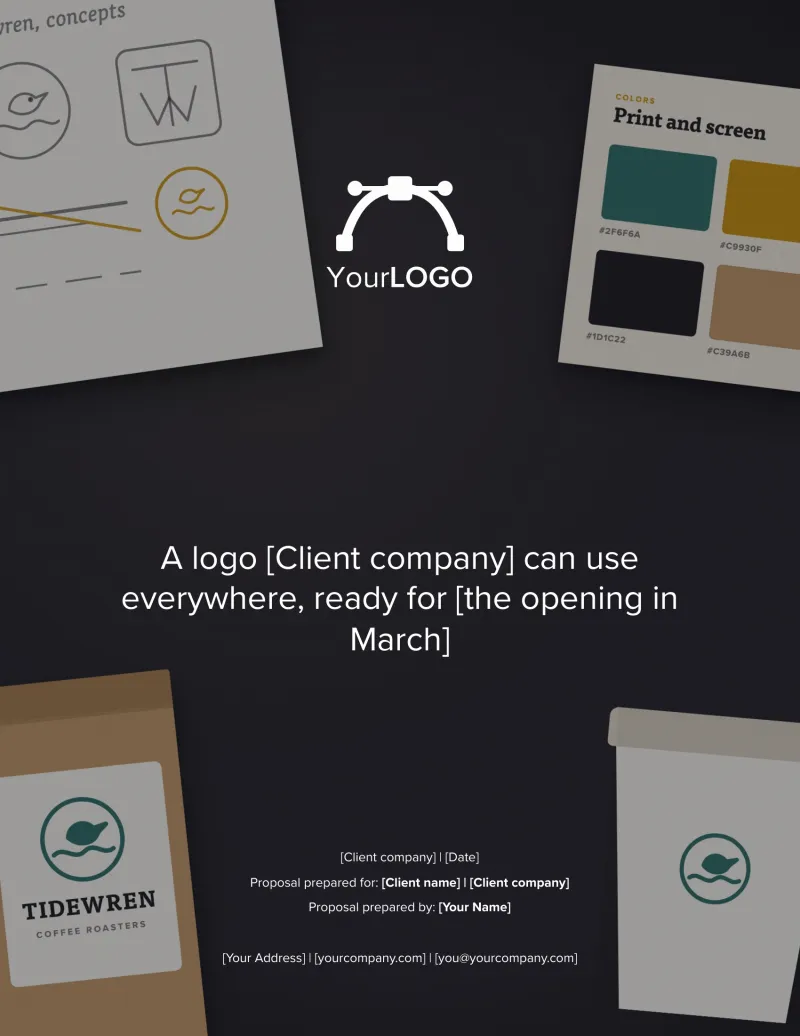
Two sections of the template above with a client's words in the brackets, so you can see how it reads when it's done. Tidewren Coffee Roasters is made up, and so are its numbers.
A logo Tidewren Coffee Roasters can use everywhere, ready for the opening in March
What we heard
You said the logo smudges on the kraft bags and disappears on the cup stamp. We'll draw a logo that prints in one color and still reads at 2 cm wide.
You said the sign maker needs final files by February 20. We'll hand over every file by February 13, a week before.
You said a grocery buyer told you the bag looks homemade. We'll test each concept on a real bag, on a shelf next to the brands you sit beside.
What success looks like: the new logo is on the sign, the cups and the bags on opening day, and two of the three grocery stores you're pitching this spring take your coffee.
What it's worth: one grocery account at about $1,200 a month is $14,400 a year in sales. This project costs $3,000.
If nothing changes: you open the cafe with a logo you already want to replace, and reprint 2,000 bags next year.
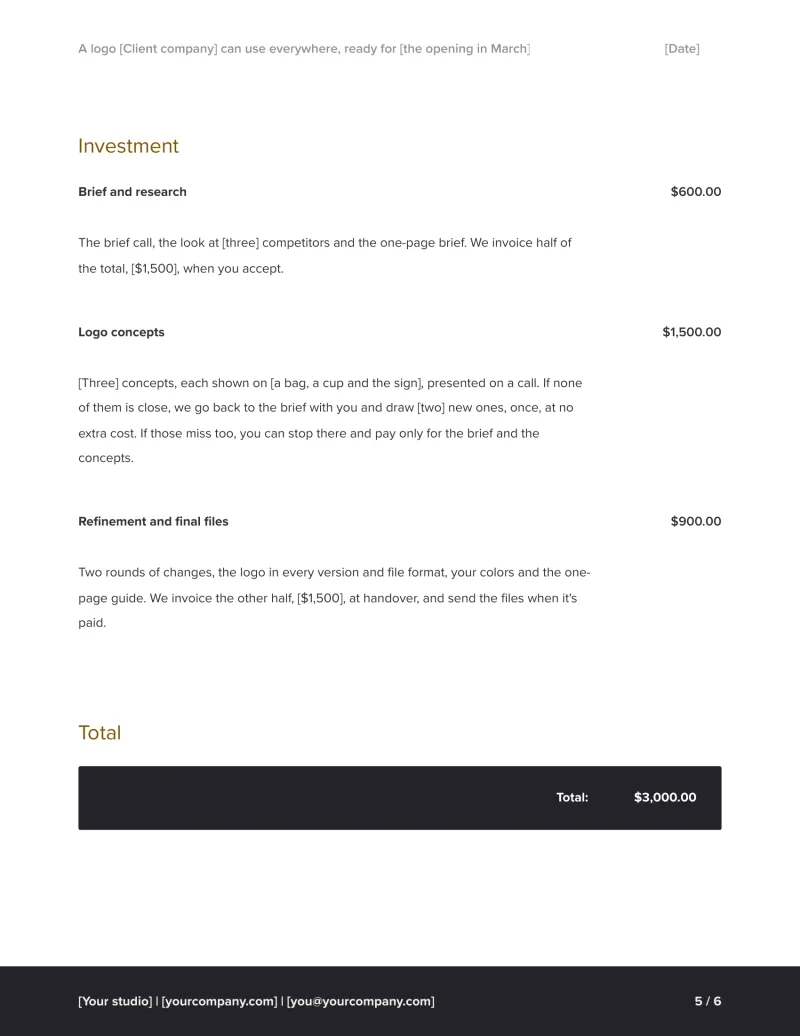
Investment
Brief and research
$600
Logo concepts
$1,500
Refinement and final files
$900
Total: $3,000
See it as your client will
Every page of the PDF, printed by Nusii. Sent as a link, it's one scrolling page on any device: your client accepts with one button and signs with their name.
The template in Nusii, the way your client will see it. It opens in a new tab.
What to charge for a logo
What logo design costs, from the pages we could check at the source. The template's example, $3,000, is a small agency's price for a logo with three concepts and two rounds of changes. Freelancers usually charge less, and a logo inside a full brand identity costs more (see the branding proposal template).
Sources: 4over4, a printer's logo cost guide, updated May 2026; ManyPixels, a design subscription's cost guide, September 2026; DesignRush, an agency directory, updated December 2025; Clutch, an agency directory's pricing guide, updated September 2026. These are vendors and directories, and we didn't find an independent survey of logo prices.
How often proposals got a yes, by price
The template's example, at $3,000, sits in the $1,000 to $5,000 band, where about half the proposals got a yes. Agencies' accepted proposals had a median value of $4,000 (July to September 2026). From 1,713 proposals first sent with Nusii, July to September 2026.
Under $1,000
67.1%
$1,000 to $5,000
50.7%
$5,000 to $15,000
48.9%
$15,000 to $50,000
36.1%
Over $50,000
33.3%
Share accepted, by the total the client saw. Bigger proposals are bigger decisions, so this shows what happened, not that a lower price would win. Method: The State of Proposals 2026.
What happens after you send it
From 3,782 proposals first sent with Nusii by marketing, web, advertising and video agencies from November 2025 to October 2026.
48.9%
were accepted
54 minutes
median time to the client's first look
3.9 days
median time to a yes
62.2%
of the yeses came within a week
Clients rarely say no. Of all proposals sent with Nusii from July to September 2026, 6.5% were rejected and 45.2% got no answer either way. Silence is the usual no, so a follow-up is worth sending.
Follow up after a week. Most yeses come within seven days. In Nusii you see when the proposal was opened and get an email when it's accepted, so you can follow up when they've read it, not when you guess they have.
The same template as a Word file you can edit (it opens in Google Docs too) and a PDF printed by Nusii. We'll email you both, plus a few emails with proposal tips. Unsubscribe any time.
Or send it with Nusii
This template is in the gallery of every Nusii account. Send it as a link: you get an email when your client opens it, and they accept and sign online, on any device.
“I own a small design agency, and Nusii has made it easy to send a proposal and get signatures all at once. Can’t beat it for the price!”
Danielle K. Lambert
Founder & CEO, The Snout Group
“I love how I can reuse and reorder sections inside a single window. No more fooling around with typesetting, converting documents, and stressing about layout!”
The document a designer sends before a logo project starts: what the client needs, how the work will go, how many concepts and rounds of changes are included, who owns the logo, the price and how to say yes. It comes before any concepts are drawn.
What should a logo design proposal include?
What the client told you and the result you’ll both check, where the logo has to work, the steps from brief to final files, the number of concepts and rounds of changes, what isn’t included, who owns the logo, one price and the next steps. Those are the seven sections of the template on this page.
Is a logo proposal the same as a logo presentation?
No. The proposal wins the job and comes first; the presentation shows the concepts you drew after the client said yes. Putting concepts in the proposal means designing for free before there’s a brief. The section on presenting the concepts above covers the second document.
How many logo concepts should a proposal include?
Three is common for a logo on its own, and ManyPixels describes “two or three concepts” at $500. Say the number in the proposal, and say what happens if none of them is close: this template allows one new set from a revised brief.
How many rounds of revisions should I include?
Two, with a rule for what a round is. In this template a round is one set of feedback from one person, and more rounds are billed by the hour after you’ve asked. That sentence keeps a committee from turning two rounds into eight.
Should I offer unlimited revisions?
No. Unlimited revisions turn the project’s price into a guess, and they push the decision from the brief to whoever replies last. Two rounds, with a clear rule and a price for more, protect both sides.
Who owns the logo after the project?
Say it in the proposal, because without it the answer depends on your contract and your country. In this template the client owns the final logo and its files once the last invoice is paid, and the concepts they didn’t pick stay with the designer. This isn’t legal advice.
How much should I charge for a logo?
Freelancers and small studios usually charge $300 to $2,500, according to 4over4, and agencies start around $2,500. This template uses $3,000 for a small agency, in three parts. Whatever you charge, say how many concepts and rounds it includes.
How long does a logo design project take?
One to four weeks with a freelancer, according to DesignRush, and four to eight weeks or more with an agency. This template plans five weeks and says what the client has to do to keep to that: one decision maker and feedback within three working days.
Should I use this or the branding proposal template?
Use this one when the client needs a logo and its files. When they need colors, type, a brand guide and the pieces it goes on, use the branding proposal template, which is built for the bigger project.
Should a logo proposal include a trademark search?
Only if you’re qualified to do one, and say so either way. This template lists trademark searches and registration under “Not included”, so the client doesn’t assume a new logo is automatically free to use.
Is this logo design proposal template free, and does it come in Word and PDF?
Yes. The whole template is on this page to read and copy, and the Word file and the PDF are free by email. To send it as a link your client can sign, you need Nusii, which has a 14-day trial and a 60-day money-back guarantee.
Can my client accept and sign the proposal online?
Yes, if you send it as an online proposal. In Nusii, your client opens a link, accepts with one button and signs with their typed name, on any device, and you get an email when they do.