



Proposal template

Website redesign proposal template

A website redesign proposal in seven sections: an audit of the current site first, a redirect for every old address, one fixed price with a way out after the audit, and the next steps. For web designers and studios redesigning a site that already gets visitors. Read it here or get it as a Word file and a PDF.

Michael Koper
By Michael Koper, founder of Nusii Updated
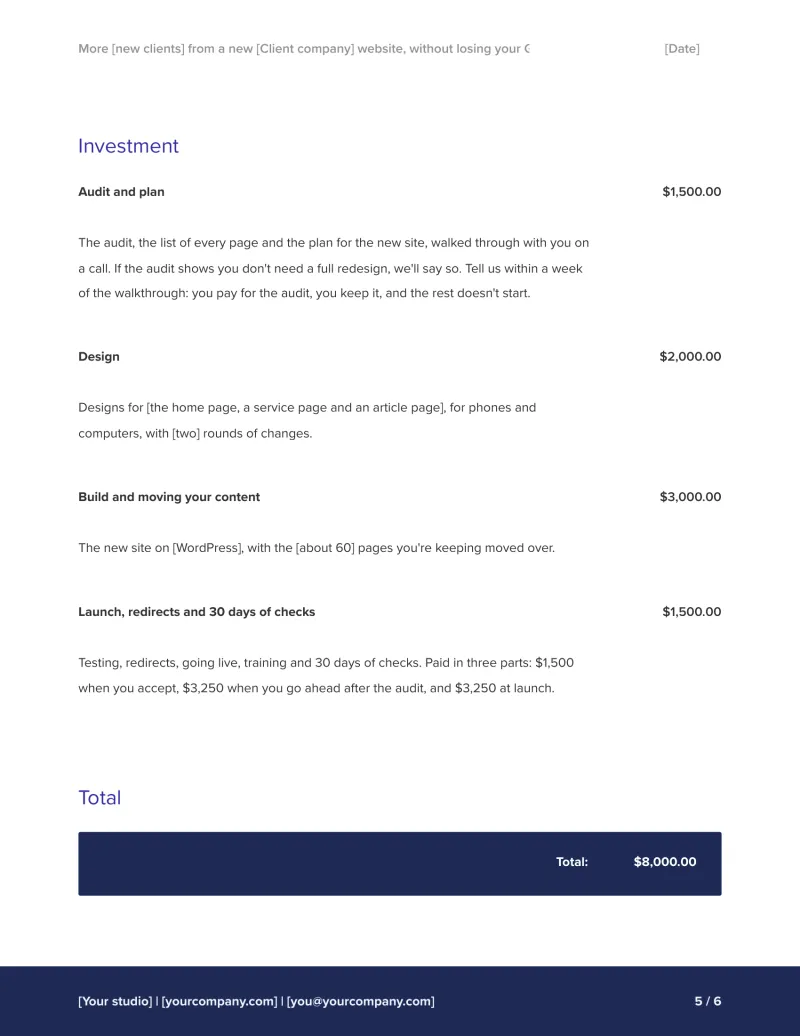
The website redesign proposal template: the cover and the investment page, $8,000 in four phases starting with an audit
Get the Word + PDF
On this page
  1. What to include
  2. The template
  3. What it can promise
  4. A filled-in example
  5. See it as your client will
  6. What to charge
  7. The email to send
  8. After you send it
  9. Word and PDF
  10. Questions

What should a website redesign proposal include?

A website redesign proposal is the document a web designer or studio sends to rebuild a site the client already has. It should say what the client told you, what the current site already does well, how you'll keep its Google traffic through the move, what's included and what isn't, one clear price and how to say yes. The template below has a section for each.

  1. 1 IntroductionWho you are, the plan, the time and the price.
  2. 2 What we heardWhat the client told you, what already works, and what the new site is worth.
  3. 3 How we'll workAn audit first, then design, build and a launch with every old address redirected.
  4. 4 Results from redesigns like this oneWhat happened to past clients' traffic and leads.
  5. 5 What's includedWhat you'll do, what you won't, what you need, and what the client keeps.
  6. 6 InvestmentOne fixed price in four phases, with a way out after the audit.
  7. 7 Next stepsHow to say yes, and when you'll follow up.

The website redesign proposal template, section by section

Copy one section or the whole thing. Under each section: what it's for, and one thing we've learned from the proposals sent with Nusii.

[Yellow] you write [Green] Nusii fills in when you send it

1. Introduction

The whole plan in two sentences, with the time and the price, and who you are. Partners and colleagues read it too, often without having been on the call. Working on your own? Write "I" instead of "we".

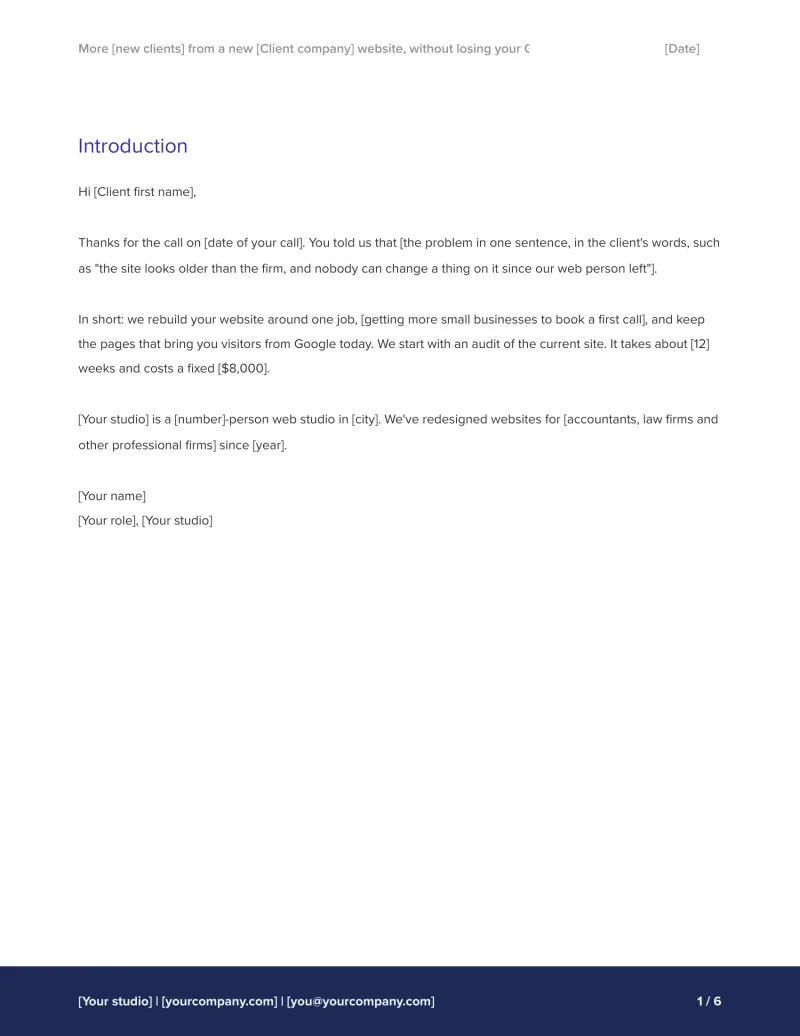
Hi [Client first name],

Thanks for the call on [date of your call]. You told us that [the problem in one sentence, in the client's words, such as "the site looks older than the firm, and nobody can change a thing on it since our web person left"].

In short: we rebuild your website around one job, [getting more small businesses to book a first call], and keep the pages that bring you visitors from Google today. We start with an audit of the current site. It takes about [12] weeks and costs a fixed [$8,000].

[Your studio] is a [number]-person web studio in [city]. We've redesigned websites for [accountants, law firms and other professional firms] since [year].

[Your name]
[Your role], [Your studio]

Proposals that mention a website redesign got their first look in a median of 54 minutes in Nusii (about 340 proposals, November 2025 to October 2026), and about a third of all first views are on a phone. That's why the time and the price are on the first screen.
2. What we heard

Shows you listened, says what the current site already does well, and puts a number on what the new one is worth. Only you can write this one: replace the examples with your client's words, and the numbers with what you found in their analytics.

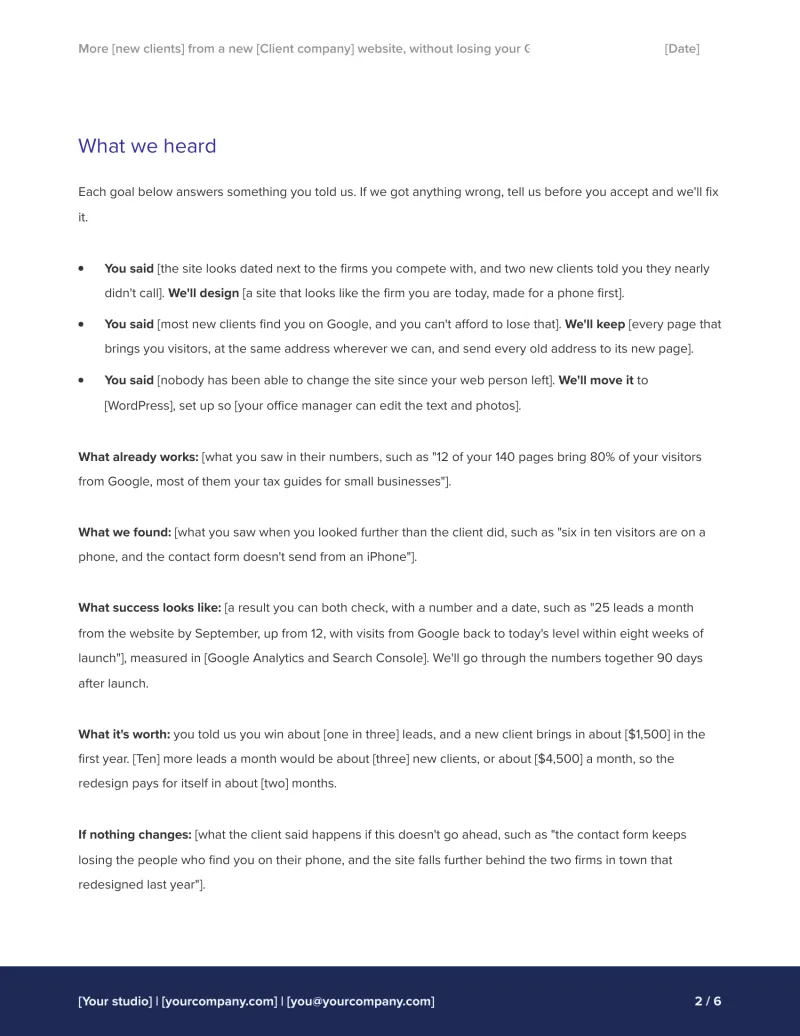
Each goal below answers something you told us. If we got anything wrong, tell us before you accept and we'll fix it.

  • You said [the site looks dated next to the firms you compete with, and two new clients told you they nearly didn't call]. We'll design [a site that looks like the firm you are today, made for a phone first].
  • You said [most new clients find you on Google, and you can't afford to lose that]. We'll keep [every page that brings you visitors, at the same address wherever we can, and send every old address to its new page].
  • You said [nobody has been able to change the site since your web person left]. We'll move it to [WordPress], set up so [your office manager can edit the text and photos].

What already works: [what you saw in their numbers, such as "12 of your 140 pages bring 80% of your visitors from Google, most of them your tax guides for small businesses"].

What we found: [what you saw when you looked further than the client did, such as "six in ten visitors are on a phone, and the contact form doesn't send from an iPhone"].

What success looks like: [a result you can both check, with a number and a date, such as "25 leads a month from the website by September, up from 12, with visits from Google back to today's level within eight weeks of launch"], measured in [Google Analytics and Search Console]. We'll go through the numbers together 90 days after launch.

What it's worth: you told us you win about [one in three] leads, and a new client brings in about [$1,500] in the first year. [Ten] more leads a month would be about [three] new clients, or about [$4,500] a month, so the redesign pays for itself in about [two] months.

If nothing changes: [what the client said happens if this doesn't go ahead, such as "the contact form keeps losing the people who find you on their phone, and the site falls further behind the two firms in town that redesigned last year"].

Ask what works before you plan what changes. "Don't wreck your client's product or service in the process of building a new one," says our 2015 book on proposals. On a redesign, what works is usually a handful of pages Google sends people to. Look at the client's Search Console before you write this; read-only access is enough.

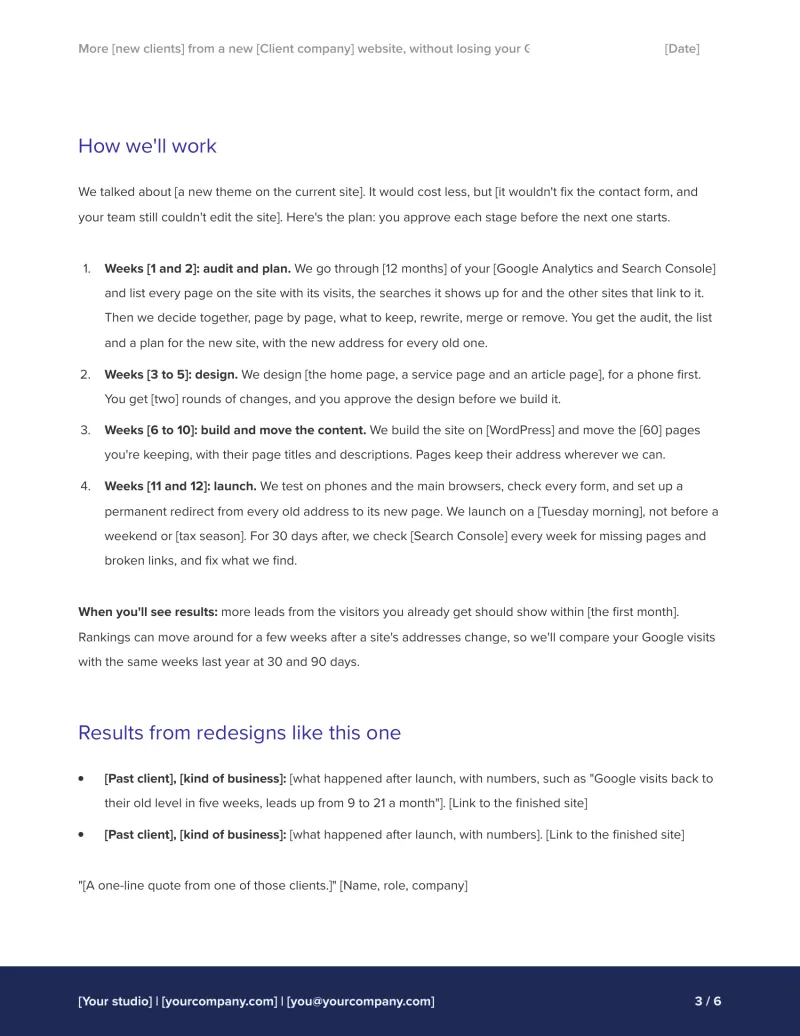
3. How we'll work

The plan in stages, what the client approves at each one, and how you'll protect what already works. The first line says why the cheaper route won't do the job. If you didn't talk about one, delete it.

We talked about [a new theme on the current site]. It would cost less, but [it wouldn't fix the contact form, and your team still couldn't edit the site]. Here's the plan: you approve each stage before the next one starts.

  1. Weeks [1 and 2]: audit and plan. We go through [12 months] of your [Google Analytics and Search Console] and list every page on the site with its visits, the searches it shows up for and the other sites that link to it. Then we decide together, page by page, what to keep, rewrite, merge or remove. You get the audit, the list and a plan for the new site, with the new address for every old one.
  2. Weeks [3 to 5]: design. We design [the home page, a service page and an article page], for a phone first. You get [two] rounds of changes, and you approve the design before we build it.
  3. Weeks [6 to 10]: build and move the content. We build the site on [WordPress] and move the [60] pages you're keeping, with their page titles and descriptions. Pages keep their address wherever we can.
  4. Weeks [11 and 12]: launch. We test on phones and the main browsers, check every form, and set up a permanent redirect from every old address to its new page. We launch on a [Tuesday morning], not before a weekend or [tax season]. For 30 days after, we check [Search Console] every week for missing pages and broken links, and fix what we find.

When you'll see results: more leads from the visitors you already get should show within [the first month]. Rankings can move around for a few weeks after a site's addresses change, so we'll compare your Google visits with the same weeks last year at 30 and 90 days.

Google's own guide to moving a site says to "Expect temporary fluctuation in site ranking during the move", and that "a small to medium-sized website can take a few weeks for most pages to move". Say so here, and the dip is part of the plan instead of a problem you explain after launch.

4. Results from redesigns like this one

Short proof for the people who weren't on the call: what happened to traffic and leads after redesigns you did. Use real numbers from a real client, or leave this section out.

  • [Past client], [kind of business]: [what happened after launch, with numbers, such as "Google visits back to their old level in five weeks, leads up from 9 to 21 a month"]. [Link to the finished site]
  • [Past client], [kind of business]: [what happened after launch, with numbers]. [Link to the finished site]

"[A one-line quote from one of those clients.]" [Name, role, company]

Proposals to a client who had accepted one before were accepted 63% of the time in Nusii, against 47% for a first proposal from the same senders (July to September 2026). A new client hasn't seen your work yet. On a redesign, the number that reassures them is what happened to a past client's Google traffic after launch.

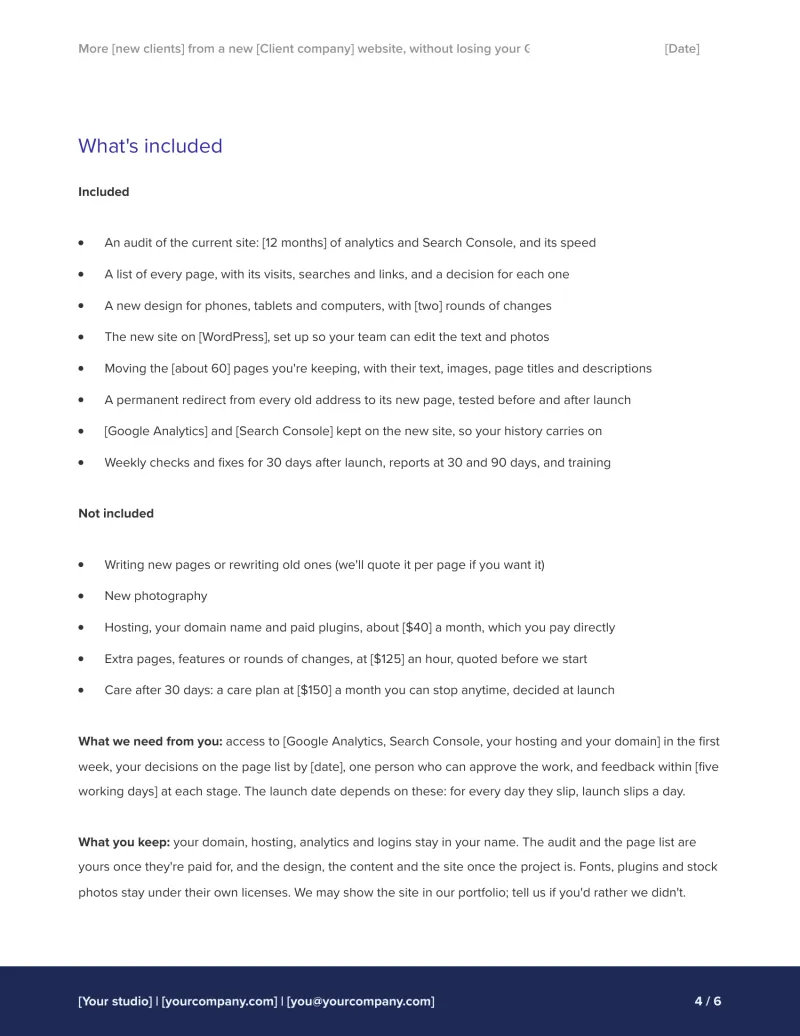
5. What's included

Draws the line between what you'll do and what you won't, says what you need from the client and when, and what they keep. On a redesign, access comes first: without the analytics in week one, there's no audit.

Included

  • An audit of the current site: [12 months] of analytics and Search Console, and its speed
  • A list of every page, with its visits, searches and links, and a decision for each one
  • A new design for phones, tablets and computers, with [two] rounds of changes
  • The new site on [WordPress], set up so your team can edit the text and photos
  • Moving the [about 60] pages you're keeping, with their text, images, page titles and descriptions
  • A permanent redirect from every old address to its new page, tested before and after launch
  • [Google Analytics] and [Search Console] kept on the new site, so your history carries on
  • Weekly checks and fixes for 30 days after launch, reports at 30 and 90 days, and training

Not included

  • Writing new pages or rewriting old ones (we'll quote it per page if you want it)
  • New photography
  • Hosting, your domain name and paid plugins, about [$40] a month, which you pay directly
  • Extra pages, features or rounds of changes, at [$125] an hour, quoted before we start
  • Care after 30 days: a care plan at [$150] a month you can stop anytime, decided at launch

What we need from you: access to [Google Analytics, Search Console, your hosting and your domain] in the first week, your decisions on the page list by [date], one person who can approve the work, and feedback within [five working days] at each stage. The launch date depends on these: for every day they slip, launch slips a day.

What you keep: your domain, hosting, analytics and logins stay in your name. The audit and the page list are yours once they're paid for, and the design, the content and the site once the project is. Fonts, plugins and stock photos stay under their own licenses. We may show the site in our portfolio; tell us if you'd rather we didn't.

"If a project does require firm completion dates, call out your assumptions about what will be required to meet those dates," as Philip Morgan and Jonathan Stark put it in our 2015 book on proposals. On a redesign, that's access to the analytics and hosting in the first week, and the client's decisions on the page list.

6. Investment

One fixed price in four phases, a way out after the audit, and how it's paid. These are example prices; the table further down shows what others charge.

Audit and plan

$1,500

The audit, the list of every page and the plan for the new site, walked through with you on a call. If the audit shows you don't need a full redesign, we'll say so. Tell us within a week of the walkthrough: you pay for the audit, you keep it, and the rest doesn't start.

Design

$2,000

Designs for [the home page, a service page and an article page], for phones and computers, with [two] rounds of changes.

Build and moving your content

$3,000

The new site on [WordPress], with the [about 60] pages you're keeping moved over.

Launch, redirects and 30 days of checks

$1,500

Testing, redirects, going live, training and 30 days of checks. Paid in three parts: $1,500 when you accept, $3,250 when you go ahead after the audit, and $3,250 at launch.

Total: $8,000

Accepted proposals that mention a website redesign had a median value of about $4,700 in Nusii (November 2025 to October 2026, monthly fees left out). Proposals of $5,000 to $15,000 were accepted about as often as those of $1,000 to $5,000 (48.9% and 50.7%, July to September 2026). The way out after the audit is for the client who isn't sure a redesign is the answer: they risk $1,500, not $8,000.

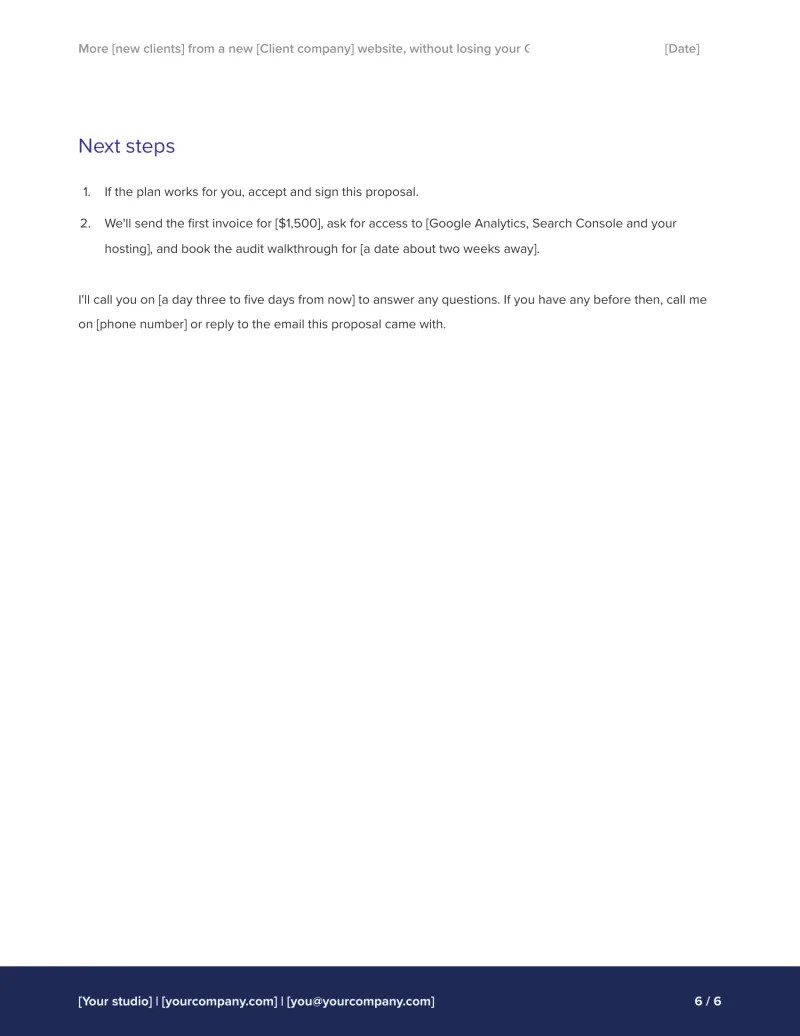
7. Next steps

Tells the client exactly what to do to say yes, what happens after, and when you'll call.

  1. If the plan works for you, accept and sign this proposal.
  2. We'll send the first invoice for [$1,500], ask for access to [Google Analytics, Search Console and your hosting], and book the audit walkthrough for [a date about two weeks away].

I'll call you on [a day three to five days from now] to answer any questions. If you have any before then, call me on [phone number] or reply to the email this proposal came with.

Proposals that mention a website redesign got their yes in a median of 4 days in Nusii, and about 60% of the yeses came within a week (about 340 proposals, November 2025 to October 2026). A call three to five days after you send it lands while most clients are still deciding.

What a redesign proposal can and can't promise about Google

Promise the work that protects the site's traffic, and when you'll look at the numbers together. Don't promise that rankings won't move: Google says they can.

  • Rankings move for a while. Google's own guide to moving a site says to “Expect temporary fluctuation in site ranking during the move”, and that “a small to medium-sized website can take a few weeks for most pages to move”. Say so before launch, so the dip is part of the plan.
  • The redirects are what you can promise. Google asks you to map the old site's addresses to the new ones and to use “server side permanent redirects”, kept “for as long as possible, generally at least 1 year”. The template's audit makes that list, and launch sets up the redirects. A page that keeps its address needs none.
  • Measure against last year. Compare visits from Google with the same weeks a year earlier, not the weeks before launch, so a seasonal dip isn't blamed on the redesign. The template reports at 30 and 90 days.

A website redesign proposal example, filled in

Two sections of the template above with a client's words in the brackets, so you can see how it reads when it's done. Larkhollow Accounting, a six-person accounting firm, is made up, and so are its numbers.

More new clients from a new Larkhollow Accounting website, without losing your Google traffic

What we heard

  • You said the site looks dated next to the firms you compete with, and two new clients told you they nearly didn't call. We'll design a site that looks like the firm you are today, made for a phone first.
  • You said most new clients find you on Google, and you can't afford to lose that. We'll keep every page that brings you visitors, at the same address wherever we can, and send every old address to its new page.
  • You said nobody has been able to change the site since your web person left. We'll move it to WordPress, set up so your office manager can edit the text and photos.

What already works: 12 of your 140 pages bring 80% of your visitors from Google, most of them your tax guides for small businesses.

What we found: six in ten visitors are on a phone, and the contact form doesn't send from an iPhone.

What success looks like: 25 leads a month from the website by September, up from 12, with visits from Google back to today's level within eight weeks of launch, measured in Google Analytics and Search Console. We'll go through the numbers together 90 days after launch.

What it's worth: you told us you win about one in three leads, and a new client brings in about $1,500 in the first year. Ten more leads a month would be about three new clients, or about $4,500 a month, so the redesign pays for itself in about two months.

If nothing changes: the contact form keeps losing the people who find you on their phone, and the site falls further behind the two firms in town that redesigned last year.

Investment

Audit and plan

$1,500

Design

$2,000

Build and moving your content

$3,000

Launch, redirects and 30 days of checks

$1,500

Total: $8,000

See it as your client will

Every page of the PDF, printed by Nusii. Sent as a link, it's one scrolling page on any device: your client accepts with one button and signs with their name.

Open the live preview

The template in Nusii, the way your client will see it. It opens in a new tab.

What to charge for a website redesign

What a small business website redesign costs, from Nusii's own proposals and the published prices we could check. The template's example, $8,000 for a site of about 60 pages you keep, sits at the top of IT Path Solutions' small-business range and inside WebFX's range for small sites, and it's well above the median accepted redesign in Nusii: the audit, the page list and the redirects are work a new build doesn't have. Before you name your price, find out what the client has in mind: how eight freelancers and agency owners ask about the budget.

What Price
Accepted redesign proposals in Nusii about $4,700 (median) one-time value, monthly fees left out; proposals that mention a redesign, November 2025 to October 2026 Nusii
Small site redesign, 1 to 50 pages $3,000 to $24,000 an agency's estimate WebFX
Redesign from an agency $5,000 to $75,000 the same estimate; $3,000 to $10,000 from a freelancer WebFX
Small business site redesign $2,500 to $8,000 a development company's planning range; $8,000 to $25,000 for a strategic business site IT Path Solutions
Redesign or full rebuild $5,000 to $25,000 a redesign in 4 to 8 weeks; a full rebuild $20,000 to $75,000 or more, in 8 to 16 weeks IT Path Solutions
Small business site, 10 to 20 pages $15,000 to $40,000 an agency's estimate Clique Studios
Hourly rate, small studios $100 to $150 an hour studios of 5 to 15 people Clique Studios
Writing new page copy $100 to $300 a page the same in two companies' guides Clique Studios

Sources: Nusii, the one-time value of accepted proposals that mention a website redesign (method as in The State of Proposals); WebFX, an agency's redesign pricing guide, 2026; IT Path Solutions, a development company's guide, updated September 2026; Clique Studios, a web design agency's guide, 2026. Apart from Nusii's row, these come from companies that sell redesigns, so treat them as sellers' figures. We didn't find an independent survey of what redesigns cost.

How often proposals got a yes, by price

Proposals over $15,000 got a yes about a third of the time. Accepted proposals that mention a website redesign had a median one-time value of about $4,700 (November 2025 to October 2026). From 1,713 proposals first sent with Nusii, July to September 2026.

Under $1,000
67.1%
$1,000 to $5,000
50.7%
$5,000 to $15,000
48.9%
$15,000 to $50,000
36.1%
Over $50,000
33.3%

Share accepted, by the total the client saw. Bigger proposals are bigger decisions, so this shows what happened, not that a lower price would win. Method: The State of Proposals 2026.

The email to send it with

The proposal does the explaining, so the email only has to get it opened and say when you'll call. Leave the price out, so your client reads the plan before they judge the number. In Nusii this goes in the Send Proposal window, and you can save it as your template for next time.

Subject: [The plan for your new website]

Hi [first name],

Here's the proposal we talked about on [day of your call]: [link].

In short: we start with an audit of the current site, so we know which pages bring you visitors, then rebuild it without losing them. If the audit shows you don't need a full redesign, you can stop there.

It's short, and you can accept it right on the page. If anything's off, reply to this email and I'll change it.

I'll call you on [a day three to five days from now] to answer any questions.

[Your name]

What happens after you send it

Of about 340 proposals first sent with Nusii from November 2025 to October 2026 that mention a website redesign, rebuild or refresh, 46% were accepted, with a median of 4 days to a yes.

46%
were accepted
54 minutes
median time to the client's first look
4 days
median time to a yes
60%
of the yeses came within a week

Clients rarely say no. Of all proposals sent with Nusii from July to September 2026, 6.5% were rejected and 45.2% got no answer either way. Silence is the usual no, so a follow-up is worth sending.

Call when you said you would. About 6 in 10 of the yeses came within a week, so a call three to five days after you send it lands while the client is still deciding. Proposals that were sent again more than an hour after the first send were accepted more often (59.2% against 47.5% for the same accounts, July to September 2026), though an interested client may be why they were sent again. In Nusii you see when the proposal was opened, so you can call once they've read it.

More numbers and the method: The State of Proposals 2026.

Get the Word and PDF files

The same template as a Word file you can edit (it opens in Google Docs too) and a PDF printed by Nusii. We'll email you both, plus a few emails with proposal tips. Unsubscribe any time.

Or send it with Nusii

This template is in the gallery of every Nusii account. Send it as a link: you get an email when your client opens it, and they accept and sign online, on any device.

There are a handful that I’ve used for more than 10 years; Nusii is at the top of this list!

Doug Ouverson
Doug Ouverson
Principal, Web By Doug

Some proposals can take 15 minutes with Nusii, but they look like they’ve taken several hours.

Ben Harrison
Ben Harrison
Director, Web Optic
Start your free trial

14-day trial · 60-day money-back guarantee

Questions about website redesign proposals

What is a website redesign proposal?

A document a web designer or studio sends to rebuild a site the client already has: what the client told you, what the current site does well, the plan, the price and how to start. Some businesses also call the request they send to agencies a redesign proposal; that’s an RFP, covered below.

What should a website redesign proposal include?

What the client told you and what already works on their site, your plan in stages with an audit first, short proof from past redesigns, what’s included and what isn’t, what you need from the client, who owns the site, one clear price and the next steps. That’s seven sections, the same as the template on this page.

How is a redesign proposal different from a web design proposal?

A redesign starts from a site that already has visitors, pages and Google rankings, so the proposal adds an audit of the current site, a decision for every page, a redirect for every old address and checks after launch. For a brand new site, use our web design proposal template.

How much should I charge for a website redesign?

It depends on the size of the site and who does it. WebFX puts a small site of up to 50 pages at $3,000 to $24,000, and IT Path Solutions a small business redesign at $2,500 to $8,000. In Nusii, accepted proposals that mention a website redesign had a median one-time value of about $4,700 (November 2025 to October 2026). This template uses $8,000 as an example price.

How long does a website redesign take?

This template plans 12 weeks for a site of about 60 pages: two for the audit, three for the design, five for the build and the content, and two for launch. IT Path Solutions puts a redesign at 4 to 8 weeks and a full rebuild at 8 to 16. The client’s content and feedback move the date more than anything, so the template ties the launch to them.

Will a website redesign hurt my client’s Google rankings?

It can, for a few weeks. Google says to “Expect temporary fluctuation in site ranking during the move” and recommends a permanent redirect from every old address to its new one. The template protects the traffic with a page list, those redirects and weekly checks for 30 days, and tells the client about the dip before launch.

Should I do the audit before I send the proposal?

Do a short look, not the full audit. An hour in the client’s analytics and Search Console gives you the numbers for “What already works” and “What we found”. The full audit is the first paid step, so don’t give it away in the proposal.

What’s the difference between a redesign proposal and a website redesign RFP?

An RFP, a request for proposals, is what a business sends to several agencies to ask for their proposals. This template is the proposal you send, ideally after a conversation with the client. If you’re answering an RFP, follow its format and use the parts of this template that fit.

Should a care plan be part of the redesign proposal?

Name it, but don’t make it part of the decision. The template includes 30 days of checks and mentions a care plan with its price, which the client decides on at launch. In Nusii, proposals with a recurring fee were accepted less often (40% against 55% for the same senders, July to September 2026). When the client is ready, send the care plan on its own with our website maintenance proposal template.

Should I offer a refresh and a full redesign as two options?

Only if the client asked about choices. In Nusii, proposals where the client could choose between options were accepted less often (40% against 52% for the same senders, July to September 2026). This template sends one price and lets the audit decide: if a refresh would do, the client can stop after it.

Can I use this template as a freelance web designer?

Yes. Write “I” instead of “we”, describe yourself in the introduction, and set the number of pages and the schedule to what you can do on your own. Everything else works the same.

Do I need a contract as well?

Attach your own agreement if you use one. This template covers the scope, the price, who owns what and how the project is paid in plain words, and it isn’t legal advice.

More templates and guides

Send your next website redesign proposal as a link, and see when it's opened

Try Nusii free for 14 days

Cancel anytime · 60-day money-back guarantee