An ecommerce website proposal in seven sections, from what your client told you to one fixed price and the next steps, with the catalog, payments, shipping and the move from the old store written in. For studios that build Shopify stores, and easy to change for WooCommerce. Read it here or get it as a Word file and a PDF.
What should an ecommerce website proposal include?
An ecommerce website proposal should say what the client told you, the result you'll both measure (usually the share of visits that end in an order), how the build and the move from the old store run, what's included and what isn't, who owns the store, one clear price and how to say yes. The template below has a section for each.
The ecommerce website proposal template, section by section
Copy one section or the whole thing. Under each section: what it's for, and one thing we've learned from the proposals sent with Nusii.
[Yellow] you write[Green] Nusii fills in when you send it
1. Introduction
The whole plan in two sentences, with the time and the price, and who you are. Partners and colleagues read it too, often without having been on the call. Working on your own? Write "I" instead of "we".
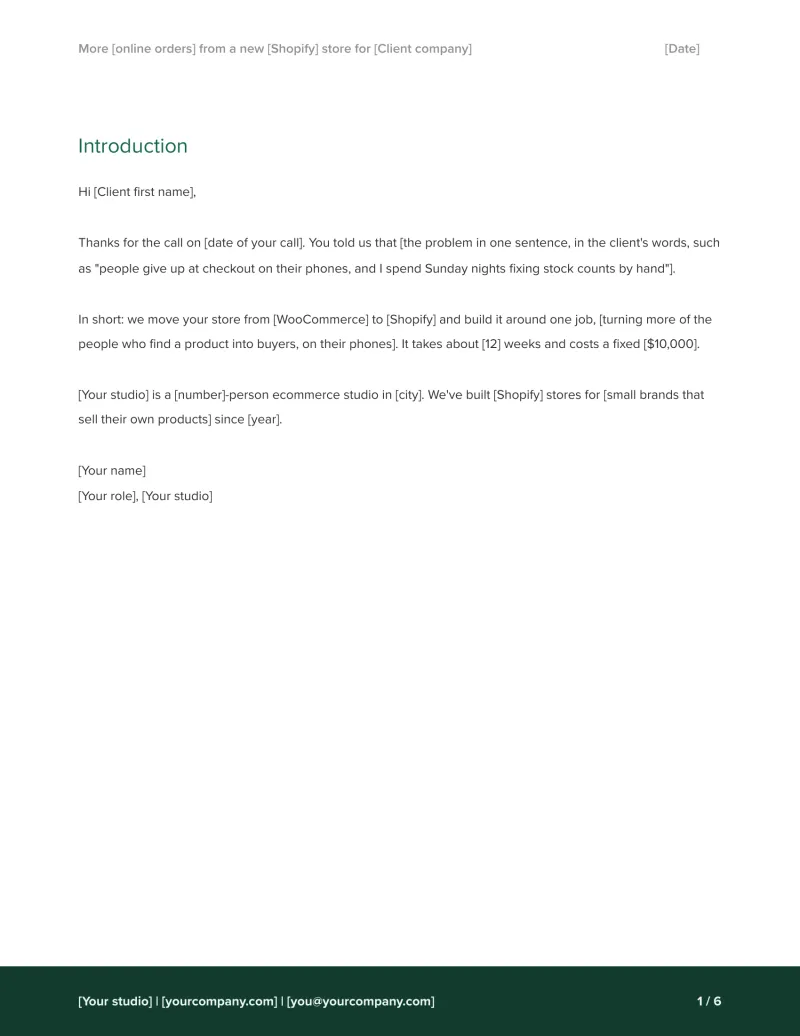
Hi [Client first name],
Thanks for the call on [date of your call]. You told us that [the problem in one sentence, in the client's words, such as "people give up at checkout on their phones, and I spend Sunday nights fixing stock counts by hand"].
In short: we move your store from [WooCommerce] to [Shopify] and build it around one job, [turning more of the people who find a product into buyers, on their phones]. It takes about [12] weeks and costs a fixed [$10,000].
[Your studio] is a [number]-person ecommerce studio in [city]. We've built [Shopify] stores for [small brands that sell their own products] since [year].
[Your name] [Your role], [Your studio]
Proposals that mention a Shopify or ecommerce store got their first look in a median of 48 minutes in Nusii (342 proposals, November 2025 to October 2026), and about a third of all first views are on a phone. That's why the time and the price are on the first screen.
2. What we heard
Shows you listened, goes one level deeper than what the client told you, and puts a number on what the new store is worth to them. Only you can write this one: replace the examples with your client's words.
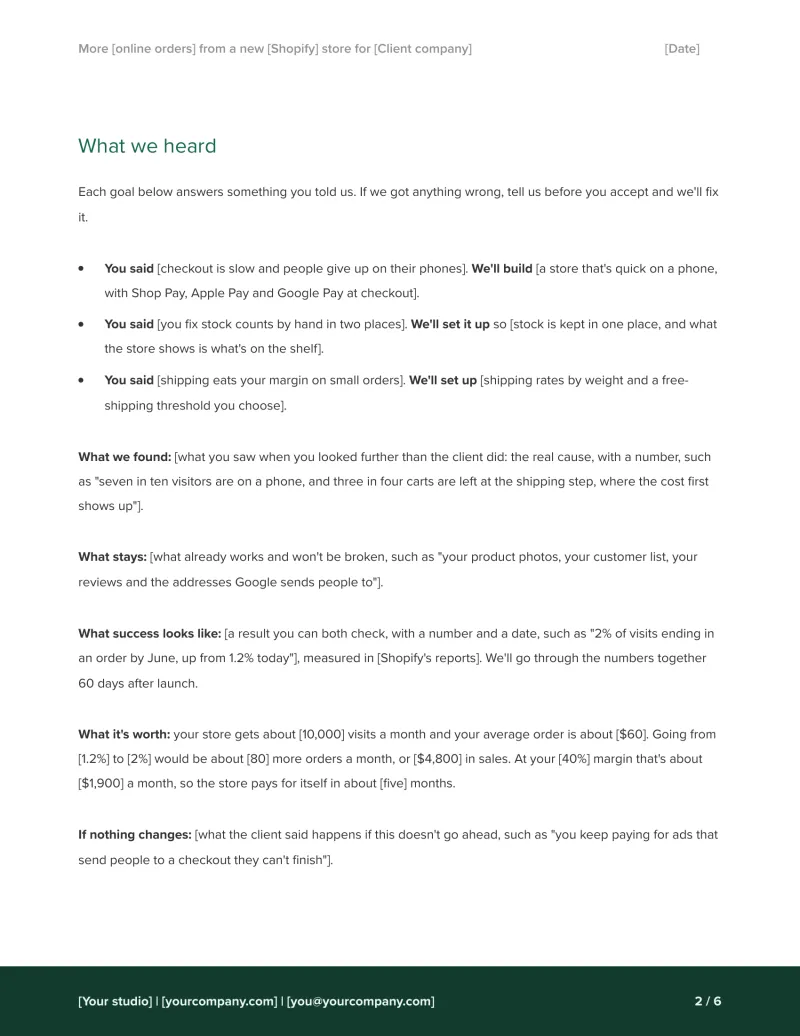
Each goal below answers something you told us. If we got anything wrong, tell us before you accept and we'll fix it.
You said[checkout is slow and people give up on their phones]. We'll build[a store that's quick on a phone, with Shop Pay, Apple Pay and Google Pay at checkout].
You said[you fix stock counts by hand in two places]. We'll set it up so [stock is kept in one place, and what the store shows is what's on the shelf].
You said[shipping eats your margin on small orders]. We'll set up[shipping rates by weight and a free-shipping threshold you choose].
What we found:[what you saw when you looked further than the client did: the real cause, with a number, such as "seven in ten visitors are on a phone, and three in four carts are left at the shipping step, where the cost first shows up"].
What stays:[what already works and won't be broken, such as "your product photos, your customer list, your reviews and the addresses Google sends people to"].
What success looks like:[a result you can both check, with a number and a date, such as "2% of visits ending in an order by June, up from 1.2% today"], measured in [Shopify's reports]. We'll go through the numbers together 60 days after launch.
What it's worth: your store gets about [10,000] visits a month and your average order is about [$60]. Going from [1.2%] to [2%] would be about [80] more orders a month, or [$4,800] in sales. At your [40%] margin that's about [$1,900] a month, so the store pays for itself in about [five] months.
If nothing changes:[what the client said happens if this doesn't go ahead, such as "you keep paying for ads that send people to a checkout they can't finish"].
Ask why now. Kurt Elster, whose agency Ethercycle has worked only on Shopify since 2014, asks "Why start this now vs six months ago or six months from now?" in our 2015 book on proposals. The answer (a launch, a wholesale deal, a platform that's ending) is often the real reason, and it belongs here.
3. How we'll work
The plan in stages, what the client approves at each one, and honest timing. The first line says why the cheaper route won't do the job. If you didn't talk about one, delete it.
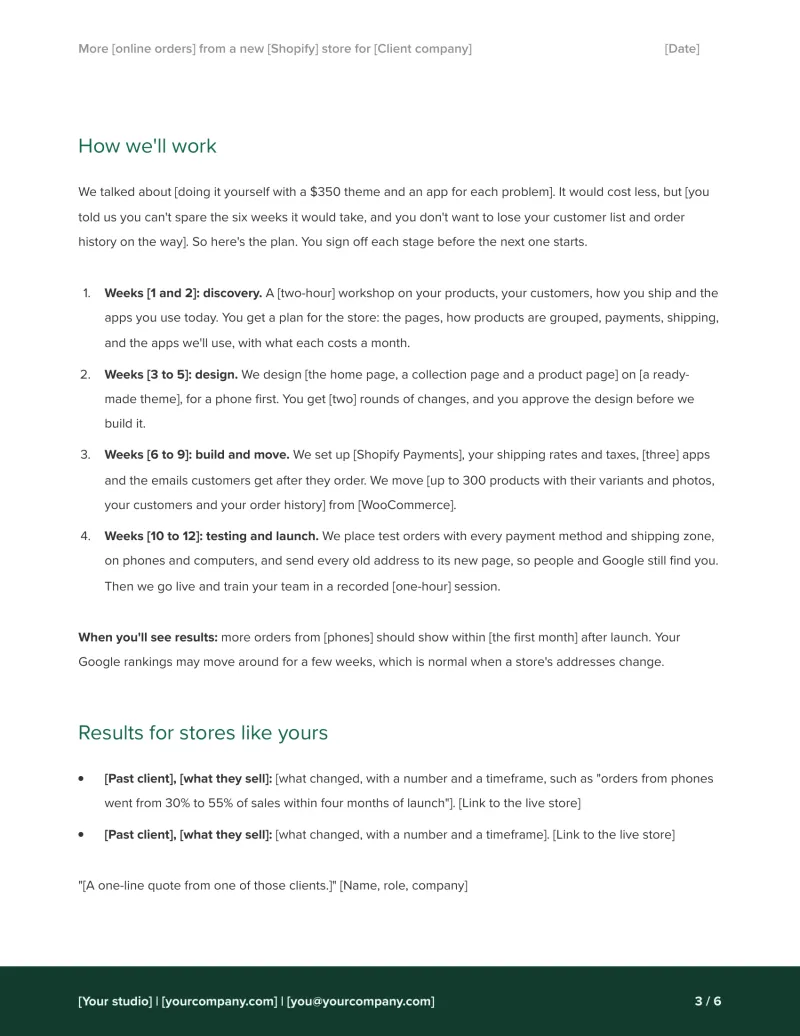
We talked about [doing it yourself with a $350 theme and an app for each problem]. It would cost less, but [you told us you can't spare the six weeks it would take, and you don't want to lose your customer list and order history on the way]. So here's the plan. You sign off each stage before the next one starts.
Weeks [1 and 2]: discovery. A [two-hour] workshop on your products, your customers, how you ship and the apps you use today. You get a plan for the store: the pages, how products are grouped, payments, shipping, and the apps we'll use, with what each costs a month.
Weeks [3 to 5]: design. We design [the home page, a collection page and a product page] on [a ready-made theme], for a phone first. You get [two] rounds of changes, and you approve the design before we build it.
Weeks [6 to 9]: build and move. We set up [Shopify Payments], your shipping rates and taxes, [three] apps and the emails customers get after they order. We move [up to 300 products with their variants and photos, your customers and your order history] from [WooCommerce].
Weeks [10 to 12]: testing and launch. We place test orders with every payment method and shipping zone, on phones and computers, and send every old address to its new page, so people and Google still find you. Then we go live and train your team in a recorded [one-hour] session.
When you'll see results: more orders from [phones] should show within [the first month] after launch. Your Google rankings may move around for a few weeks, which is normal when a store's addresses change.
"Why not build something with WordPress and WooCommerce, or Shopify?" is the example our 2015 book on proposals gives for trying to talk a client out of hiring you. Put the cheaper route and its catch in the first line, and the client sees you weighed it. Google says to "Expect temporary fluctuation in site ranking during the move" when a site's addresses change, so say that before launch, not after.
4. Results for stores like yours
Short proof for the people who weren't on the call: what changed for stores like this one. Use real numbers from a real client, or leave this section out.
[Past client], [what they sell]:[what changed, with a number and a timeframe, such as "orders from phones went from 30% to 55% of sales within four months of launch"]. [Link to the live store]
[Past client], [what they sell]:[what changed, with a number and a timeframe]. [Link to the live store]
"[A one-line quote from one of those clients.]" [Name, role, company]
Proposals to a client who had accepted one before were accepted 63% of the time in Nusii, against 46% for a first proposal from the same senders (July to September 2026). A new client hasn't seen your work yet. One result and a link to the live store do that job without filling the proposal with screenshots.
5. What's included
Draws the line between what you'll do and what you won't, says what you need from the client, and what they keep. Ecommerce projects run late on product data more than on anything else, so it gets a date.
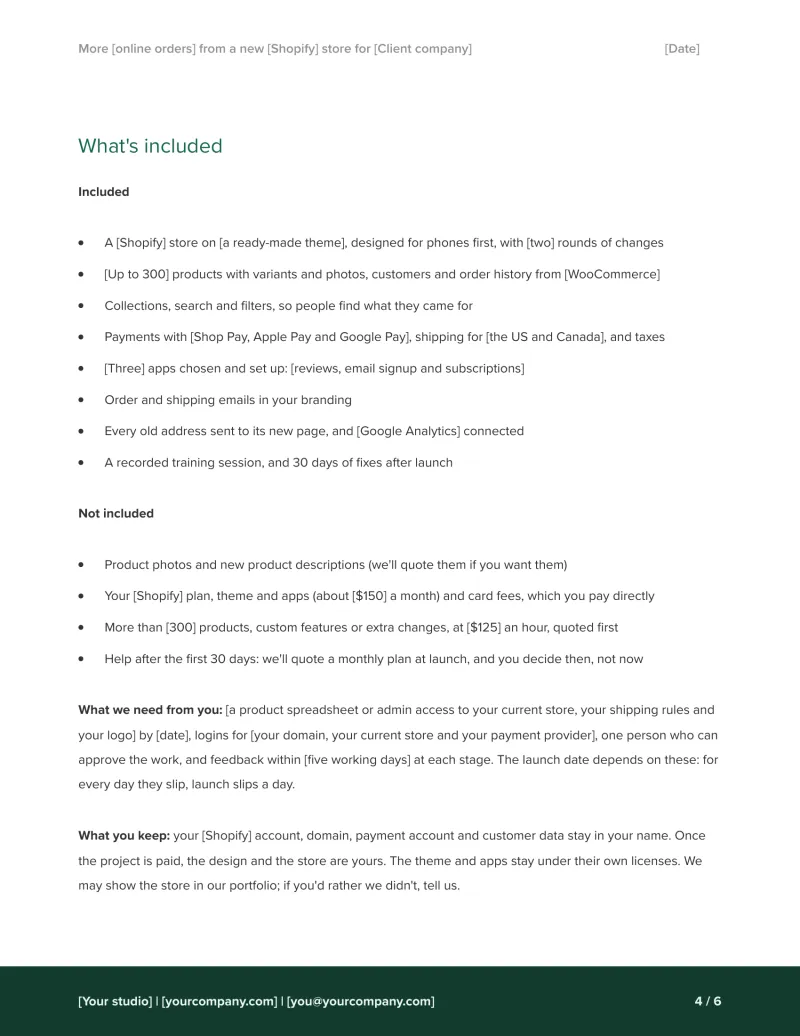
Included
A [Shopify] store on [a ready-made theme], designed for phones first, with [two] rounds of changes
[Up to 300] products with variants and photos, customers and order history from [WooCommerce]
Collections, search and filters, so people find what they came for
Payments with [Shop Pay, Apple Pay and Google Pay], shipping for [the US and Canada], and taxes
[Three] apps chosen and set up: [reviews, email signup and subscriptions]
Order and shipping emails in your branding
Every old address sent to its new page, and [Google Analytics] connected
A recorded training session, and 30 days of fixes after launch
Not included
Product photos and new product descriptions (we'll quote them if you want them)
Your [Shopify] plan, theme and apps (about [$150] a month) and card fees, which you pay directly
More than [300] products, custom features or extra changes, at [$125] an hour, quoted first
Help after the first 30 days: we'll quote a monthly plan at launch, and you decide then, not now
What we need from you:[a product spreadsheet or admin access to your current store, your shipping rules and your logo] by [date], logins for [your domain, your current store and your payment provider], one person who can approve the work, and feedback within [five working days] at each stage. The launch date depends on these: for every day they slip, launch slips a day.
What you keep: your [Shopify] account, domain, payment account and customer data stay in your name. Once the project is paid, the design and the store are yours. The theme and apps stay under their own licenses. We may show the store in our portfolio; if you'd rather we didn't, tell us.
"You will almost never be the only party responsible for the outcome of a project," as Philip Morgan and Jonathan Stark put it in our 2015 book on proposals. On a store, the client's part is the product data: a spreadsheet, or access to the old store, by a date you both write down.
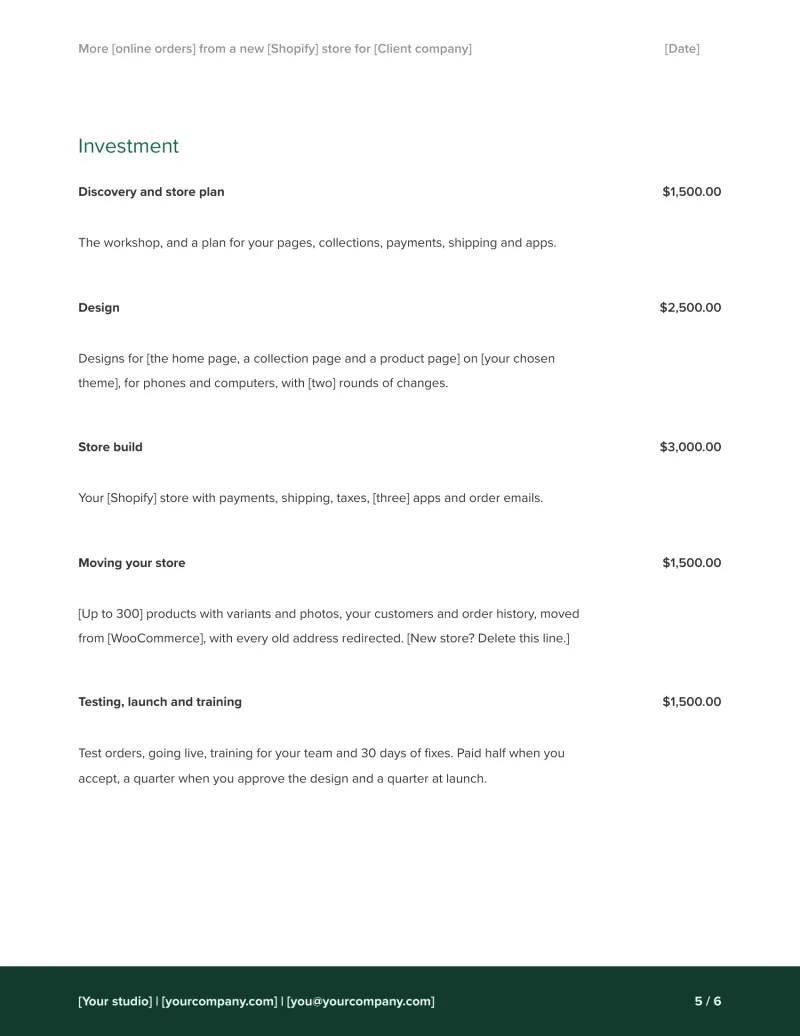
6. Investment
One fixed price in five phases, and how it's paid. These are example prices; the table further down shows what others charge.
Discovery and store plan
$1,500
The workshop, and a plan for your pages, collections, payments, shipping and apps.
Design
$2,500
Designs for [the home page, a collection page and a product page] on [your chosen theme], for phones and computers, with [two] rounds of changes.
Store build
$3,000
Your [Shopify] store with payments, shipping, taxes, [three] apps and order emails.
Moving your store
$1,500
[Up to 300] products with variants and photos, your customers and order history, moved from [WooCommerce], with every old address redirected. [New store? Delete this line.]
Testing, launch and training
$1,500
Test orders, going live, training for your team and 30 days of fixes. Paid half when you accept, a quarter when you approve the design and a quarter at launch.
Total: $10,000
Accepted proposals that mention a Shopify or ecommerce store had a median one-time value of $4,200 in Nusii (140 proposals, November 2025 to October 2026, monthly fees left out). This example is more than twice that, so "What it's worth" has to do its job. Proposals of $5,000 to $15,000 were accepted 48.9% of the time (July to September 2026).
7. Next steps
Tells the client exactly what to do to say yes, what happens after, and when you'll call.
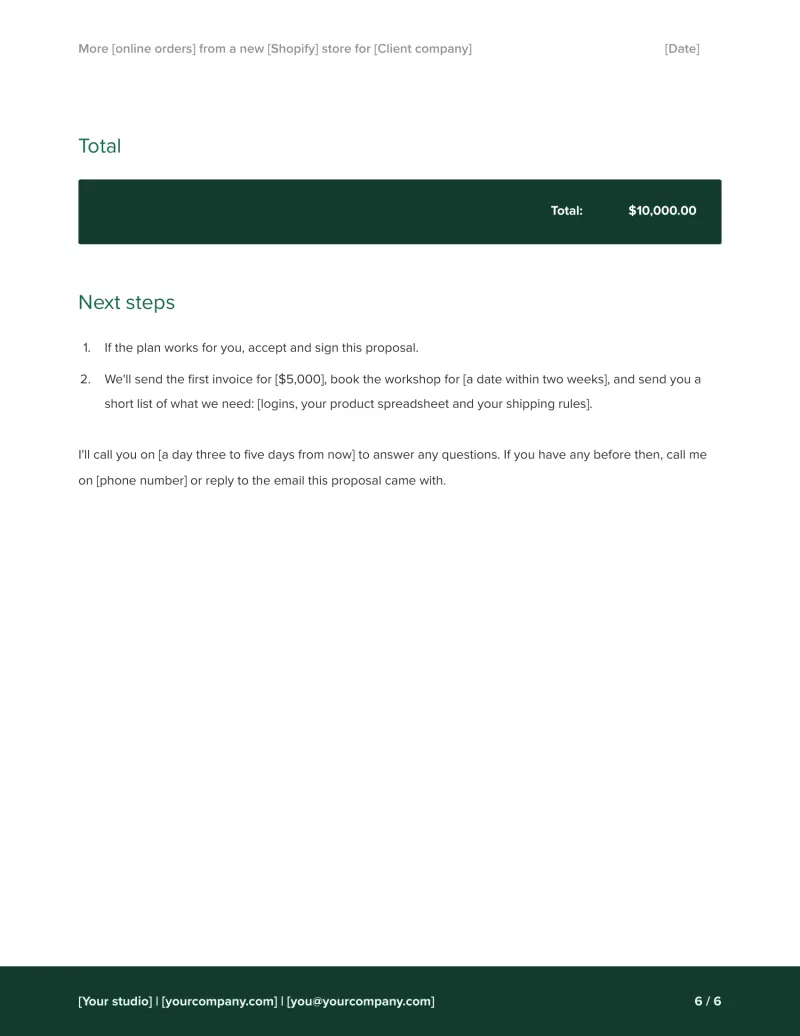
If the plan works for you, accept and sign this proposal.
We'll send the first invoice for [$5,000], book the workshop for [a date within two weeks], and send you a short list of what we need: [logins, your product spreadsheet and your shipping rules].
I'll call you on [a day three to five days from now] to answer any questions. If you have any before then, call me on [phone number] or reply to the email this proposal came with.
Proposals that mention a Shopify or ecommerce store got their yes in a median of 4.7 days, and 64% of the yeses came within a week (342 proposals, November 2025 to October 2026). A call three to five days after you send it lands while most clients are still deciding.
An ecommerce website proposal example, filled in
Two sections of the template above with a client's words in the brackets, so you can see how it reads when it's done. Brindlewick Candle Co. is made up, and so are its numbers.
More online orders from a new Shopify store for Brindlewick Candle Co.
What we heard
You said checkout is slow and people give up on their phones. We'll build a store that's quick on a phone, with Shop Pay, Apple Pay and Google Pay at checkout.
You said you fix stock counts by hand in two places, the store and the spreadsheet you use for the craft fairs. We'll set it up so stock is kept in one place, and what the store shows is what's on the shelf.
You said shipping eats your margin on single candles. We'll set up shipping rates by weight and free shipping over $75.
What success looks like: 2% of visits ending in an order by June, up from 1.2% today, measured in Shopify's reports.
What it's worth: your store gets about 10,000 visits a month and your average order is about $60. Going from 1.2% to 2% would be about 80 more orders a month, or $4,800 in sales. At your 40% margin that's about $1,900 a month, so the store pays for itself in about five months.
If nothing changes: you keep paying for Instagram ads that send people to a checkout they can't finish, right before the holiday season.
Investment
Discovery and store plan
$1,500
Design
$2,500
Store build
$3,000
Moving your store
$1,500
Testing, launch and training
$1,500
Total: $10,000
See it as your client will
Every page of the PDF, printed by Nusii. Sent as a link, it's one scrolling page on any device: your client accepts with one button and signs with their name.
The template in Nusii, the way your client will see it. It opens in a new tab.
What to charge for a Shopify or ecommerce website
What an online store build costs, from the pages we could check. The template's example, $10,000 for a store of up to 300 products moved from another platform, sits inside GoodFirms' survey range for a growing store and at the bottom of DesignRush's range for a Shopify or WooCommerce build. In Nusii, accepted proposals that mention a Shopify or ecommerce store had a median one-time value of $4,200 (140 proposals, November 2025 to October 2026, monthly fees left out), so many store projects are smaller than this one.
What
Price
Source
Ecommerce website, survey of web firms
$5,000 to $50,000+GoodFirms' 2024 survey, 4 to 16 weeks, as reported by Digital AppliedDigital Applied
Sources: Digital Applied, an agency's roundup of published figures, updated October 2026; DesignRush, an agency directory's cost guide, updated February 2026; Shopify Theme Store, theme prices as listed. These come from companies that sell store builds or list the agencies that do, and directory rates are asking prices, so treat them as sellers' figures. We didn't find an independent measure of what Shopify studios actually charge.
How often proposals got a yes, by price
Proposals over $15,000 got a yes about a third of the time. Accepted proposals that mention a Shopify or ecommerce store had a median one-time value of $4,200 (140 proposals, November 2025 to October 2026). From 1,713 proposals first sent with Nusii, July to September 2026.
Under $1,000
67.1%
$1,000 to $5,000
50.7%
$5,000 to $15,000
48.9%
$15,000 to $50,000
36.1%
Over $50,000
33.3%
Share accepted, by the total the client saw. Bigger proposals are bigger decisions, so this shows what happened, not that a lower price would win. Method: The State of Proposals 2026.
What happens after you send it
From 342 proposals first sent with Nusii from November 2025 to October 2026 that mention a Shopify or ecommerce store build (some cover more than the build).
50.0%
were accepted
48 minutes
median time to the client's first look
4.7 days
median time to a yes
63.7%
of the yeses came within a week
Clients rarely say no. Of all proposals sent with Nusii from July to September 2026, 6.5% were rejected and 45.2% got no answer either way. Silence is the usual no, so a follow-up is worth sending.
Follow up after a week. Most yeses come within seven days. In Nusii you see when the proposal was opened and get an email when it's accepted, so you can follow up when they've read it, not when you guess they have.
The same template as a Word file you can edit (it opens in Google Docs too) and a PDF printed by Nusii. We'll email you both, plus a few emails with proposal tips. Unsubscribe any time.
Or send it with Nusii
This template is in the gallery of every Nusii account. Send it as a link: you get an email when your client opens it, and they accept and sign online, on any device.
“I’ve tried many tools over the years before and after and still nothing has compared.”
Julian Crasci
Managing Director, Webrisor
“The best thing about Nusii is being alerted when a client has viewed the proposal. Highly recommend.”
A document that tells a store owner what you’ll build for them, what it costs and how to start. It usually covers what they told you, the goals, how the build and the move from their old store run, what’s included and what isn’t, the price, and how to say yes.
What should a Shopify website proposal include?
What the client told you and the goals that follow from it, your plan in stages (payments, shipping, apps and the move from the old store included), short proof from similar stores, what’s included and what isn’t, who owns the store, one clear price, and the next steps. That’s seven sections, the same as the template on this page.
Is an ecommerce website proposal different from a web design proposal?
Yes, in the parts a store has and a brochure site doesn’t: the product catalog, payments, shipping and taxes, apps, test orders, and moving products, customers and orders from the old store. For a website without a shop, our web design proposal template is the better start.
How much should I charge for a Shopify store?
It depends on the number of products, the design work and whether there’s an old store to move. GoodFirms’ 2024 survey, as reported by Digital Applied, puts a growing store at $5,000 to $15,000, and DesignRush puts a Shopify or WooCommerce build with customizations at $10,000 to $20,000 and up. This template uses $10,000 as an example price.
How do I quote an ecommerce website?
In phases the client can follow: discovery, design, the build, the move from the old store, and testing and launch. Put the number of products, apps and rounds of changes in writing, with an hourly rate for anything beyond them. This template does that in five line items that add up to one fixed price.
How long does it take to build a Shopify store?
This template plans 12 weeks for a store of up to 300 products moved from another platform: two for discovery, three for design, four for the build and the move, and three for testing and launch. A new store on a ready-made theme with a few products takes less, and product data that arrives late makes it longer.
What does the client pay for besides your fee?
Their Shopify plan, a paid theme if you use one, apps and a fee on each sale. The template lists them under “Not included”, for the client to pay directly. Shopify’s plan prices and card rates differ by country, so check its pricing page before you write a number in.
Who owns the Shopify store after launch?
Your client should, and the proposal should say so. The template keeps the Shopify account, domain, payment account and customer data in the client’s name from the start. Once the project is paid, the design and the store are theirs; the theme and apps stay under their own licenses.
Should the proposal cover moving the old store?
Yes, as its own line, so the client sees what moves and what it costs: products with their variants and photos, customers, order history, and a redirect from every old address. Google says to “Expect temporary fluctuation in site ranking during the move”, so tell the client before launch.
Can I use this template for WooCommerce or another platform?
Yes. The platform is in brackets wherever it appears, so WooCommerce, BigCommerce or Squarespace fit. For a new store with nothing to move, delete the “Moving your store” line and the move from the build stage.
Should product photos or support after launch be in the proposal?
Name them, but don’t make them part of the decision. The template lists photos and new product descriptions as not included, and offers to quote a monthly plan at launch. In Nusii, proposals with a recurring fee were accepted less often (39.5% against 54.5% for the same senders, July to September 2026).
Should I offer several packages?
Offer them only if the client asked about choices. In Nusii, proposals where the client could choose between options were accepted less often (40.3% against 51.3% for the same senders, July to September 2026). This template has one clear price; add an optional section for an extra the client asked about.
Can I use this template as a freelance Shopify developer?
Yes. Write “I” instead of “we”, describe yourself in the introduction, and set the number of products and the schedule to what you can do on your own. Everything else works the same.
Do I need a contract as well?
Attach your own agreement if you use one. This template covers the scope, the price, who owns what and how the project is paid in plain words, and it isn’t legal advice.