


Proposal template

Mobile app development proposal template

An app proposal for iPhone and Android in eight short sections, from what your client told you to a clickable prototype, the build, the App Store and Google Play launch and optional care after launch. For app studios and freelance developers. Read it here or get it as a Word file and a PDF.

Michael Koper
By Michael Koper, founder of Nusii Updated
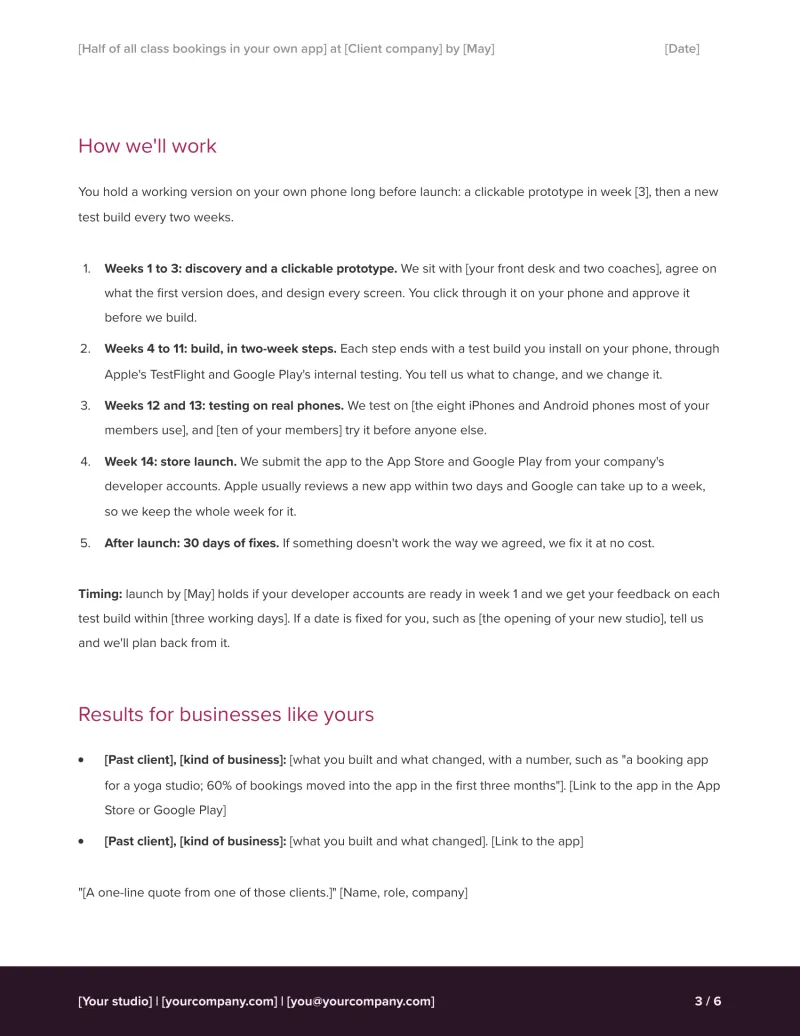
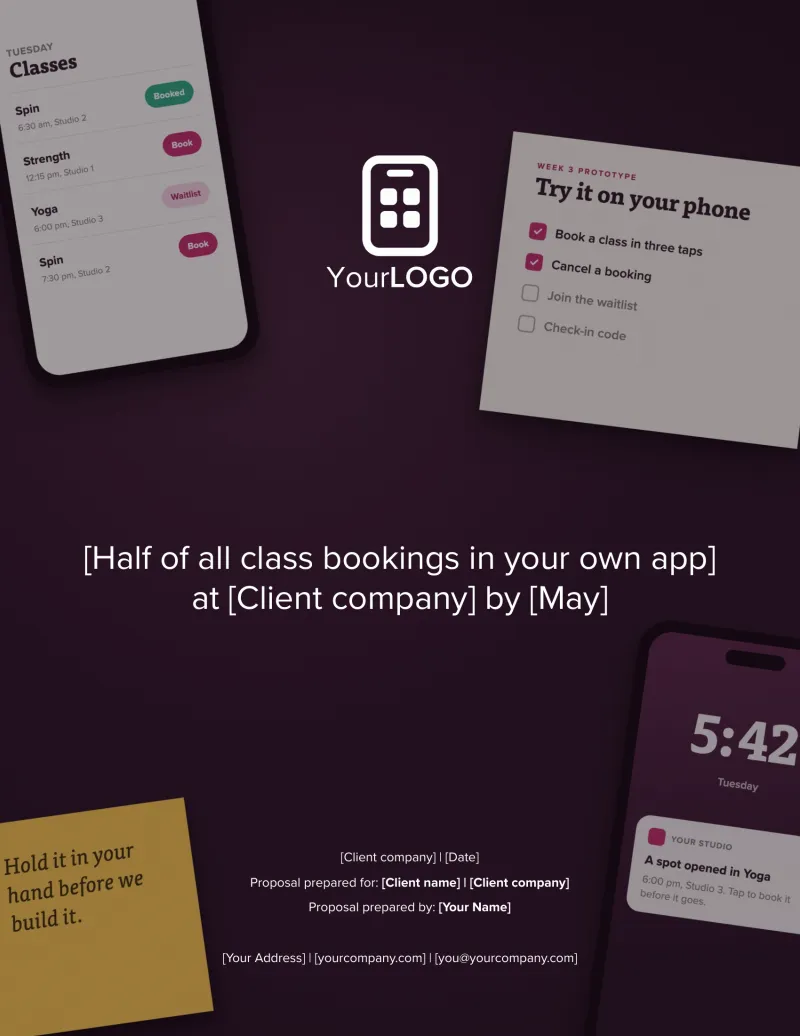
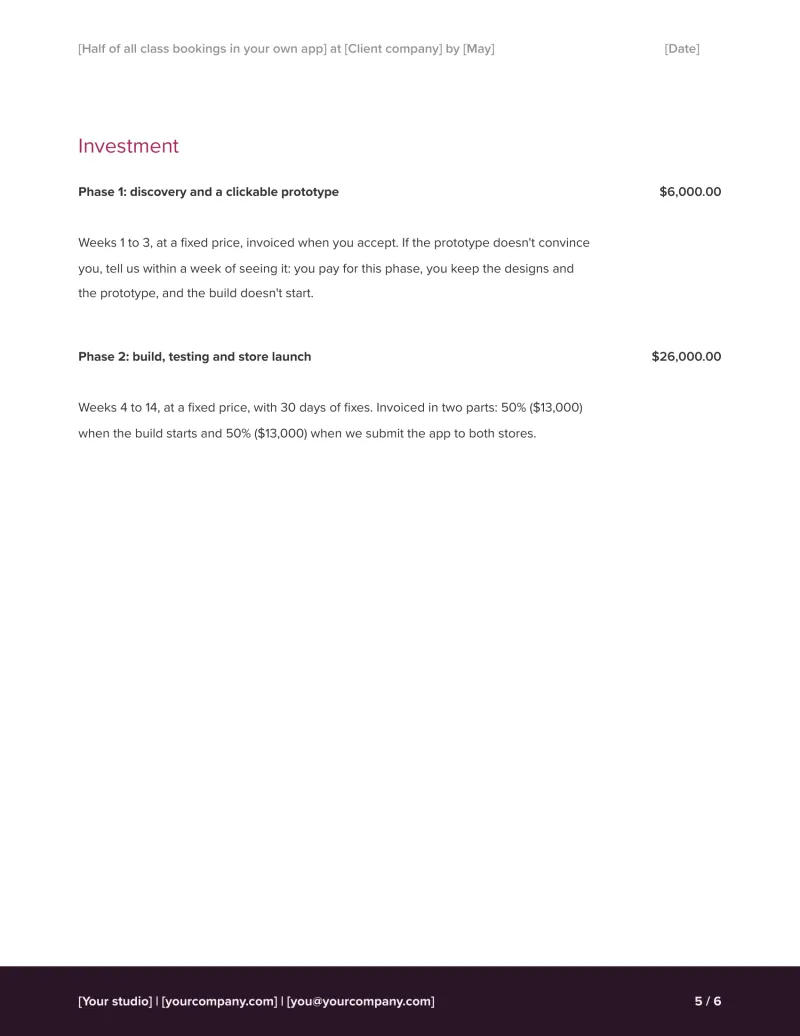
The mobile app development proposal template: the cover and the investment page with a $6,000 prototype and a $26,000 build
Get the Word + PDF
On this page
  1. What to include
  2. The template
  3. What it can promise
  4. A filled-in example
  5. How to write one
  6. See it as your client will
  7. What to charge
  8. After you send it
  9. Word and PDF
  10. Questions

What should a mobile app development proposal include?

A mobile app development proposal is the document that takes a client from the first call to a yes on their app: what they told you, how you'll design, build and launch it on iPhone and Android, the price and how to accept. It has eight parts, and the template below has a section for each:

  1. 1 IntroductionWho you are and the plan, in two sentences.
  2. 2 What we heardThe client's goals in their words, and what they're worth.
  3. 3 How we'll workThe prototype, the test builds and the store launch, week by week.
  4. 4 Results for businesses like yoursWhat you built for clients like this one, with links to the apps.
  5. 5 What's includedWhat you'll build, what you won't, whose accounts it goes in, and who owns it.
  6. 6 InvestmentTwo fixed prices: the prototype first, then the build, with a way out between them.
  7. 7 App care after launchOptional monthly care for the updates Apple and Google ask for.
  8. 8 Next stepsHow to say yes, and when you'll follow up.

The mobile app development proposal template, section by section

Copy one section or the whole thing. Under each section: what it's for, and one thing we've learned from the proposals sent with Nusii.

[Yellow] you write [Green] Nusii fills in when you send it

1. Introduction

The whole plan in two sentences, and who you are. Partners and colleagues read it too, often without having been on the call. Working on your own? Write "I" instead of "we".

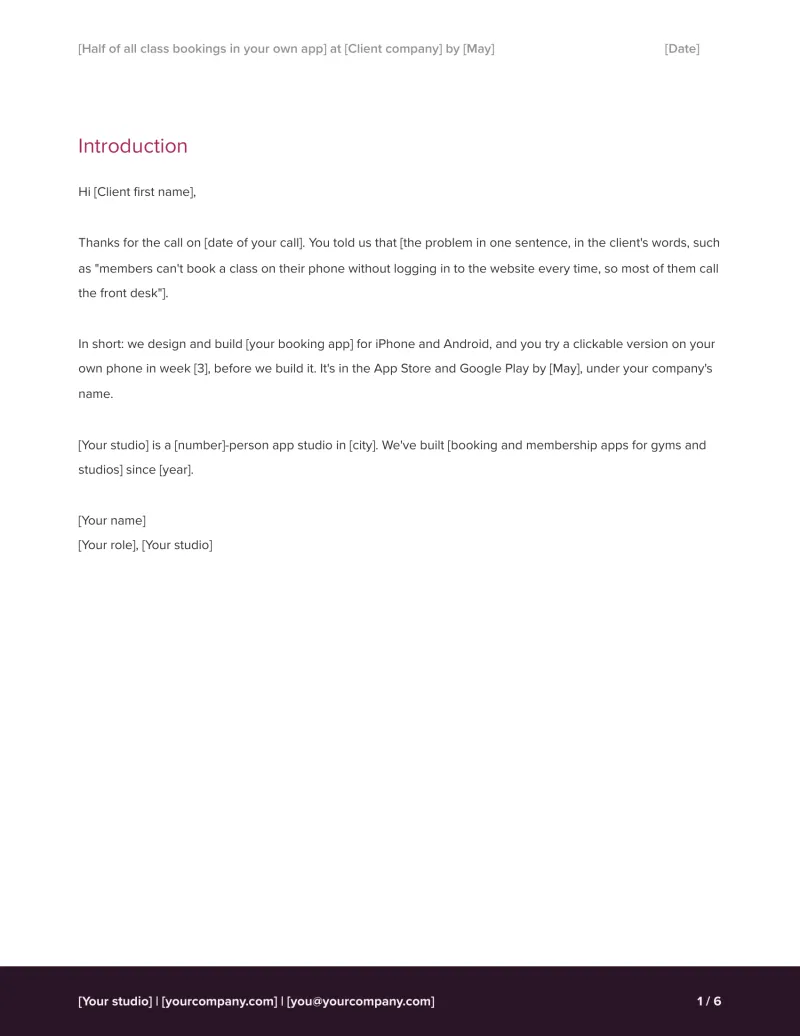
Hi [Client first name],

Thanks for the call on [date of your call]. You told us that [the problem in one sentence, in the client's words, such as "members can't book a class on their phone without logging in to the website every time, so most of them call the front desk"].

In short: we design and build [your booking app] for iPhone and Android, and you try a clickable version on your own phone in week [3], before we build it. It's in the App Store and Google Play by [May], under your company's name.

[Your studio] is a [number]-person app studio in [city]. We've built [booking and membership apps for gyms and studios] since [year].

[Your name]
[Your role], [Your studio]

Software companies' proposals in Nusii got their first look in a median of 30 minutes (762 proposals, November 2025 to October 2026), and about a third of all first views are on a phone. Leave React Native or Swift out of the opening: your client cares what the app does for their customers, and the choice goes in What's included.
2. What we heard

Shows you listened, turns what the client told you into goals you can both check after launch, and puts a number on what it's worth to them. Only you can write this one: replace the examples with your client's words.

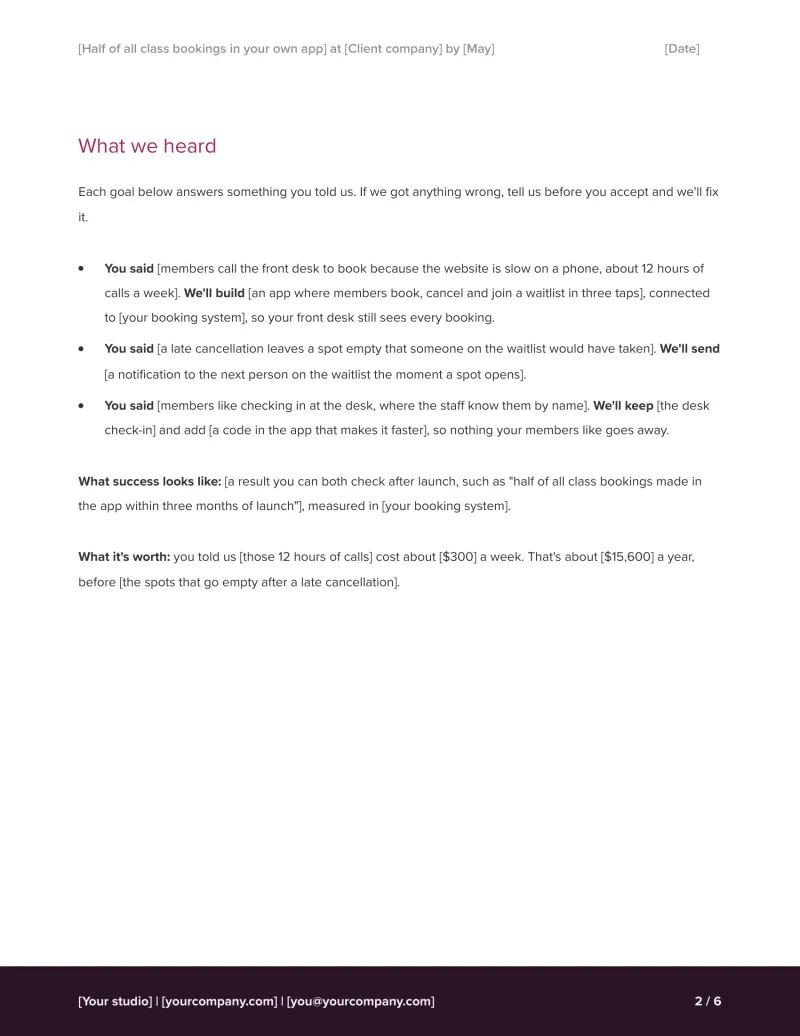
Each goal below answers something you told us. If we got anything wrong, tell us before you accept and we'll fix it.

  • You said [members call the front desk to book because the website is slow on a phone, about 12 hours of calls a week]. We'll build [an app where members book, cancel and join a waitlist in three taps], connected to [your booking system], so your front desk still sees every booking.
  • You said [a late cancellation leaves a spot empty that someone on the waitlist would have taken]. We'll send [a notification to the next person on the waitlist the moment a spot opens].
  • You said [members like checking in at the desk, where the staff know them by name]. We'll keep [the desk check-in] and add [a code in the app that makes it faster], so nothing your members like goes away.

What success looks like: [a result you can both check after launch, such as "half of all class bookings made in the app within three months of launch"], measured in [your booking system].

What it's worth: you told us [those 12 hours of calls] cost about [$300] a week. That's about [$15,600] a year, before [the spots that go empty after a late cancellation].

Ask on the call why a mobile-friendly website, or the app their booking system already offers, won't do. Philip Morgan and Jonathan Stark, a mobile strategy consultant, call it talking your client out of hiring you in our 2015 book on proposals. The answer is the reason a custom app is worth paying for, so it belongs here.

3. How we'll work

The plan in steps, so the client knows when they'll hold the app in their hand, what the app stores add to the schedule, and what you need from them to launch on time.

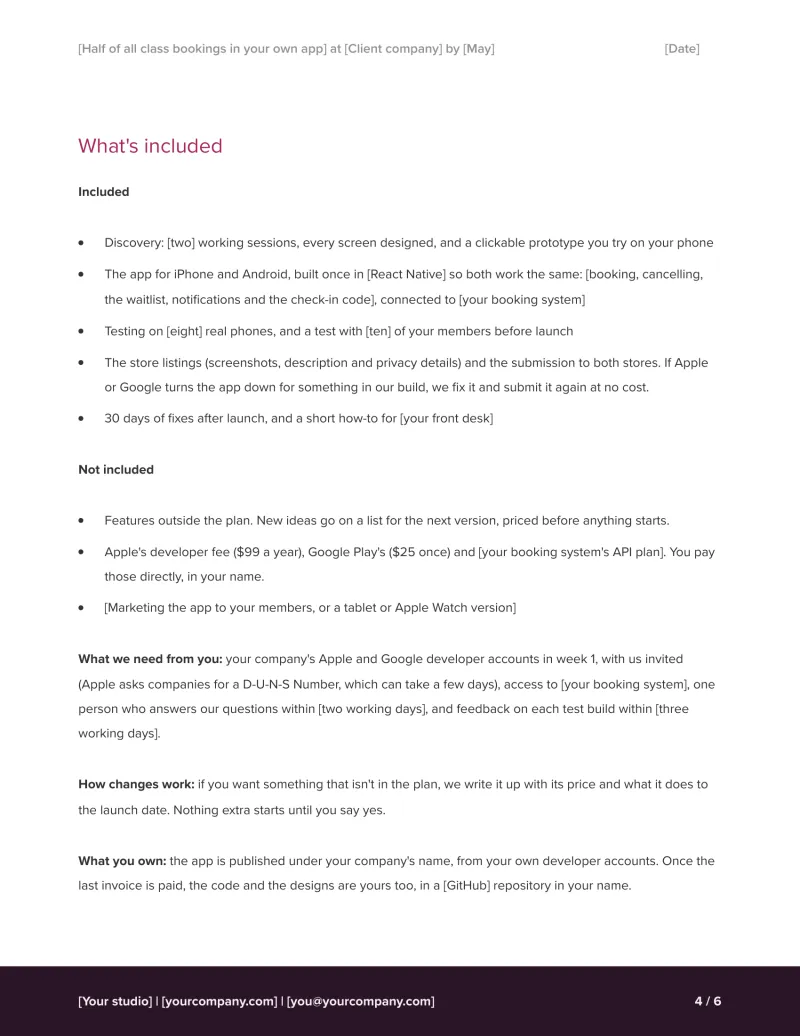
You hold a working version on your own phone long before launch: a clickable prototype in week [3], then a new test build every two weeks.

  1. Weeks 1 to 3: discovery and a clickable prototype. We sit with [your front desk and two coaches], agree on what the first version does, and design every screen. You click through it on your phone and approve it before we build.
  2. Weeks 4 to 11: build, in two-week steps. Each step ends with a test build you install on your phone, through Apple's TestFlight and Google Play's internal testing. You tell us what to change, and we change it.
  3. Weeks 12 and 13: testing on real phones. We test on [the eight iPhones and Android phones most of your members use], and [ten of your members] try it before anyone else.
  4. Week 14: store launch. We submit the app to the App Store and Google Play from your company's developer accounts. Apple usually reviews a new app within two days and Google can take up to a week, so we keep the whole week for it.
  5. After launch: 30 days of fixes. If something doesn't work the way we agreed, we fix it at no cost.

Timing: launch by [May] holds if your developer accounts are ready in week 1 and we get your feedback on each test build within [three working days]. If a date is fixed for you, such as [the opening of your new studio], tell us and we'll plan back from it.

Marie Poulin, interviewed for our 2015 book, puts a new product's first working version in phase 1 and adds at least 25% to her estimate for the unknowns. On an app, the unknowns include the store reviews: Apple reviews 90% of submissions within 48 hours, and Google Play can take up to seven days or longer.

4. Results for businesses like yours

Short proof for the people who weren't on the call: apps you built for clients like this one, and what changed.

  • [Past client], [kind of business]: [what you built and what changed, with a number, such as "a booking app for a yoga studio; 60% of bookings moved into the app in the first three months"]. [Link to the app in the App Store or Google Play]
  • [Past client], [kind of business]: [what you built and what changed]. [Link to the app]

"[A one-line quote from one of those clients.]" [Name, role, company]

Proposals to a repeat client were accepted 62.7% of the time in Nusii, against 43.3% for a first proposal to a client (July to September 2026). A new client hasn't seen your work yet, and an app is the easiest work to show: link it in the store, and they can install it before your call.

5. What's included

Draws the line between what you'll build and what you won't, says whose accounts the app goes in and who owns it. Most app disputes start with "I thought that was included" or "why is the app under your name?"

Included

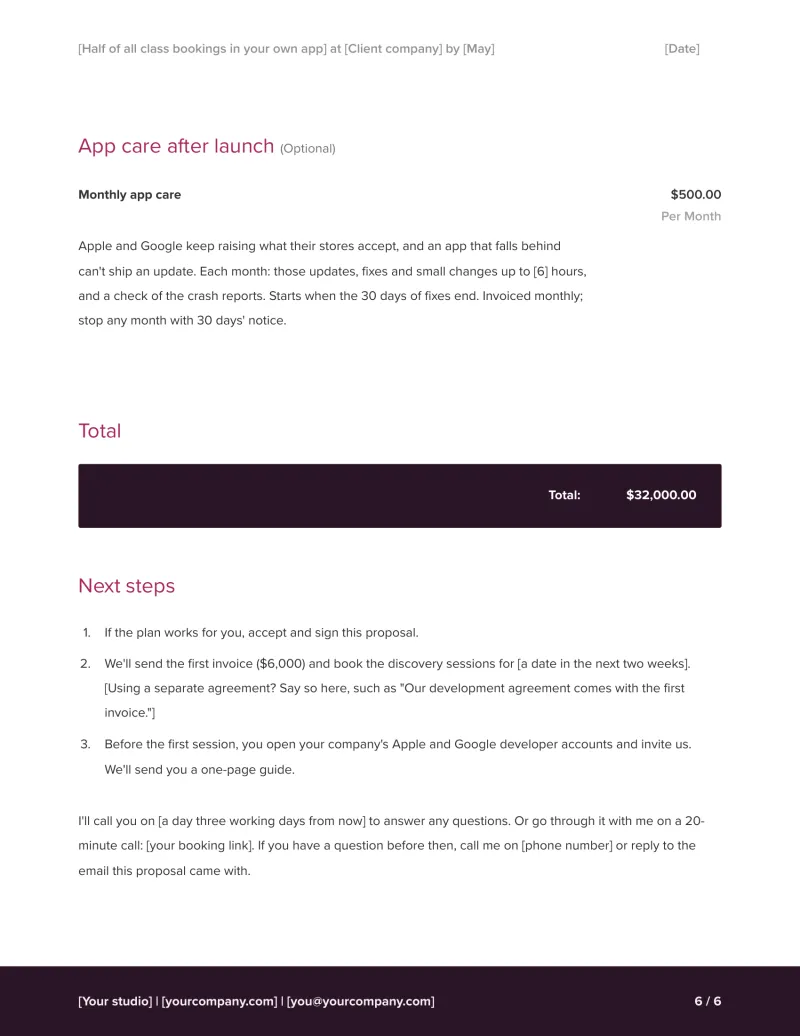
  • Discovery: [two] working sessions, every screen designed, and a clickable prototype you try on your phone
  • The app for iPhone and Android, built once in [React Native] so both work the same: [booking, cancelling, the waitlist, notifications and the check-in code], connected to [your booking system]
  • Testing on [eight] real phones, and a test with [ten] of your members before launch
  • The store listings (screenshots, description and privacy details) and the submission to both stores. If Apple or Google turns the app down for something in our build, we fix it and submit it again at no cost.
  • 30 days of fixes after launch, and a short how-to for [your front desk]

Not included

  • Features outside the plan. New ideas go on a list for the next version, priced before anything starts.
  • Apple's developer fee ($99 a year), Google Play's ($25 once) and [your booking system's API plan]. You pay those directly, in your name.
  • [Marketing the app to your members, or a tablet or Apple Watch version]

What we need from you: your company's Apple and Google developer accounts in week 1, with us invited (Apple asks companies for a D-U-N-S Number, which can take a few days), access to [your booking system], one person who answers our questions within [two working days], and feedback on each test build within [three working days].

How changes work: if you want something that isn't in the plan, we write it up with its price and what it does to the launch date. Nothing extra starts until you say yes.

What you own: the app is published under your company's name, from your own developer accounts. Once the last invoice is paid, the code and the designs are yours too, in a [GitHub] repository in your name.

Publish the app from your client's own developer accounts, never yours: the App Store shows the account's name as the seller, and moving an app between accounts later is work nobody wants to pay for. Apple asks companies for a D-U-N-S Number to open an account, so ask for it on the first call.

6. Investment

Two fixed prices: the prototype first, then the build, with a way out between them. This is an example price; the table further down shows what app developers charge.

Phase 1: discovery and a clickable prototype

$6,000

Weeks 1 to 3, at a fixed price, invoiced when you accept. If the prototype doesn't convince you, tell us within a week of seeing it: you pay for this phase, you keep the designs and the prototype, and the build doesn't start.

Phase 2: build, testing and store launch

$26,000

Weeks 4 to 14, at a fixed price, with 30 days of fixes. Invoiced in two parts: 50% ($13,000) when the build starts and 50% ($13,000) when we submit the app to both stores.

Total: $32,000

Software companies' accepted proposals in Nusii had a median value of $2,552 (April to September 2026), and across all industries, proposals over $15,000 got a yes less often than smaller ones. The way out after the prototype keeps the first decision at $6,000.

7. App care after launch Optional

An optional monthly line for the question every app client should ask: who keeps it in the stores when Apple and Google change their rules? Your client ticks it to add it, and it starts only when the 30 days of fixes end.

Monthly app care

$500 a month

Apple and Google keep raising what their stores accept, and an app that falls behind can't ship an update. Each month: those updates, fixes and small changes up to [6] hours, and a check of the crash reports. Starts when the 30 days of fixes end. Invoiced monthly; stop any month with 30 days' notice.

Not in the total. In Nusii your client ticks it to add it.

Proposals with a recurring fee were accepted less often in Nusii than one-off ones (39.7% against 54.5% for the same senders, July to September 2026). Keeping care optional, and after launch, lets the client decide on the build by itself.

8. Next steps

Tells the client exactly what to do to say yes, what happens after, and when you'll call. No expiry date, no "limited availability".

  1. If the plan works for you, accept and sign this proposal.
  2. We'll send the first invoice ($6,000) and book the discovery sessions for [a date in the next two weeks]. [Using a separate agreement? Say so here, such as "Our development agreement comes with the first invoice."]
  3. Before the first session, you open your company's Apple and Google developer accounts and invite us. We'll send you a one-page guide.

I'll call you on [a day three working days from now] to answer any questions. Or go through it with me on a 20-minute call: [your booking link]. If you have a question before then, call me on [phone number] or reply to the email this proposal came with.

Software companies' accepted proposals in Nusii got their yes in a median of 1.2 days, and 70.4% of the yeses came within a week (November 2025 to October 2026). If you haven't heard by the third working day, the client is still deciding, and that's when a call helps.

What a mobile app proposal can and can't promise

Promise the work, the test builds and the dates you control. Don't promise what Apple or Google will decide: their review isn't yours to give.

  • Store approval. Apple and Google review every new app and every update, and either can turn one down. Don't promise approval, or a refund if it's refused, as one template ranking for this search does. Promise to fix anything in your build and submit it again at no cost: the template's “What's included” says so.
  • Review times. Apple says it reviews “at least 50% of submissions in less than 24 hours and 90% in less than 48 hours”. Google Play says some apps get “review times of up to 7 days or longer in exceptional cases”. Keep a launch week, and never put a store's approval date in the proposal.
  • Whose account. Publish from your client's company accounts: the App Store shows the account's name as the seller, and Apple asks companies for a D-U-N-S Number, which can take a few days. On Google Play, a personal developer account opened after November 13, 2023 has to run a closed test with “a minimum of 12 testers who have been opted in continuously for at least 14 days” before its app can go public.
  • After launch. The stores keep raising what they accept. Since April 28, 2026, Apple takes only apps built with Xcode 26 or later, and since August 31, 2026, Google Play takes only new apps and updates that target Android 16. Say who keeps the app current: the template's optional app care does.

A mobile app proposal example, filled in

Two sections of the template above with a client's words in the brackets, so you can see how it reads when it's done. Tallow Street Fitness is made up, and so are its numbers.

Half of all class bookings in your own app at Tallow Street Fitness by May

What we heard

  • You said members call the front desk to book because the website is slow on a phone, about 12 hours of calls a week. We'll build an app where members book, cancel and join a waitlist in three taps, connected to your booking system, so your front desk still sees every booking.
  • You said a late cancellation leaves a spot empty that someone on the waitlist would have taken. We'll send a notification to the next person on the waitlist the moment a spot opens.
  • You said members like checking in at the desk, where the staff know them by name. We'll keep the desk check-in and add a code in the app that makes it faster, so nothing your members like goes away.

What success looks like: half of all class bookings made in the app within three months of launch, measured in your booking system.

What it's worth: you told us those 12 hours of calls cost about $300 a week. That's about $15,600 a year, before the spots that go empty after a late cancellation.

Investment

Phase 1: discovery and a clickable prototype

$6,000

Phase 2: build, testing and store launch

$26,000

Total: $32,000

How to write a mobile app proposal, step by step

Five steps, from the first call to the follow-up. The template above already follows them; here's why each one matters.

  1. Find out why an app, and why now

    On the first call, ask what the app should change for the business, who will use it, what they use today, the budget they have in mind, and why now. Then ask why a mobile-friendly website, or the app their booking or shop software already offers, won't do: the answer is why a custom app is worth paying for. Write it down in their words: it becomes the “What we heard” section. Our 10 questions for the first client call cover it, and how to ask about the budget covers the hardest one.

  2. Scope a first version you can show in three weeks

    Pick the few things the app must do to reach the client's goal, and put the rest on a list for the next version. Then make the first phase a clickable prototype the client tries on their own phone: they see the app before anyone writes the code, while changes are still cheap. Marie Poulin, interviewed for our 2015 book on proposals, prices a new product's first version as phase 1 and adds at least 25% to her estimate for the unknowns.

  3. Put the app stores in the plan

    Say whose developer accounts the app goes in (your client's), when they need to open them, and how long the reviews take. Apple asks companies for a D-U-N-S Number to open an account, Apple reviews 90% of submissions within 48 hours, and Google Play can take up to seven days or longer, so keep a week for the launch. What it can promise has the details.

  4. Price the prototype and the build separately

    Send two fixed prices, the prototype first and the build after it, with a way out between them: if the prototype doesn't convince your client, they pay for that phase and keep the designs. Price one app for iPhone and Android rather than a choice of platforms: in Nusii, proposals where the client could choose between options were accepted less often (38% against 53%, July to September 2026). What it costs has the market ranges.

  5. Send it as a link, then call on the third day

    Software companies' accepted proposals in Nusii got their yes in a median of 1.2 days, and 70.4% of the yeses came within a week (November 2025 to October 2026). So write in the proposal when you'll call, and call: by the third working day, the clients who haven't answered are still deciding.

    If two weeks pass in silence, send one last line, from Blair Enns via our 2015 book on proposals: “I haven't heard back from you on the app, so I'm going to assume you've gone in a different direction or your priorities have changed.”

See it as your client will

Every page of the PDF, printed by Nusii. Sent as a link, it's one scrolling page on any device: your client accepts with one button and signs with their name.

Open the live preview

The template in Nusii, the way your client will see it. It opens in a new tab.

What mobile app development costs

What clients of app developers paid, from the sources we could check at the source, and the store fees your client pays. The template's example price, $32,000 for a prototype and a first version on iPhone and Android, sits in the most common project size.

What Price
Mobile app project, the most common size $10,000 to $49,999 what most app projects reviewed on Clutch cost Clutch
Mobile app project, average $90,780 pulled up by large projects, which run about 11 months Clutch
Hourly rate, app development companies $25 to $49 an hour the most common range on Clutch, the same for iPhone, Android and cross-platform Clutch
Apple Developer Program $99 a year paid by your client, in their company's name Apple
Google Play developer account $25 once paid by your client, in their company's name Google

Sources: Clutch, mobile app pricing guide, from verified client reviews, September 2026; Apple, Apple Developer Program enrollment; Google, Play Console Help, get started with Play Console. Clutch's figures come from reviews by clients of the app developers it lists. The store fees are Apple's and Google's own.

How often proposals got a yes, by price

Proposals over $15,000 got a yes about a third of the time. Software companies' accepted proposals had a median value of $2,552 (April to September 2026): most of what they send is smaller than a new app, which is why the prototype comes first, at its own price. From 1,713 proposals first sent with Nusii, July to September 2026.

Under $1,000
67.1%
$1,000 to $5,000
50.7%
$5,000 to $15,000
48.9%
$15,000 to $50,000
36.1%
Over $50,000
33.3%

Share accepted, by the total the client saw. Bigger proposals are bigger decisions, so this shows what happened, not that a lower price would win. Method: The State of Proposals 2026.

What happens after you send it

From 762 proposals software companies first sent with Nusii, November 2025 to October 2026.

55.8%
were accepted
30 minutes
median time to the client's first look
1.2 days
median time to a yes
70.4%
of the yeses came within a week

Clients rarely say no. Of all proposals sent with Nusii from July to September 2026, 6.5% were rejected and 45.2% got no answer either way. Silence is the usual no, so a follow-up is worth sending.

Follow up after a week. Most yeses come within seven days. In Nusii you see when the proposal was opened and get an email when it's accepted, so you can follow up when they've read it, not when you guess they have.

More numbers and the method: The State of Proposals 2026.

Get the Word and PDF files

The same template as a Word file you can edit (it opens in Google Docs too) and a PDF printed by Nusii. We'll email you both, plus a few emails with proposal tips. Unsubscribe any time.

Or send it with Nusii

This template is in the gallery of every Nusii account. Send it as a link: you get an email when your client opens it, and they accept and sign online, on any device.

We use a lot of digital systems and develop systems ourselves. Nusii is one of our favorite services. It has made us more efficient and contributed to more satisfied customers. We highly recommend Nusii.

Jostein Flatin
Jostein Flatin
CEO, Studio X

It also makes creating and sending proposals easier, so I can spend more time focused on the work itself.

John Verbrugge
John Verbrugge
Technology Consultant, Shared Hands
Start your free trial

14-day trial · 60-day money-back guarantee

Questions about mobile app development proposals

What is a mobile app development proposal?

A document that tells a prospective client what app you’ll build for them, how and by when, what it costs and how to say yes. It usually covers their goals, the prototype and the build, testing, the store launch, what’s included, who owns the app, the price and the next steps.

What should an app proposal include?

What the client told you and the goals that follow from it, how you’ll work and when they’ll hold the app in their hand, short proof from similar clients, what’s included and whose developer accounts it goes in, the price and the next steps. The template on this page has a section for each, plus an optional one for care after launch.

How much does it cost to build a mobile app?

It depends on the scope, but most app projects reviewed on Clutch cost $10,000 to $49,999 (Clutch’s mobile app pricing guide, September 2026). This template uses $32,000 as an example price: $6,000 for a clickable prototype and $26,000 for the build and the store launch. Your client also pays Apple $99 a year and Google $25 once for the developer accounts.

Should I build native apps or one cross-platform app?

This template assumes one codebase for iPhone and Android, in React Native or Flutter, so one team builds and tests both apps and the client gets one price. If you build native apps (Swift for iPhone, Kotlin for Android), change that line in What’s included and keep one price for both rather than a choice of platforms.

Whose developer account should the app be published from?

Your client’s. The App Store shows the account’s name as the seller, and moving an app to another account later is extra work. Ask your client to open their Apple and Google accounts in the first week and invite you; Apple asks companies for a D-U-N-S Number, which can take a few days.

How long do App Store and Google Play reviews take?

Apple says it reviews at least half of all submissions within 24 hours and 90% within 48 hours. Google Play says some reviews take up to 7 days or longer in exceptional cases. Keep a week for the launch, and don’t promise a store’s approval date.

What happens after the app is launched?

The template includes 30 days of fixes. After that, Apple and Google keep raising what their stores accept (Xcode 26 since April 2026, Android 16 since August 2026), and an app that falls behind can’t ship an update. The optional app care line covers those updates for a monthly fee the client can stop.

Can I use this template for a web app?

A web app has no stores or developer accounts, so the software development proposal template fits it better. Use this one when the client wants an app people install from the App Store or Google Play.

Should I include a contract in the proposal?

Keep the proposal plain: what you’ll build, when, the price and how it’s paid, how changes work and who owns the app and the code. If you use a development agreement, attach it or send it with the first invoice, and have a lawyer check it.

Can my client accept and sign the proposal online?

Yes, if you send it as an online proposal. In Nusii, your client opens a link, accepts with one button and signs with their typed name, on any device, and you get an email when they do. The Word file and the PDF need signing the old way.

More templates and guides

Send your next mobile app development proposal as a link, and see when it's opened

Try Nusii free for 14 days

Cancel anytime · 60-day money-back guarantee