A PPC proposal in seven sections, from what your client told you to a paid setup, a flat monthly fee for Google Ads and the next steps, with the ad budget kept apart. For agencies and freelance PPC managers. Read it here or get it as a Word file and a PDF.
A PPC proposal should say what the client told you, the result you'll both measure (usually the cost of a lead or a booked job), how you'll work, what's included, who pays Google and whose account it is, your fee kept apart from the ad budget, and exactly how to say yes. The template below has a section for each.
Copy one section or the whole thing. Under each section: what it's for, and one thing we've learned from the proposals sent with Nusii.
[Yellow] you write[Green] Nusii fills in when you send it
1. Introduction
The whole plan in two sentences, and who you are. Partners and colleagues read it too, often without having been on the call. Working on your own? Write "I" instead of "we".
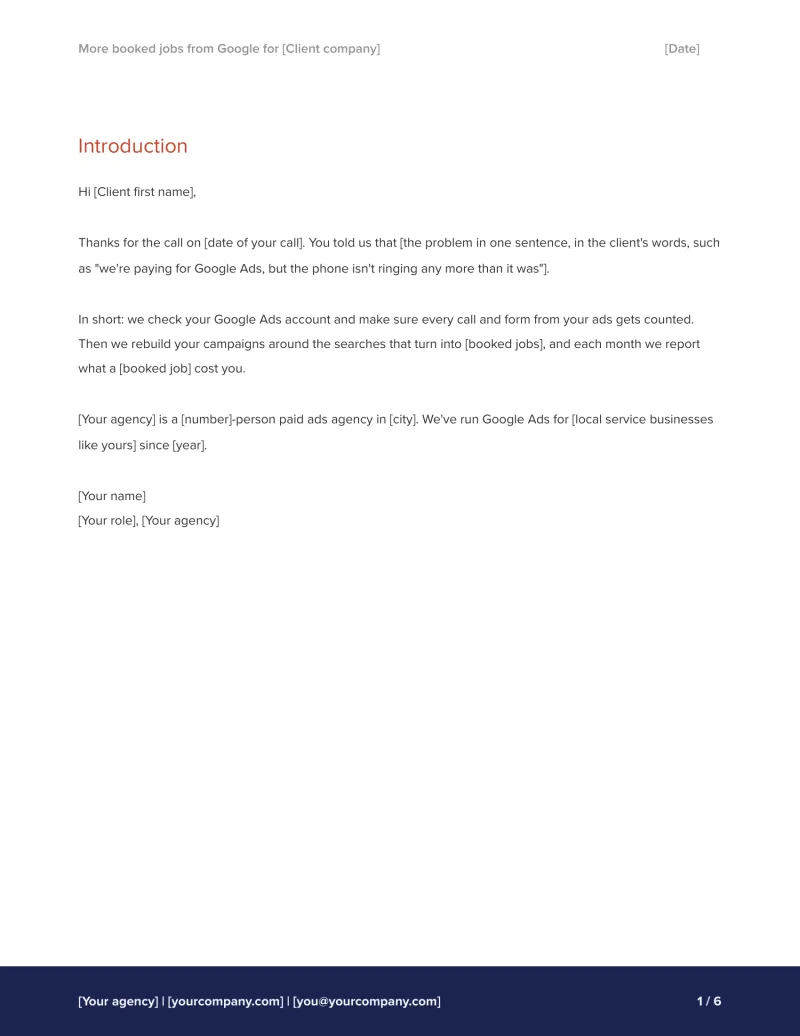
Hi [Client first name],
Thanks for the call on [date of your call]. You told us that [the problem in one sentence, in the client's words, such as "we're paying for Google Ads, but the phone isn't ringing any more than it was"].
In short: we check your Google Ads account and make sure every call and form from your ads gets counted. Then we rebuild your campaigns around the searches that turn into [booked jobs], and each month we report what a [booked job] cost you.
[Your agency] is a [number]-person paid ads agency in [city]. We've run Google Ads for [local service businesses like yours] since [year].
[Your name] [Your role], [Your agency]
Agencies' proposals in Nusii got their first look in a median of 54 minutes (3,782 proposals, November 2025 to October 2026), and about a third of first views are on a phone. That's why this section is short, and why the template says "searches we block" and never "negative keywords". Your client may never have heard the second one.
2. What we heard
Shows you listened, turns what the client told you into goals you can both check later, and puts a number on what the ads are worth to them. Only you can write this one: replace the examples with your client's words.
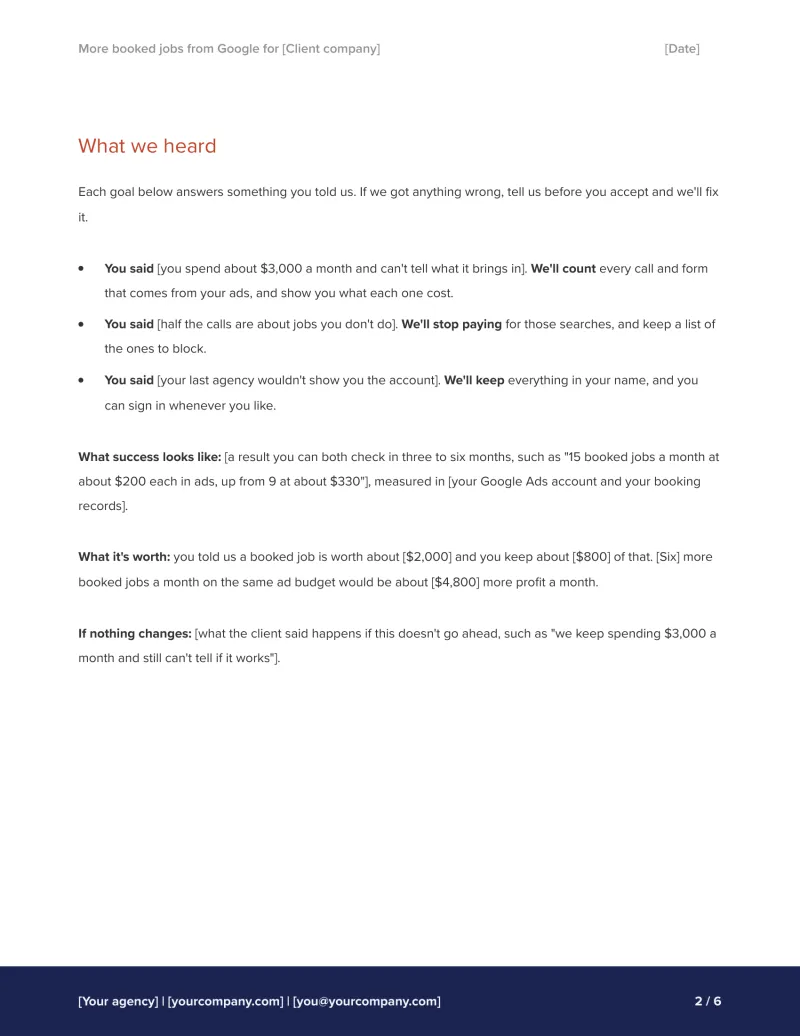
Each goal below answers something you told us. If we got anything wrong, tell us before you accept and we'll fix it.
You said[you spend about $3,000 a month and can't tell what it brings in]. We'll count every call and form that comes from your ads, and show you what each one cost.
You said[half the calls are about jobs you don't do]. We'll stop paying for those searches, and keep a list of the ones to block.
You said[your last agency wouldn't show you the account]. We'll keep everything in your name, and you can sign in whenever you like.
What success looks like:[a result you can both check in three to six months, such as "15 booked jobs a month at about $200 each in ads, up from 9 at about $330"], measured in [your Google Ads account and your booking records].
What it's worth: you told us a booked job is worth about [$2,000] and you keep about [$800] of that. [Six] more booked jobs a month on the same ad budget would be about [$4,800] more profit a month.
If nothing changes:[what the client said happens if this doesn't go ahead, such as "we keep spending $3,000 a month and still can't tell if it works"].
Ask for four numbers on the call: what they spend a month, how many calls or forms that brings in, how many become booked jobs, and what a booked job is worth. They fill in "What it's worth". As Philip Morgan and Jonathan Stark put it in our 2015 book on proposals, "the buyer will set the value", so the numbers should be your client's.
3. How we'll work
The plan step by step, so the client knows what happens first, what they approve, and when to expect results.
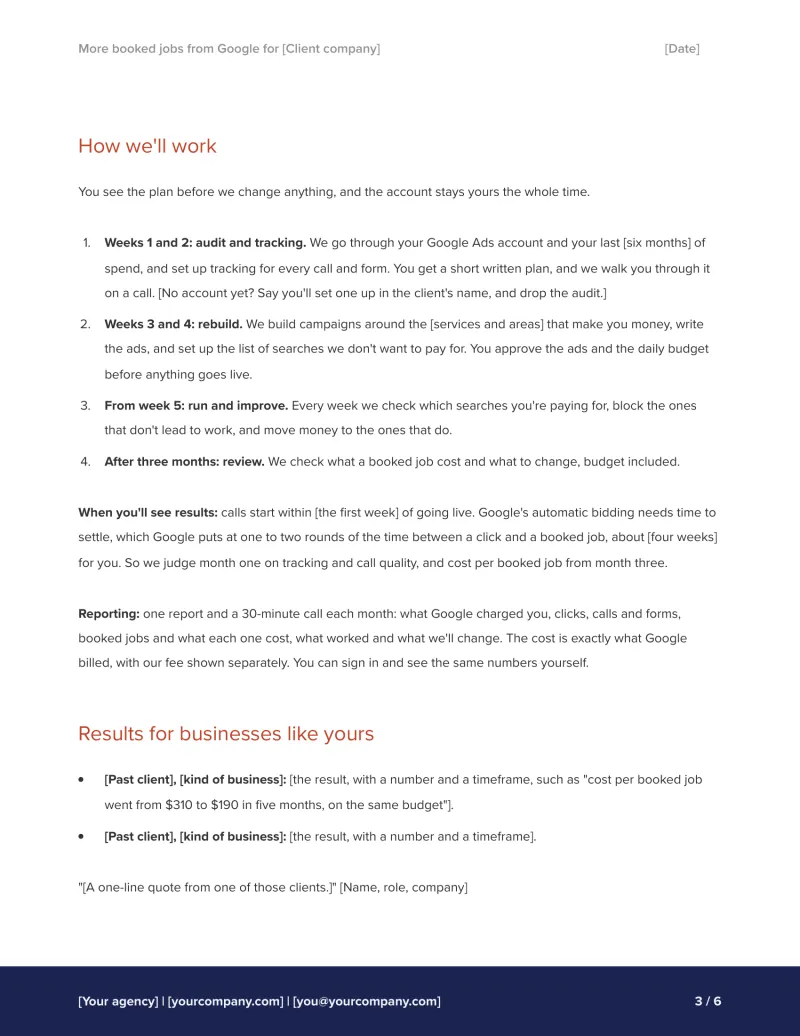
You see the plan before we change anything, and the account stays yours the whole time.
Weeks 1 and 2: audit and tracking. We go through your Google Ads account and your last [six months] of spend, and set up tracking for every call and form. You get a short written plan, and we walk you through it on a call. [No account yet? Say you'll set one up in the client's name, and drop the audit.]
Weeks 3 and 4: rebuild. We build campaigns around the [services and areas] that make you money, write the ads, and set up the list of searches we don't want to pay for. You approve the ads and the daily budget before anything goes live.
From week 5: run and improve. Every week we check which searches you're paying for, block the ones that don't lead to work, and move money to the ones that do.
After three months: review. We check what a booked job cost and what to change, budget included.
When you'll see results: calls start within [the first week] of going live. Google's automatic bidding needs time to settle, which Google puts at one to two rounds of the time between a click and a booked job, about [four weeks] for you. So we judge month one on tracking and call quality, and cost per booked job from month three.
Reporting: one report and a 30-minute call each month: what Google charged you, clicks, calls and forms, booked jobs and what each one cost, what worked and what we'll change. The cost is exactly what Google billed, with our fee shown separately. You can sign in and see the same numbers yourself.
Accepted proposals in Nusii had a median of 7 sections, the rest 9 (1,713 proposals, July to September 2026). The keyword list and the campaign structure belong in the written plan from week 2, not here.
4. Results for businesses like yours
Short proof for the people who weren't on the call: what happened for businesses like this one. Use real numbers from a real client, or leave this section out.
[Past client], [kind of business]:[the result, with a number and a timeframe, such as "cost per booked job went from $310 to $190 in five months, on the same budget"].
[Past client], [kind of business]:[the result, with a number and a timeframe].
"[A one-line quote from one of those clients.]" [Name, role, company]
Proposals to a client who had accepted one before were accepted 62% of the time in Nusii, against 46% for a first proposal from the same senders (July to September 2026). A new client hasn't seen your work yet: one result from a business like theirs does more here than a screenshot of your ads.
5. What's included
Draws the line between what you'll do and what you won't, says what you need from the client, and what they keep. The line in brackets covers senders who work with businesses, or who also run ads on Bing.
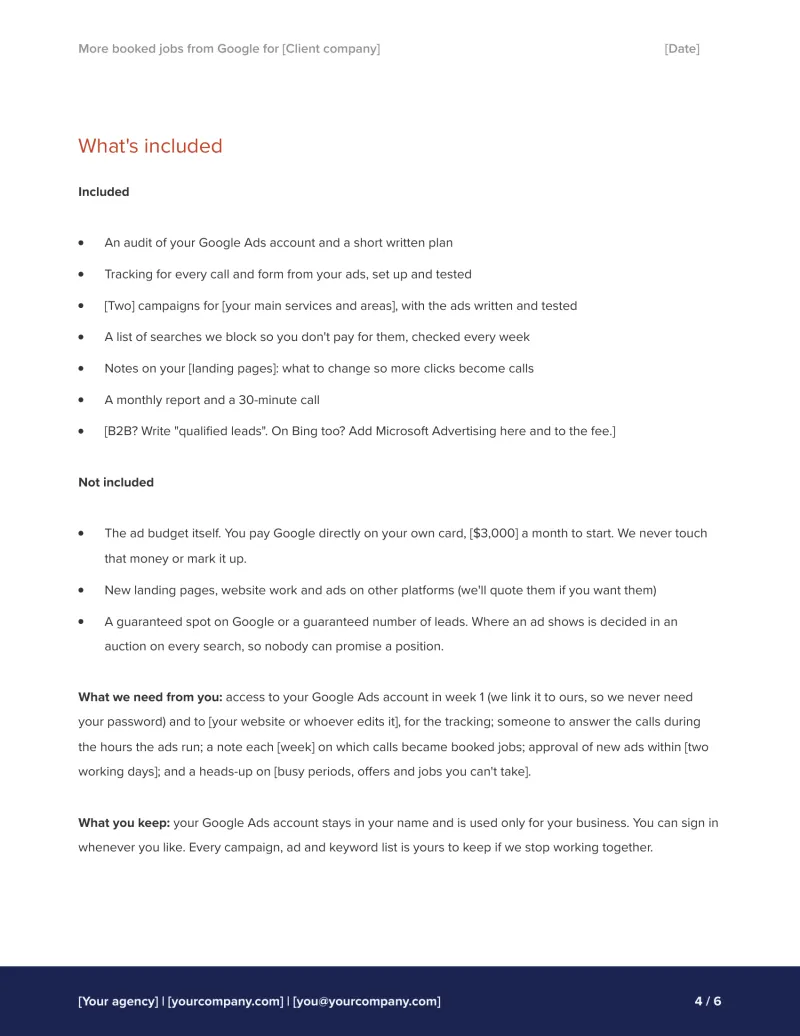
Included
An audit of your Google Ads account and a short written plan
Tracking for every call and form from your ads, set up and tested
[Two] campaigns for [your main services and areas], with the ads written and tested
A list of searches we block so you don't pay for them, checked every week
Notes on your [landing pages]: what to change so more clicks become calls
A monthly report and a 30-minute call
[B2B? Write "qualified leads". On Bing too? Add Microsoft Advertising here and to the fee.]
Not included
The ad budget itself. You pay Google directly on your own card, [$3,000] a month to start. We never touch that money or mark it up.
New landing pages, website work and ads on other platforms (we'll quote them if you want them)
A guaranteed spot on Google or a guaranteed number of leads. Where an ad shows is decided in an auction on every search, so nobody can promise a position.
What we need from you: access to your Google Ads account in week 1 (we link it to ours, so we never need your password) and to [your website or whoever edits it], for the tracking; someone to answer the calls during the hours the ads run; a note each [week] on which calls became booked jobs; approval of new ads within [two working days]; and a heads-up on [busy periods, offers and jobs you can't take].
What you keep: your Google Ads account stays in your name and is used only for your business. You can sign in whenever you like. Every campaign, ad and keyword list is yours to keep if we stop working together.
Google says "It's not possible to guarantee a specific ad position" on its search results, and its policy tells partners to avoid unrealistic claims about results. Leave the guarantee line in: it protects you too.
6. Investment
One price to start, for the audit, the tracking and the rebuild, then a flat monthly fee, each with when it's invoiced, and a way out before the monthly work begins. These are example prices; the table further down shows what others charge.
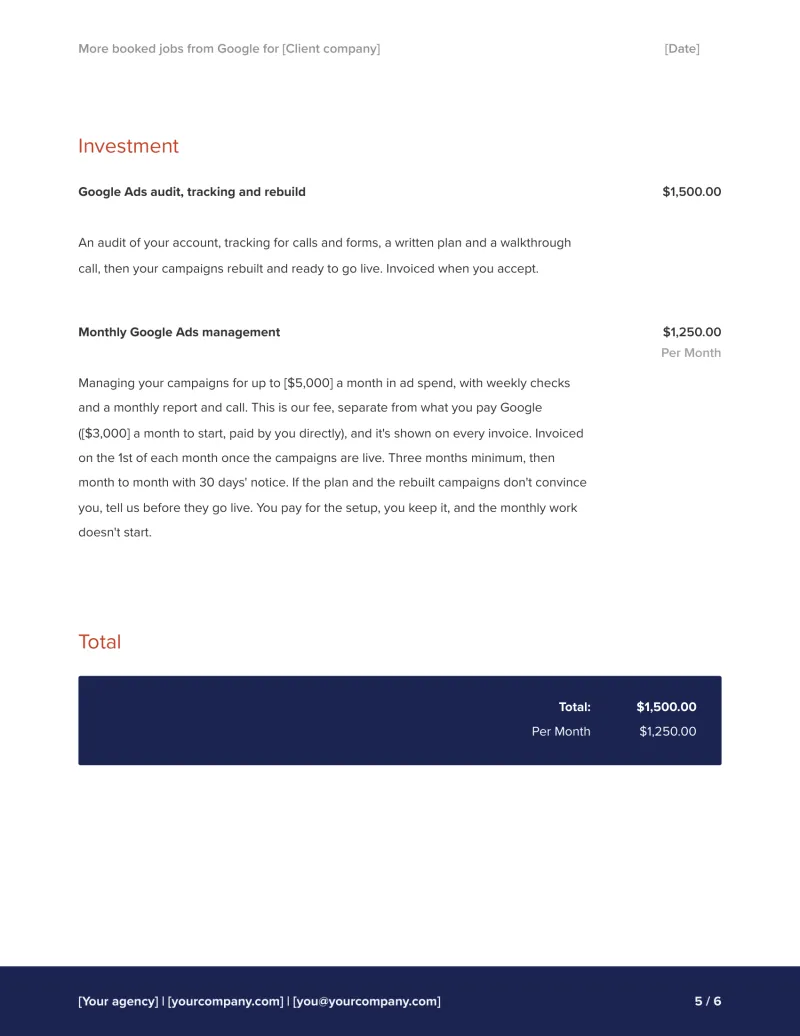
Google Ads audit, tracking and rebuild
$1,500
An audit of your account, tracking for calls and forms, a written plan and a walkthrough call, then your campaigns rebuilt and ready to go live. Invoiced when you accept.
Monthly Google Ads management
$1,250 a month
Managing your campaigns for up to [$5,000] a month in ad spend, with weekly checks and a monthly report and call. This is our fee, separate from what you pay Google ([$3,000] a month to start, paid by you directly), and it's shown on every invoice. Invoiced on the 1st of each month once the campaigns are live. Three months minimum, then month to month with 30 days' notice. If the plan and the rebuilt campaigns don't convince you, tell us before they go live. You pay for the setup, you keep it, and the monthly work doesn't start.
Total: $1,500then $1,250 a month
In Nusii, proposals with a recurring fee were accepted less often than one-off ones (39% against 55% for the same senders, July to September 2026). A monthly fee is a bigger decision. The setup gives the client a first step with a clear end.
7. Next steps
Tells the client exactly what to do to say yes, what happens after, and when you'll call.
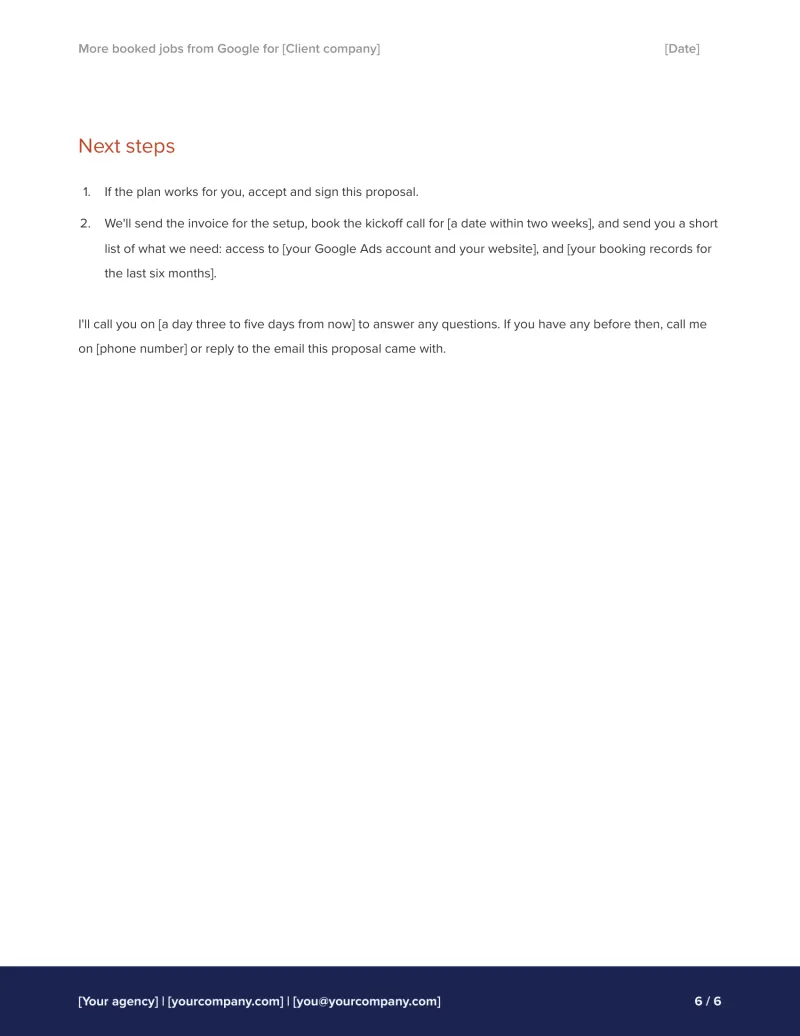
If the plan works for you, accept and sign this proposal.
We'll send the invoice for the setup, book the kickoff call for [a date within two weeks], and send you a short list of what we need: access to [your Google Ads account and your website], and [your booking records for the last six months].
I'll call you on [a day three to five days from now] to answer any questions. If you have any before then, call me on [phone number] or reply to the email this proposal came with.
Accepted proposals in Nusii that mention PPC or Google Ads got their yes in a median of 3.7 days, and 65% of them within a week (November 2025 to October 2026). A call three to five days after you send it lands while most clients are still deciding.
See it as your client will
Every page of the PDF, printed by Nusii. Sent as a link, it's one scrolling page on any device: your client accepts with one button and signs with their name.
The template in Nusii, the way your client will see it. It opens in a new tab.
Who pays Google, and whose account it is
A PPC proposal has two prices in it: your fee and the ad budget. Most PPC templates only have the first. Put both in writing, and say whose account it is. Google's rules for anyone managing ads for a client cover part of this:
Your fee. “Inform new customers in writing before each first purchase and disclose the fee on all customer invoices.”
In the template: the monthly line item
The ad costs. Where a monthly report is required, “report the exact amount charged by Google, exclusive of any fees that you charge”, or let the client sign in and see it.
In the template: Reporting, under How we’ll work
One account per client. “You use a separate account for each end-advertiser.”
In the template: What you keep
No promised positions. “It’s not possible to guarantee a specific ad position.”
What PPC management costs, from the pages we could check at the source. The template's example prices, $1,500 to set up and $1,250 a month, sit between one agency's published plans and another's starting point for agencies. In Nusii, about 80% of proposals that mention PPC or Google Ads had a recurring fee, and the accepted ones had a median one-time value of $2,000, monthly fees left out (313 proposals, November 2025 to October 2026). The ad budget is separate. At WordStream's 2026 average of $90.92 a lead for home services, $500 a month buys about five leads and $3,000 about 33.
What
Price
Source
Management, up to $5,000 a month in ad spend
$750 a monthone large agency's list price, after a first month of $1,200 with an auditWebFX
Sources: WebFX, an agency's published plans and pricing guide, 2026; ClicksGeek, an agency's pricing guide; ForwardFirst Media, an agency's published packages; Nutshell, a CRM vendor's guide; WordStream, 2026 benchmarks from US search campaigns run April 2025 to March 2026. WebFX, ClicksGeek and ForwardFirst Media sell PPC management, Nutshell sells a CRM and WordStream sells advertising software, so treat these as sellers' figures. We didn't find an independent survey of what PPC managers charge.
How often proposals got a yes, by price
Proposals over $15,000 got a yes about a third of the time. Agencies' accepted proposals had a median value of $4,000. From 1,713 proposals first sent with Nusii, July to September 2026.
Under $1,000
67.1%
$1,000 to $5,000
50.6%
$5,000 to $15,000
48.9%
$15,000 to $50,000
36.1%
Over $50,000
33.3%
Share accepted, by the total the client saw. Bigger proposals are bigger decisions, so this shows what happened, not that a lower price would win. Method: The State of Proposals 2026.
What happens after you send it
From 1,352 proposals first sent with Nusii from November 2025 to October 2026 that mention PPC or Google Ads (many cover more than PPC).
50.0%
were accepted
1.1 hours
median time to the client's first look
3.7 days
median time to a yes
64.9%
of the yeses came within a week
Clients rarely say no. Of all proposals sent with Nusii from July to September 2026, 6.4% were rejected and 45.4% got no answer either way. Silence is the usual no, so a follow-up is worth sending.
Follow up after a week. Most yeses come within seven days. In Nusii you see when the proposal was opened and get an email when it's accepted, so you can follow up when they've read it, not when you guess they have.
The same template as a Word file you can edit (it opens in Google Docs too) and a PDF printed by Nusii. We'll email you both, plus a few emails with proposal tips. Unsubscribe any time.
Or send it with Nusii
This template is in the gallery of every Nusii account. Send it as a link: you get an email when your client opens it, and they accept and sign online, on any device.
“Have been using Nusii for years for all our marketing proposals. It’s well structured, easy to use and delivers a very professional impression to our prospects and clients. Service is excellent too. Highly recommend.”
Annette Welsford
Founder & CEO, Commonsense Marketing
“I’ve built a library of reusable sections and proposal templates, so I can pull together a tailored proposal without starting from scratch every time.”
A document that tells a prospective client how you’ll run their paid search ads, what it costs and how to start. It usually covers their goals, the campaigns you’ll build, what’s included and what isn’t, your fee, the ad budget, and how you’ll report results.
What should a PPC proposal include?
What the client told you and the goals that follow from it, your plan, short proof from similar clients, what’s included and what isn’t, who pays Google, your fee, and the next steps. That’s seven sections, the same as the template on this page.
Is a PPC proposal the same as a Google Ads or SEM proposal?
In practice, yes. PPC (pay per click) is how the ads are paid for, Google Ads is the biggest place to run them, and SEM (search engine marketing) usually means paid search. AdWords is Google Ads’ old name. This template is written for Google Ads and works for Microsoft Advertising with one change, marked in brackets.
How much should I charge for PPC management?
Many agencies charge a setup fee, then a monthly fee. WebFX publishes $750 a month for up to $5,000 in ad spend, and ClicksGeek puts agencies at $1,500 a month and up. This template uses $1,500 to set up and $1,250 a month as example prices. Raise both for more campaigns or a harder market.
Should I charge a flat fee or a percentage of ad spend?
A flat fee is easier for a client to understand, and a percentage grows with the work on big accounts. This template uses a flat fee up to a spending limit. If you add a percentage above that limit, 15% is what both WebFX and ForwardFirst Media publish.
Should the ad budget be in a PPC proposal?
Yes, in writing, and kept apart from your fee. The client sees two separate costs: what they pay you and what they pay Google. The template names a monthly budget, says the client pays Google directly, and leaves it out of the total.
Who owns the Google Ads account?
Your client should, and the proposal should say so. The template keeps the account in the client’s name. You link it to your manager account, so you can run it without their password. Google requires a separate account for each advertiser you manage.
What results can I promise in a PPC proposal?
Promise the work and measure the result, but don’t guarantee a position or a number of leads. Google says “It’s not possible to guarantee a specific ad position”, and its policy tells partners to avoid unrealistic claims. Set a goal in your client’s numbers, such as the cost of a booked job, and report on it every month.
How long before PPC results show?
Calls can start within days of going live, but the numbers take longer to settle. Google says its Smart Bidding typically settles within one to two conversion cycles, the time from a click to a sale or lead. That’s why the template judges the cost of a booked job from month three.
Is $500 a month enough for Google Ads?
It depends on what a lead costs in that trade, but it’s usually too little to learn from. At WordStream’s 2026 average of $66.69 a lead, $500 buys about seven leads a month, and about five in home services. WebFX recommends $1,000 to $3,000 a month for a campaign that gathers meaningful data.
Can I use this template for B2B clients or Microsoft Advertising?
Yes. Swap “booked jobs” for “qualified leads” throughout, and change the title to match, such as “More qualified leads from Google”. To run ads on Bing too, add Microsoft Advertising to what’s included and to the monthly fee. There’s a line in brackets to remind you.
Can I use this template as a freelance PPC manager?
Yes. Write “I” instead of “we”, describe yourself in the introduction, and set the number of campaigns to what you can run on your own. Everything else, from the goals to the way out after the setup, works the same.
Should I offer several packages?
Offer them only if the client asked about choices. In Nusii, proposals where the client could choose between options were accepted less often (40% against 51% for the same senders, July to September 2026). This template has one clear price; add an optional section for an extra the client asked about.
Do I need a contract as well?
Attach your own agreement if you use one. This template covers the scope, the price, who owns what and how to end the work in plain words, and it isn’t legal advice.
Is there a PPC proposal example in PDF or Word?
Yes. The whole template is on this page, and you can get it as a Word file and a PDF by email for free. The prices and bracketed examples are there to be replaced.
Can my client accept and sign the proposal online?
Yes, if you send it as an online proposal. In Nusii, your client opens a link, accepts with one button and signs with their typed name, on any device, and you get an email when they do. The Word file and the PDF need signing the old way.