

Proposal template

Copywriting proposal template

A copywriting proposal in seven sections, from what your client told you to customer research, a messaging guide, six website pages, the price and the next steps. For copywriters and agencies. Read it here or get it as a Word file and a PDF.

Michael Koper
By Michael Koper, founder of Nusii Updated
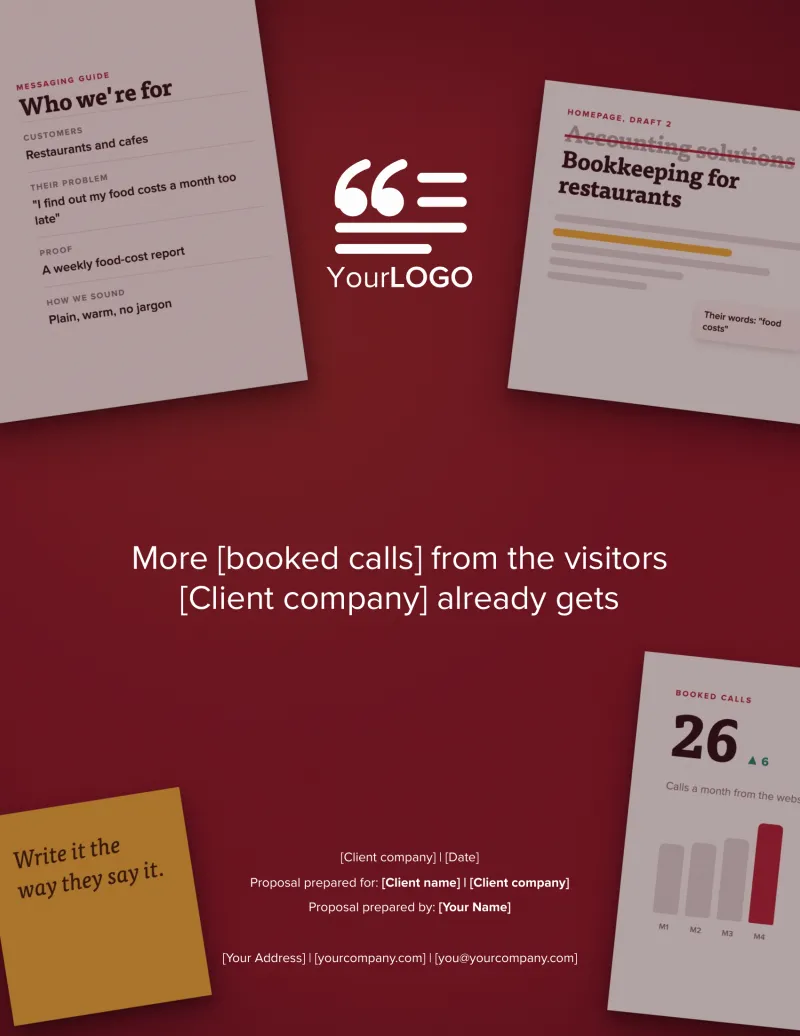
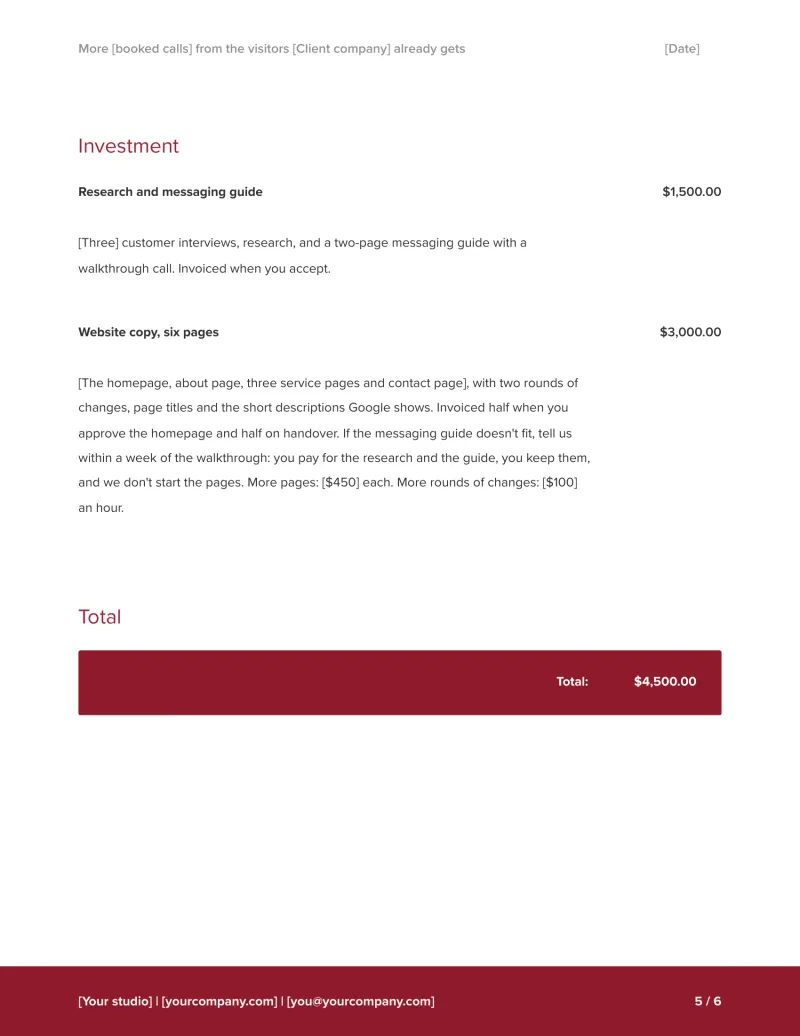
The copywriting proposal template: the cover and the investment page with $1,500 for research and a messaging guide and $3,000 for six website pages
Get the Word + PDF
On this page
  1. What to include
  2. The template
  3. A filled-in example
  4. See it as your client will
  5. What to charge
  6. The email to send
  7. After you send it
  8. Word and PDF
  9. Questions

What should a copywriting proposal include?

A copywriting proposal should say what the client told you, the result you'll both measure (booked calls or sales, not word counts), how you'll work from research to the final pages, what's included and what isn't, who owns the copy, the price, and exactly how to say yes. The template below has a section for each.

  1. 1 Introduction
  2. 2 What we heard
  3. 3 How we'll work
  4. 4 Results for businesses like yours
  5. 5 What's included
  6. 6 Investment
  7. 7 Next steps

The copywriting proposal template, section by section

Copy one section or the whole thing. Under each section: what it's for, and one thing we've learned from the proposals sent with Nusii.

[Yellow] you write [Green] Nusii fills in when you send it

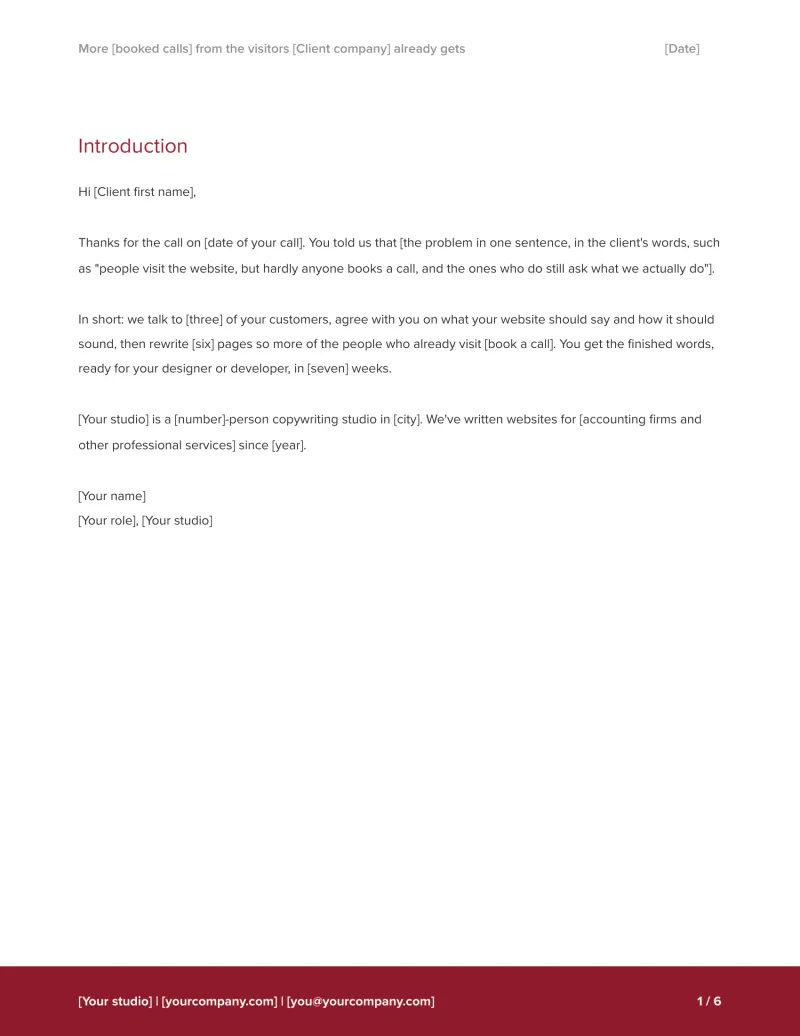
1. Introduction

The whole plan in two sentences, and who you are. Partners and colleagues read it too, often without having been on the call. Working on your own? Write "I" instead of "we".

Hi [Client first name],

Thanks for the call on [date of your call]. You told us that [the problem in one sentence, in the client's words, such as "people visit the website, but hardly anyone books a call, and the ones who do still ask what we actually do"].

In short: we talk to [three] of your customers, agree with you on what your website should say and how it should sound, then rewrite [six] pages so more of the people who already visit [book a call]. You get the finished words, ready for your designer or developer, in [seven] weeks.

[Your studio] is a [number]-person copywriting studio in [city]. We've written websites for [accounting firms and other professional services] since [year].

[Your name]
[Your role], [Your studio]

Proposals that mention copywriting got their first look in Nusii in a median of 48 minutes (872 proposals, November 2025 to October 2026), and about a third of first views are on a phone. Two short paragraphs are all most clients read before they decide whether to keep going.
2. What we heard

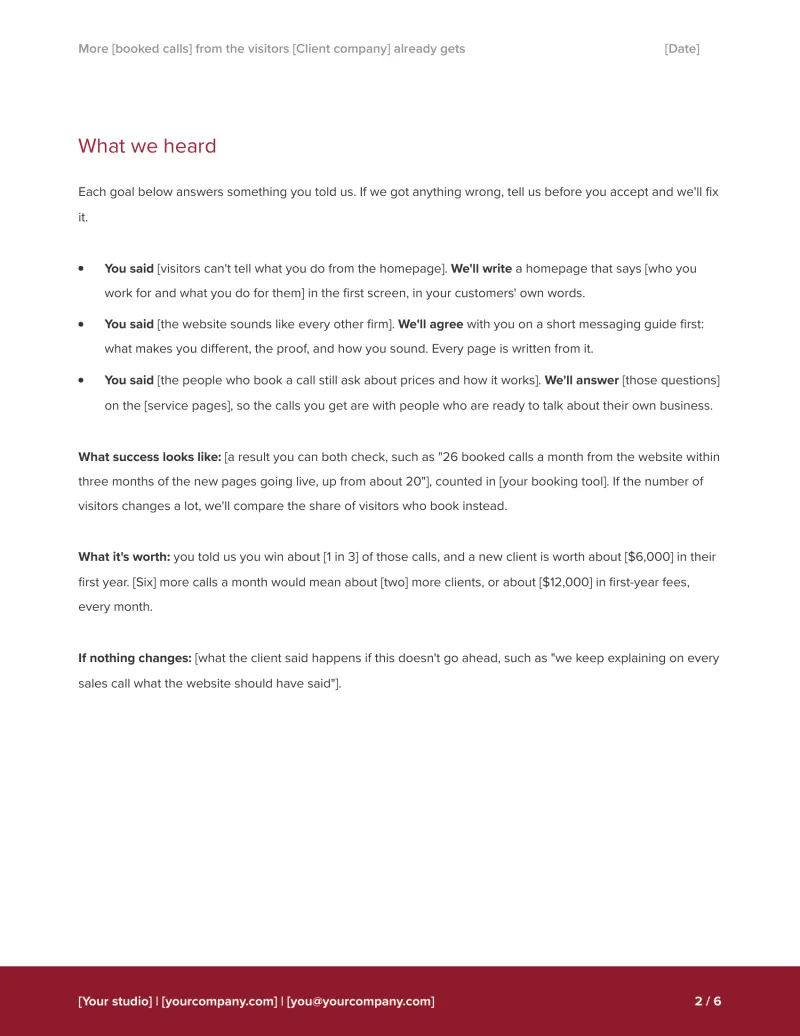
Shows you listened, turns what the client told you into goals you can both check later, and puts a number on what better words are worth. Only you can write this one: replace the examples with your client's words.

Each goal below answers something you told us. If we got anything wrong, tell us before you accept and we'll fix it.

  • You said [visitors can't tell what you do from the homepage]. We'll write a homepage that says [who you work for and what you do for them] in the first screen, in your customers' own words.
  • You said [the website sounds like every other firm]. We'll agree with you on a short messaging guide first: what makes you different, the proof, and how you sound. Every page is written from it.
  • You said [the people who book a call still ask about prices and how it works]. We'll answer [those questions] on the [service pages], so the calls you get are with people who are ready to talk about their own business.

What success looks like: [a result you can both check, such as "26 booked calls a month from the website within three months of the new pages going live, up from about 20"], counted in [your booking tool]. If the number of visitors changes a lot, we'll compare the share of visitors who book instead.

What it's worth: you told us you win about [1 in 3] of those calls, and a new client is worth about [$6,000] in their first year. [Six] more calls a month would mean about [two] more clients, or about [$12,000] in first-year fees, every month.

If nothing changes: [what the client said happens if this doesn't go ahead, such as "we keep explaining on every sales call what the website should have said"].

Our 2015 book on proposals put it bluntly: "an eloquent piece of well meaning copy is unlikely to fulfil the business needs of your client." Ask four numbers on the call (visitors a month, booked calls, how many calls they win, what a client is worth) so "What success looks like" is a business result, not a matter of taste.

3. How we'll work

The plan step by step, so the client knows what happens first, what they approve, and when to expect results.

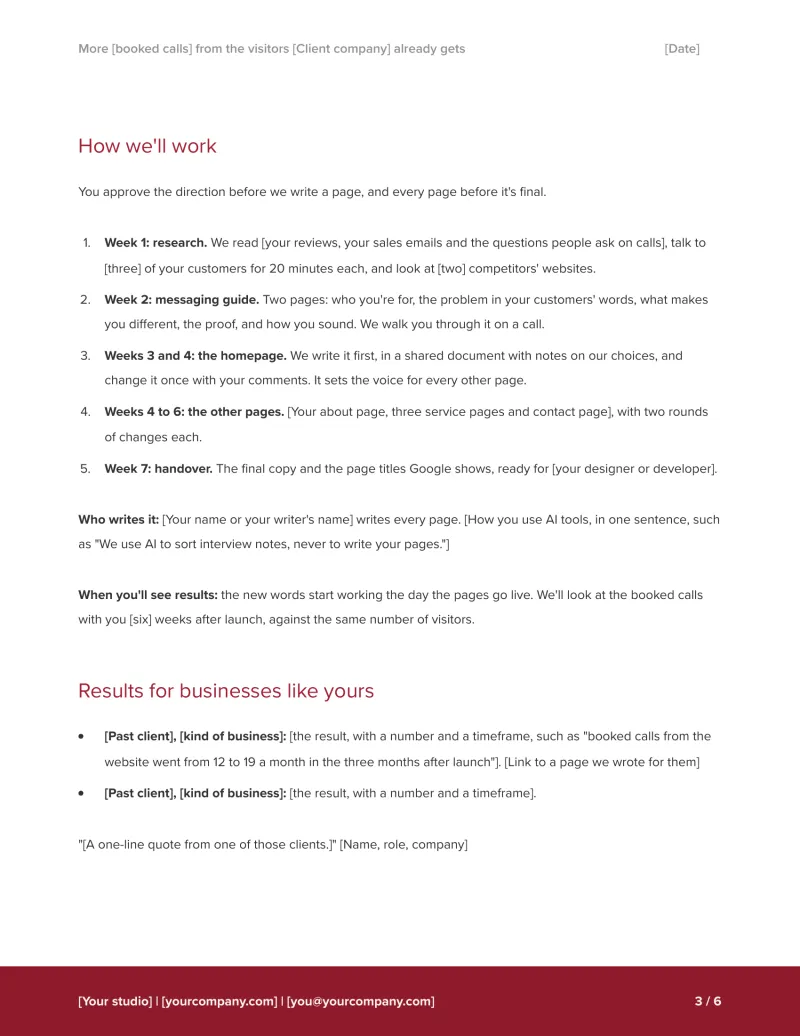
You approve the direction before we write a page, and every page before it's final.

  1. Week 1: research. We read [your reviews, your sales emails and the questions people ask on calls], talk to [three] of your customers for 20 minutes each, and look at [two] competitors' websites.
  2. Week 2: messaging guide. Two pages: who you're for, the problem in your customers' words, what makes you different, the proof, and how you sound. We walk you through it on a call.
  3. Weeks 3 and 4: the homepage. We write it first, in a shared document with notes on our choices, and change it once with your comments. It sets the voice for every other page.
  4. Weeks 4 to 6: the other pages. [Your about page, three service pages and contact page], with two rounds of changes each.
  5. Week 7: handover. The final copy and the page titles Google shows, ready for [your designer or developer].

Who writes it: [Your name or your writer's name] writes every page. [How you use AI tools, in one sentence, such as "We use AI to sort interview notes, never to write your pages."]

When you'll see results: the new words start working the day the pages go live. We'll look at the booked calls with you [six] weeks after launch, against the same number of visitors.

74% of copywriters now use generative AI, and 35% say a client, colleague or employer makes them use it (ProCopywriters' 2026 survey of 573 copywriters, UK). Your client has read the same headlines. One plain sentence on how you use it answers the question before it turns into a doubt.

4. Results for businesses like yours

Short proof for the people who weren't on the call: what happened for businesses like this one. Copy is something they can read, so link to a page you wrote. Use real numbers from a real client, or leave this section out.

  • [Past client], [kind of business]: [the result, with a number and a timeframe, such as "booked calls from the website went from 12 to 19 a month in the three months after launch"]. [Link to a page we wrote for them]
  • [Past client], [kind of business]: [the result, with a number and a timeframe].

"[A one-line quote from one of those clients.]" [Name, role, company]

Proposals to a client who had accepted one before were accepted 63% of the time in Nusii, against 46% for a first proposal from the same senders (July to September 2026). A new client hasn't seen your work yet: one result and one live page do more here than a list of everything you've written.

5. What's included

Draws the line between what you'll write and what you won't, says what you need from the client, and who owns the words.

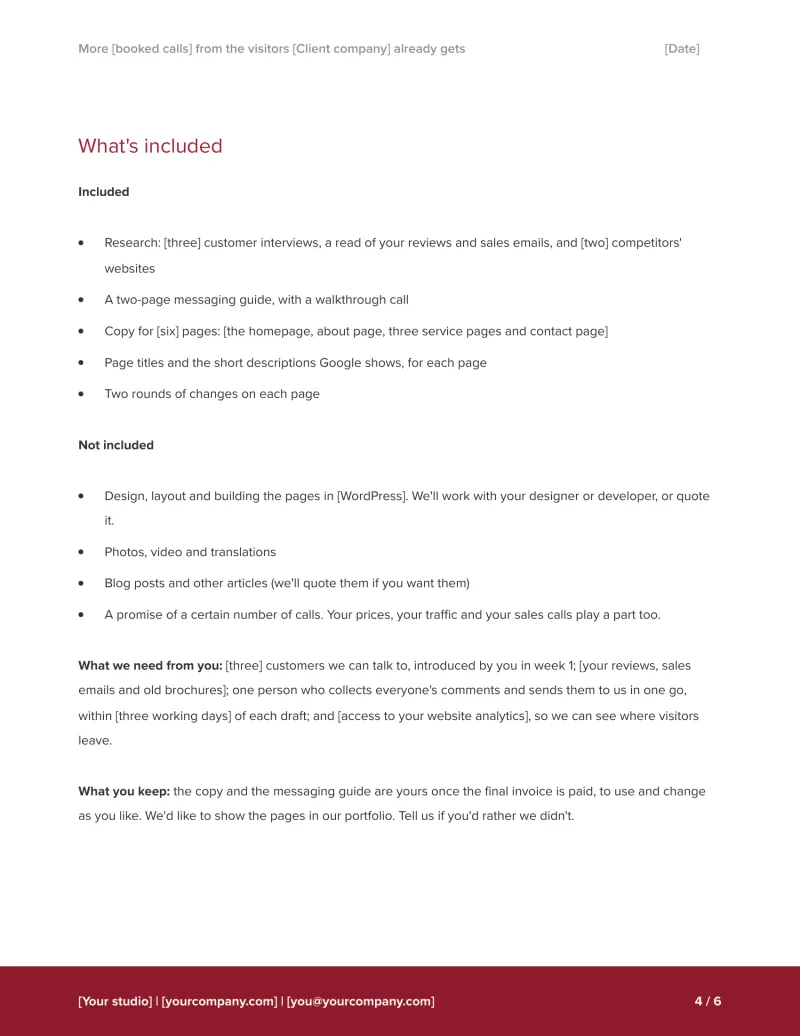
Included

  • Research: [three] customer interviews, a read of your reviews and sales emails, and [two] competitors' websites
  • A two-page messaging guide, with a walkthrough call
  • Copy for [six] pages: [the homepage, about page, three service pages and contact page]
  • Page titles and the short descriptions Google shows, for each page
  • Two rounds of changes on each page

Not included

  • Design, layout and building the pages in [WordPress]. We'll work with your designer or developer, or quote it.
  • Photos, video and translations
  • Blog posts and other articles (we'll quote them if you want them)
  • A promise of a certain number of calls. Your prices, your traffic and your sales calls play a part too.

What we need from you: [three] customers we can talk to, introduced by you in week 1; [your reviews, sales emails and old brochures]; one person who collects everyone's comments and sends them to us in one go, within [three working days] of each draft; and [access to your website analytics], so we can see where visitors leave.

What you keep: the copy and the messaging guide are yours once the final invoice is paid, to use and change as you like. We'd like to show the pages in our portfolio. Tell us if you'd rather we didn't.

Under US law, the person who writes the words is ordinarily their author, and a client only becomes the author of commissioned work in nine narrow cases, with a written agreement signed by both (U.S. Copyright Office, Circular 30, revised August 2024). Clients ask who owns the copy. "What you keep" answers it in writing.

6. Investment

One project in two parts, each with when it's invoiced, and a way out after the messaging guide. These are example prices; the table further down shows what others charge.

Research and messaging guide

$1,500

[Three] customer interviews, research, and a two-page messaging guide with a walkthrough call. Invoiced when you accept.

Website copy, six pages

$3,000

[The homepage, about page, three service pages and contact page], with two rounds of changes, page titles and the short descriptions Google shows. Invoiced half when you approve the homepage and half on handover. If the messaging guide doesn't fit, tell us within a week of the walkthrough: you pay for the research and the guide, you keep them, and we don't start the pages. More pages: [$450] each. More rounds of changes: [$100] an hour.

Total: $4,500

In Nusii, proposals with a recurring fee were accepted less often than one-off ones (39.5% against 54.5% for the same senders, July to September 2026). This template keeps it to one project with a clear end, and the messaging guide is a first step the client can stop after. Want monthly writing? The content marketing template is built for it.

7. Next steps

Tells the client exactly what to do to say yes, what happens after, and when you'll call.

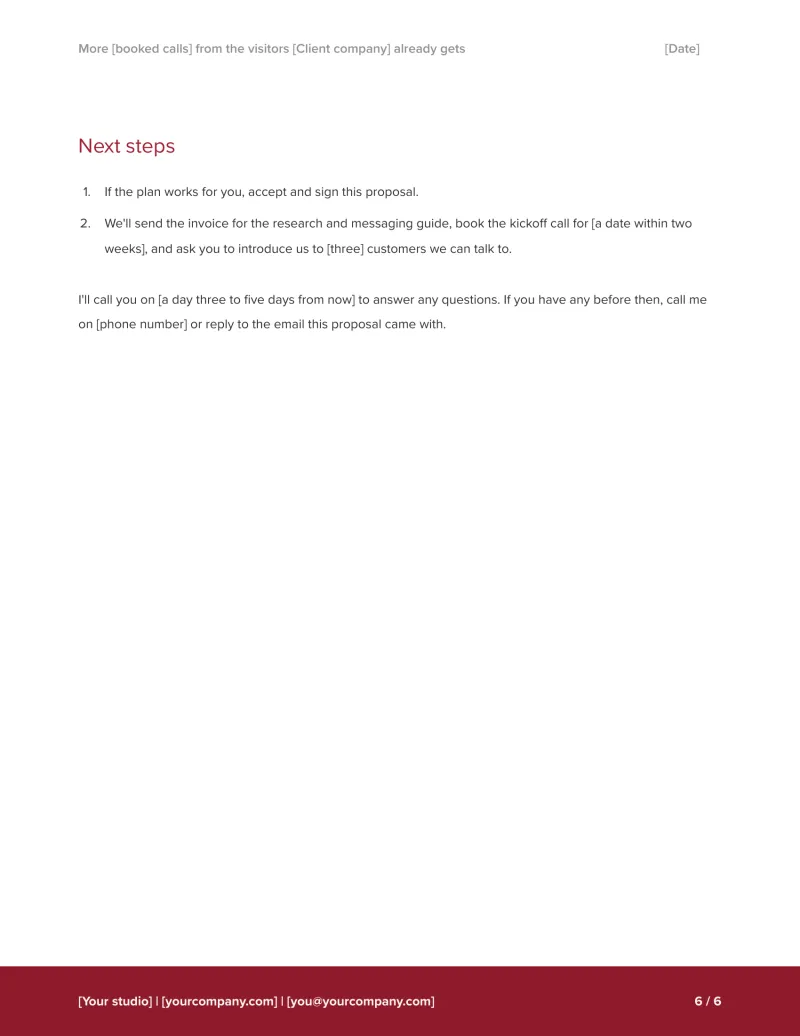
  1. If the plan works for you, accept and sign this proposal.
  2. We'll send the invoice for the research and messaging guide, book the kickoff call for [a date within two weeks], and ask you to introduce us to [three] customers we can talk to.

I'll call you on [a day three to five days from now] to answer any questions. If you have any before then, call me on [phone number] or reply to the email this proposal came with.

Accepted proposals that mention copywriting got their yes in a median of 4 days in Nusii, and 63% of them within a week (November 2025 to October 2026). A call three to five days after you send it lands while most clients are still deciding.

A copywriting proposal example, filled in

Two sections of the template above with a client's words in the brackets, so you can see how it reads when it's done. Ledger & Ladle, a bookkeeping firm for restaurants and cafes, is made up, and so are its numbers.

More booked calls from the visitors Ledger & Ladle already gets

What we heard

  • You said visitors can't tell from the homepage that you only work with restaurants. We'll write a homepage that says who you work for (restaurants and cafes) and what you do for them (the books, payroll and a weekly food-cost report) in the first screen, in your customers' own words.
  • You said the website sounds like every other accounting firm. We'll agree with you on a short messaging guide first: what makes you different, the proof, and how you sound. Every page is written from it.
  • You said the people who book a call still ask about prices and how the switch from their old bookkeeper works. We'll answer those questions on the three service pages, so the calls you get are with owners who are ready to talk about their own restaurant.

What success looks like: 26 booked calls a month from the website within three months of the new pages going live, up from about 20, counted in your booking calendar.

What it's worth: you told us you win about 1 in 3 of those calls, and a new client is worth about $6,000 in their first year. Six more calls a month would mean about two more clients, or about $12,000 in first-year fees, every month.

If nothing changes: you keep explaining on every sales call what the website should have said.

Investment

Research and messaging guide

$1,500

Website copy, six pages

$3,000

Total: $4,500

See it as your client will

Every page of the PDF, printed by Nusii. Sent as a link, it's one scrolling page on any device: your client accepts with one button and signs with their name.

Open the live preview

The template in Nusii, the way your client will see it. It opens in a new tab.

What to charge for copywriting

What website copy costs, from the sources we could check. The template's example price, $4,500 for research, a messaging guide and six pages, puts the six pages at $500 each, inside AWAI's range for writing a small website. In Nusii, accepted proposals that mention copywriting had a median value of $3,500, monthly fees left out (286 proposals, November 2025 to October 2026).

What Price
Writing a small website, 5 to 6 pages $1,500 to $3,500 a project price, from AWAI's guide for web copywriters AWAI
Homepage copy $450 to $4,500 one page, the same guide AWAI
Sales page $450 to $10,000 $450 to $1,000 for one page, up to $10,000 for 6 to 20 pages AWAI
Website page copy in the UK £200 to £600 a page £1,000 to £5,000 for a full site of 5 to 10 pages Whito
Freelance copywriter day rate in the UK £440 a day the median, from a survey of 573 copywriters ProCopywriters

Sources: AWAI, Pricing Guide for Web Copywriters, read in November 2026; ProCopywriters, Copywriter Survey 2026, 573 respondents; Whito, UK copywriting costs, compiled from other sources, 2026. AWAI trains copywriters and Whito sells content writing. ProCopywriters' survey is the only one with its own sample, and it gives a day rate rather than a project price.

How often proposals got a yes, by price

Proposals over $15,000 got a yes about a third of the time. Accepted proposals that mention copywriting had a median one-time value of $3,500 (286 proposals, November 2025 to October 2026). From 1,713 proposals first sent with Nusii, July to September 2026.

Under $1,000
67.1%
$1,000 to $5,000
50.7%
$5,000 to $15,000
48.9%
$15,000 to $50,000
36.1%
Over $50,000
33.3%

Share accepted, by the total the client saw. Bigger proposals are bigger decisions, so this shows what happened, not that a lower price would win. Method: The State of Proposals 2026.

The email to send it with

The proposal does the explaining, so the email only has to get it opened and say when you'll call. Leave the price out, so your client reads the plan before they judge the number. In Nusii this goes in the Send Proposal window, and you can save it as your template for next time.

Subject: [The plan for your new website copy]

Hi [first name],

Here's the proposal we talked about on [day of your call]: [link].

In short: we talk to [three] of your customers, agree on what your website should say, then rewrite [six] pages.

It's short, and you can accept it right on the page. If anything's off, reply to this email and I'll change it.

I'll call you on [a day three to five days from now] to answer any questions.

[Your name]

What happens after you send it

From 872 proposals first sent with Nusii from November 2025 to October 2026 that mention copywriting (most cover more than copy).

43.5%
were accepted
48 minutes
median time to the client's first look
4 days
median time to a yes
63.1%
of the yeses came within a week

Clients rarely say no. Of all proposals sent with Nusii from July to September 2026, 6.5% were rejected and 45.2% got no answer either way. Silence is the usual no, so a follow-up is worth sending.

Follow up after a week. Most yeses come within seven days. In Nusii you see when the proposal was opened and get an email when it's accepted, so you can follow up when they've read it, not when you guess they have.

More numbers and the method: The State of Proposals 2026.

Get the Word and PDF files

The same template as a Word file you can edit (it opens in Google Docs too) and a PDF printed by Nusii. We'll email you both, plus a few emails with proposal tips. Unsubscribe any time.

Or send it with Nusii

This template is in the gallery of every Nusii account. Send it as a link: you get an email when your client opens it, and they accept and sign online, on any device.

I can put together a polished proposal quickly without fighting the software, and my clients can review and sign it electronically, which makes it easier for them to say yes and get started.

Janelle Hardin
Janelle Hardin
Founder, Dingo Integrated Marketing

Have been using Nusii for years for all our marketing proposals. It’s well structured, easy to use and delivers a very professional impression to our prospects and clients. Service is excellent too. Highly recommend.

Annette Welsford
Annette Welsford
Founder & CEO, Commonsense Marketing
Start your free trial

14-day trial · 60-day money-back guarantee

Questions about copywriting proposals

What is a copywriting proposal?

A document that tells a prospective client what you’ll write for them, what it will do for their business, what it costs and how to start. It usually covers their goals, your process, what’s included and what isn’t, who owns the copy, the price and the next steps.

What should a copywriting proposal include?

What the client told you and the goals that follow from it, how you’ll work, short proof from similar clients, what’s included and what isn’t, the price, and the next steps. That’s seven sections, the same as the template on this page.

How much should I charge for website copy?

AWAI’s guide for web copywriters puts a small website of 5 to 6 pages at $1,500 to $3,500 and a homepage alone at $450 to $4,500. This template uses $1,500 for research and a messaging guide and $3,000 for six pages as example prices. Raise them for a bigger site, a harder subject or a client with more at stake.

Should I price copywriting per page, per word or per project?

Per project, with a price for each extra page, is the simplest for both sides: the client knows the total and you know the scope. Per-word pricing makes a short, sharp page cost less than a long one, which isn’t what most clients are paying for. The template gives one project price and names the price of an extra page and an extra round of changes.

How many rounds of changes should I include?

Two rounds on each page is common, and it’s what this template uses. Say in the proposal what a further round costs, so a third round is the client’s choice and not a surprise. Asking for one person to collect everyone’s comments keeps each round to one set of changes.

Who owns the copy when the project is done?

Say it in the proposal, because the default may not be what your client expects. Under US law the writer is ordinarily the author of what they write, and commissioned copy only belongs to the client from the start in narrow cases with a signed agreement. This template hands the copy to the client once the final invoice is paid. It isn’t legal advice.

Should I tell clients whether I use AI?

Yes, in one plain sentence. In ProCopywriters’ 2026 survey, 74% of copywriters said they use generative AI, and your client will wonder. The template has a “Who writes it” line where you say who writes the pages and what AI does, if anything.

What’s the difference between a copywriting brief and a proposal?

The brief is the client telling you what they need; the proposal is your answer, with the plan, the price and how to say yes. Use the brief and your call to fill in “What we heard”, in the client’s own words.

Can I use this template as a freelance copywriter or writer?

Yes. Write “I” instead of “we”, describe yourself in the introduction, and set the number of pages and weeks to what you can deliver on your own. For blog posts and articles every month, the content marketing proposal template fits better.

Should I offer several packages?

Offer them only if the client asked about choices. In Nusii, proposals where the client could choose between options were accepted less often (40% against 51% for the same senders, July to September 2026). This template has one clear price, with the price of extra pages in the line item.

What should I write in the email that goes with the proposal?

A few lines: a link to the proposal, the plan in one sentence and the day you’ll call. Leave the price out, so your client reads the plan before judging the number. There’s an email to copy further up this page.

Can my client accept and sign the proposal online?

Yes, if you send it as an online proposal. In Nusii, your client opens a link, accepts with one button and signs with their typed name, on any device, and you get an email when they do. The Word file and the PDF need signing the old way.

More templates and guides

Send your next copywriting proposal as a link, and see when it's opened

Try Nusii free for 14 days

Cancel anytime · 60-day money-back guarantee