

Proposal template

Influencer marketing proposal template

An influencer marketing proposal in seven sections, from what the brand told you to a creator shortlist, a six-week campaign, your fee with the creators' fees kept apart, and the next steps. For agencies pitching an influencer campaign to a brand. Read it here or get it as a Word file and a PDF.

Michael Koper
By Michael Koper, founder of Nusii Updated
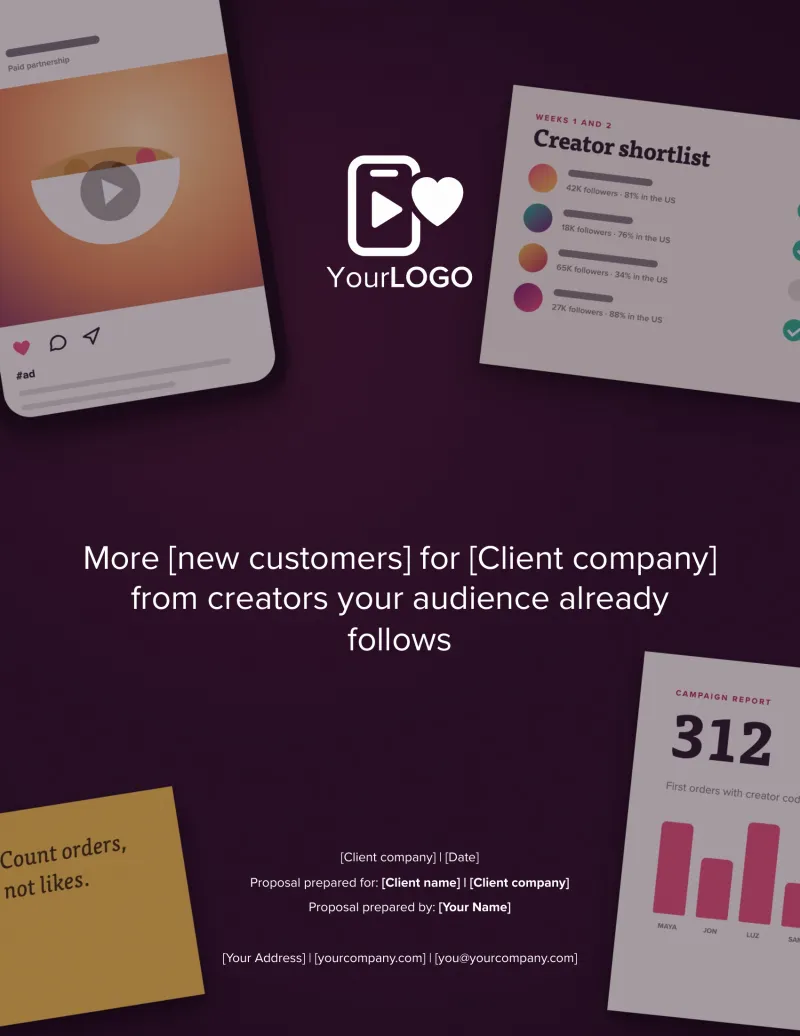
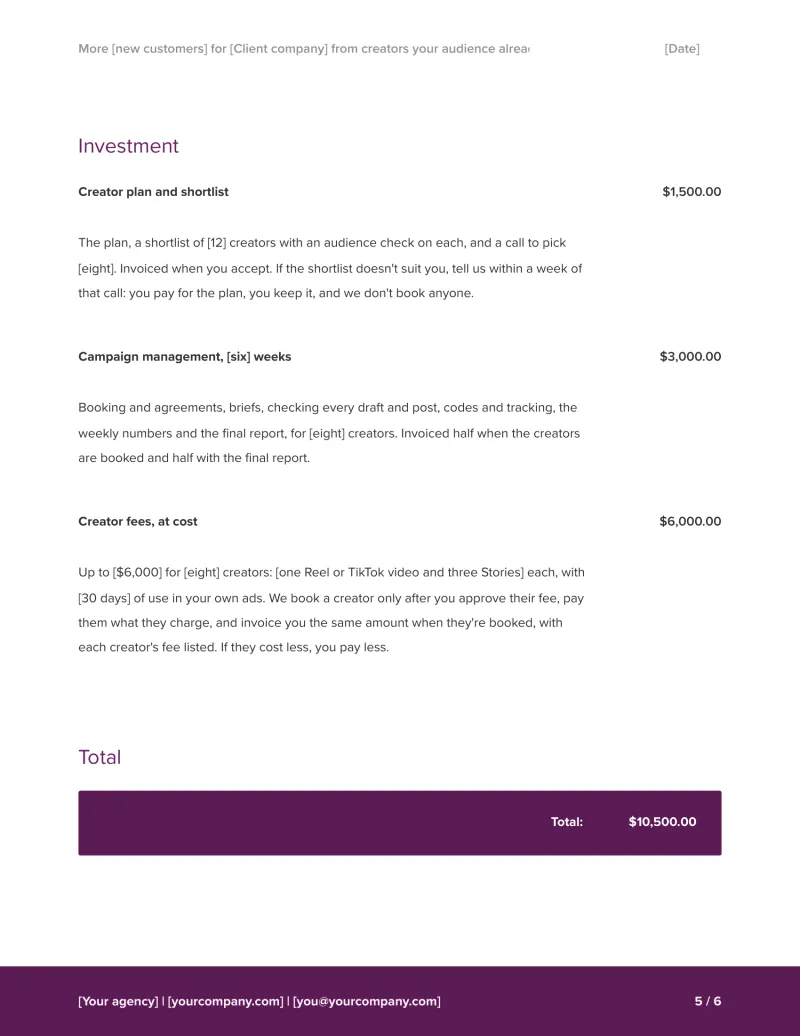
The influencer marketing proposal template: the cover and the investment page with $1,500 for the creator plan, $3,000 for campaign management and $6,000 of creator fees at cost
Get the Word + PDF
On this page
  1. What to include
  2. The template
  3. A filled-in example
  4. See it as your client will
  5. Labeled as ads
  6. What to charge
  7. The email to send
  8. After you send it
  9. Word and PDF
  10. Questions

What should an influencer marketing proposal include?

An influencer marketing proposal should say what the brand told you, the result you'll both measure (orders or sign-ups, not only views), how you'll pick, brief and approve the creators, how the posts are labeled as ads, what's included and what isn't, your fee and the creators' fees kept apart, and exactly how to say yes. The template below has a section for each.

  1. 1 Introduction
  2. 2 What we heard
  3. 3 How we'll work
  4. 4 Results for businesses like yours
  5. 5 What's included
  6. 6 Investment
  7. 7 Next steps

The influencer marketing proposal template, section by section

Copy one section or the whole thing. Under each section: what it's for, and one thing we've learned from the proposals sent with Nusii.

[Yellow] you write [Green] Nusii fills in when you send it

1. Introduction

The whole plan in two sentences, and who you are. The brand's founder or marketing lead often forwards it to someone who wasn't on the call. Working on your own? Write "I" instead of "we".

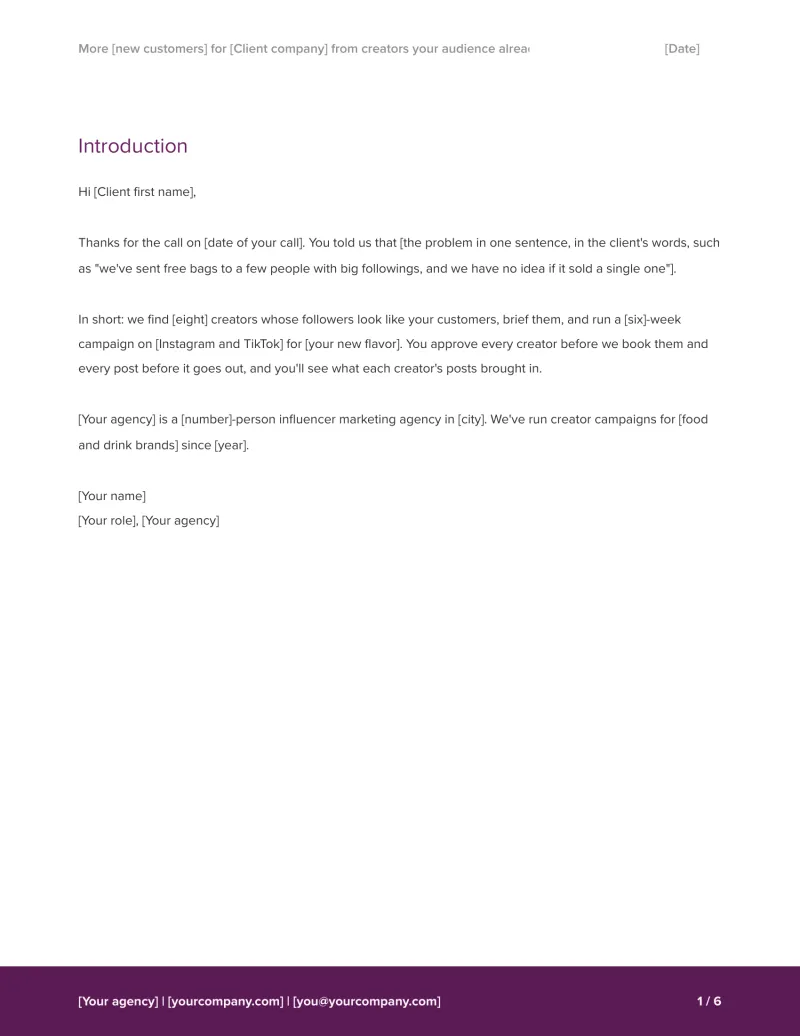
Hi [Client first name],

Thanks for the call on [date of your call]. You told us that [the problem in one sentence, in the client's words, such as "we've sent free bags to a few people with big followings, and we have no idea if it sold a single one"].

In short: we find [eight] creators whose followers look like your customers, brief them, and run a [six]-week campaign on [Instagram and TikTok] for [your new flavor]. You approve every creator before we book them and every post before it goes out, and you'll see what each creator's posts brought in.

[Your agency] is a [number]-person influencer marketing agency in [city]. We've run creator campaigns for [food and drink brands] since [year].

[Your name]
[Your role], [Your agency]

Agencies' proposals in Nusii got their first look in a median of 54 minutes (3,782 proposals, November 2025 to October 2026), and about a third of first views are on a phone. Two short paragraphs that make sense without the call are what most clients read before they decide whether to keep going.
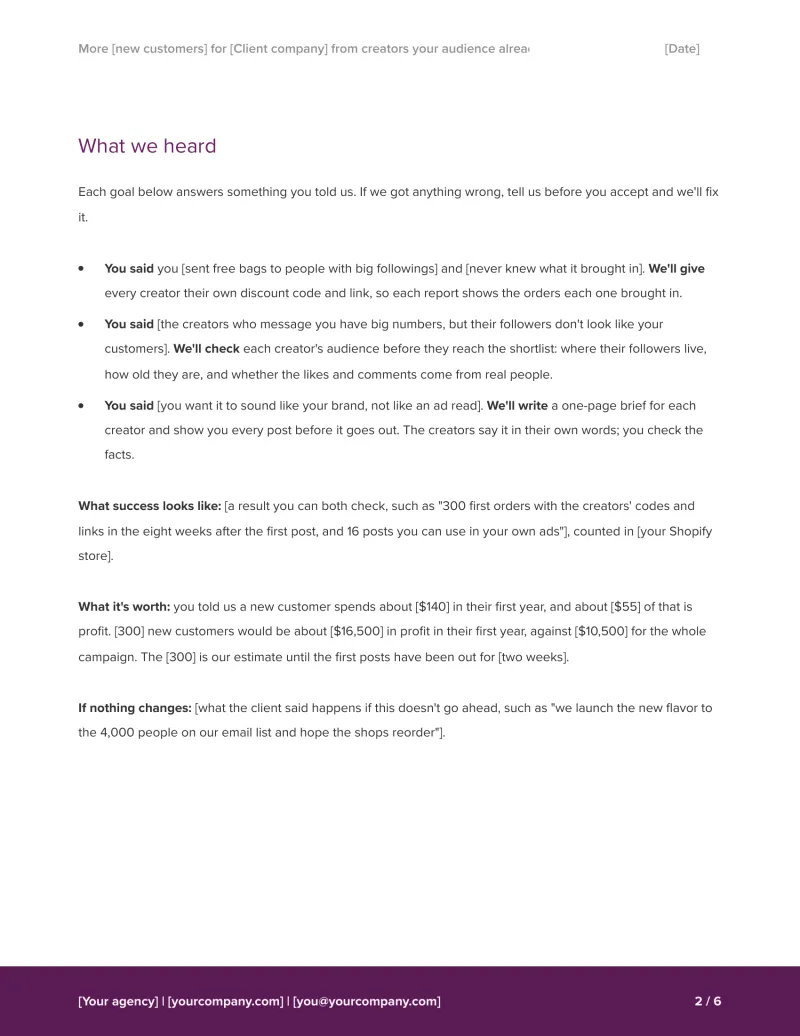
2. What we heard

Shows you listened, turns what the brand told you into goals you can both check later, and puts a number on what the campaign is worth to them. Only you can write this one: replace the examples with your client's words.

Each goal below answers something you told us. If we got anything wrong, tell us before you accept and we'll fix it.

  • You said you [sent free bags to people with big followings] and [never knew what it brought in]. We'll give every creator their own discount code and link, so each report shows the orders each one brought in.
  • You said [the creators who message you have big numbers, but their followers don't look like your customers]. We'll check each creator's audience before they reach the shortlist: where their followers live, how old they are, and whether the likes and comments come from real people.
  • You said [you want it to sound like your brand, not like an ad read]. We'll write a one-page brief for each creator and show you every post before it goes out. The creators say it in their own words; you check the facts.

What success looks like: [a result you can both check, such as "300 first orders with the creators' codes and links in the eight weeks after the first post, and 16 posts you can use in your own ads"], counted in [your Shopify store].

What it's worth: you told us a new customer spends about [$140] in their first year, and about [$55] of that is profit. [300] new customers would be about [$16,500] in profit in their first year, against [$10,500] for the whole campaign. The [300] is our estimate until the first posts have been out for [two weeks].

If nothing changes: [what the client said happens if this doesn't go ahead, such as "we launch the new flavor to the 4,000 people on our email list and hope the shops reorder"].

Ask for three numbers on the call: what a new customer spends in their first year, how much of that is profit, and how many first orders a normal month brings. Our 2015 book on proposals starts from exactly this kind of baseline ("We're currently spending $2,500 a month on advertising and in return we get 5 new signups"). With those numbers, "What it's worth" is the brand's own sum, not your promise.

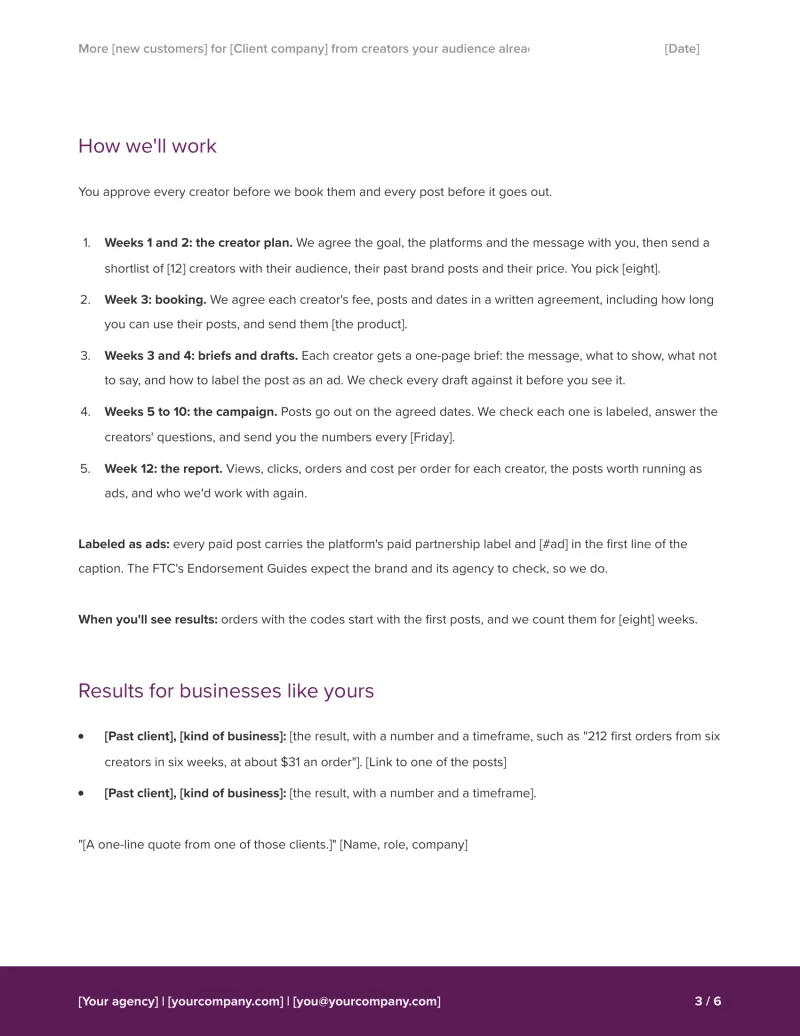
3. How we'll work

The campaign step by step: what the brand approves, when posts go out, how they're labeled as ads, and when the numbers come in.

You approve every creator before we book them and every post before it goes out.

  1. Weeks 1 and 2: the creator plan. We agree the goal, the platforms and the message with you, then send a shortlist of [12] creators with their audience, their past brand posts and their price. You pick [eight].
  2. Week 3: booking. We agree each creator's fee, posts and dates in a written agreement, including how long you can use their posts, and send them [the product].
  3. Weeks 3 and 4: briefs and drafts. Each creator gets a one-page brief: the message, what to show, what not to say, and how to label the post as an ad. We check every draft against it before you see it.
  4. Weeks 5 to 10: the campaign. Posts go out on the agreed dates. We check each one is labeled, answer the creators' questions, and send you the numbers every [Friday].
  5. Week 12: the report. Views, clicks, orders and cost per order for each creator, the posts worth running as ads, and who we'd work with again.

Labeled as ads: every paid post carries the platform's paid partnership label and [#ad] in the first line of the caption. The FTC's Endorsement Guides expect the brand and its agency to check, so we do.

When you'll see results: orders with the codes start with the first posts, and we count them for [eight] weeks.

In their chapter of our 2015 book on proposals, Philip Morgan and Jonathan Stark say a proposal should hold "zero or fewer surprises" for the client: everything in it was talked through first. Name the kind of creators you have in mind on the call, so the shortlist confirms what the brand expects. The approvals at each step keep it that way once the campaign runs.

4. Results for businesses like yours

Short proof for the people who weren't on the call: what a campaign did for a brand like this one. Use real numbers from a real client, or leave this section out.

  • [Past client], [kind of business]: [the result, with a number and a timeframe, such as "212 first orders from six creators in six weeks, at about $31 an order"]. [Link to one of the posts]
  • [Past client], [kind of business]: [the result, with a number and a timeframe].

"[A one-line quote from one of those clients.]" [Name, role, company]

Proposals to a client who had accepted one before were accepted 63% of the time in Nusii, against 47% for a first proposal from the same senders (July to September 2026). A new brand hasn't seen your work yet: one campaign with its numbers and a link to one post does more here than a wall of creator photos.

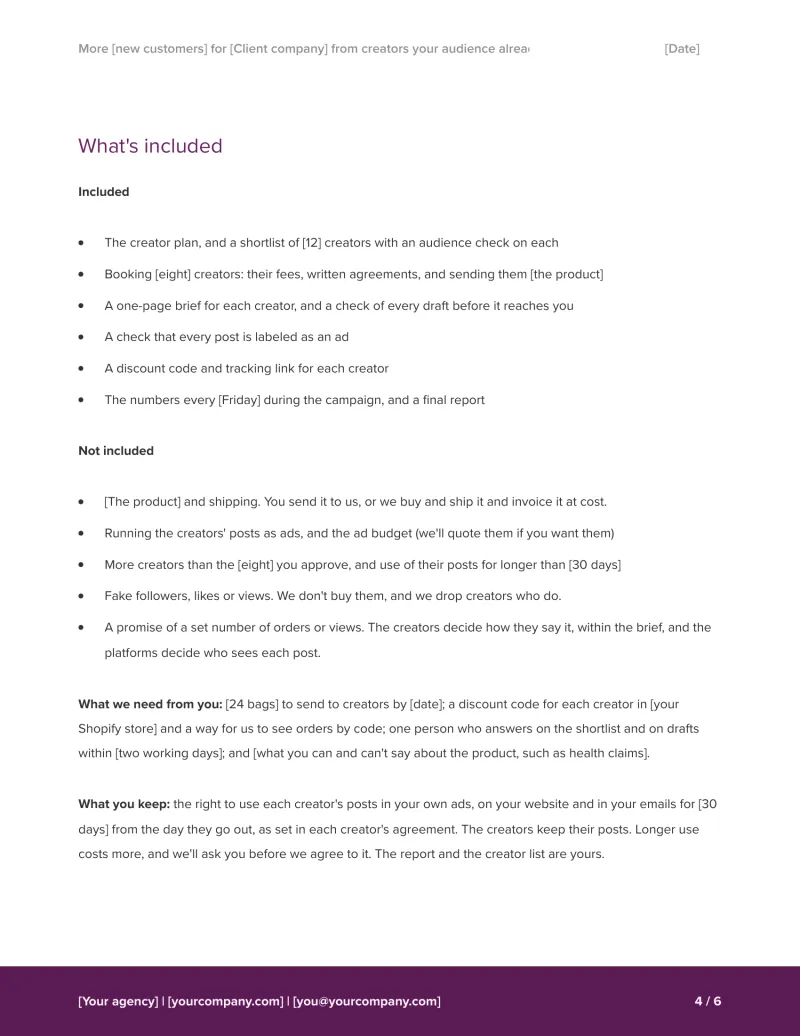
5. What's included

Draws the line between what the agency does and what it doesn't, says what you need from the brand, and who can use the creators' posts and for how long.

Included

  • The creator plan, and a shortlist of [12] creators with an audience check on each
  • Booking [eight] creators: their fees, written agreements, and sending them [the product]
  • A one-page brief for each creator, and a check of every draft before it reaches you
  • A check that every post is labeled as an ad
  • A discount code and tracking link for each creator
  • The numbers every [Friday] during the campaign, and a final report

Not included

  • [The product] and shipping. You send it to us, or we buy and ship it and invoice it at cost.
  • Running the creators' posts as ads, and the ad budget (we'll quote them if you want them)
  • More creators than the [eight] you approve, and use of their posts for longer than [30 days]
  • Fake followers, likes or views. We don't buy them, and we drop creators who do.
  • A promise of a set number of orders or views. The creators decide how they say it, within the brief, and the platforms decide who sees each post.

What we need from you: [24 bags] to send to creators by [date]; a discount code for each creator in [your Shopify store] and a way for us to see orders by code; one person who answers on the shortlist and on drafts within [two working days]; and [what you can and can't say about the product, such as health claims].

What you keep: the right to use each creator's posts in your own ads, on your website and in your emails for [30 days] from the day they go out, as set in each creator's agreement. The creators keep their posts. Longer use costs more, and we'll ask you before we agree to it. The report and the creator list are yours.

Since 2024, US rules ban buying fake followers, likes or views that make an account look more influential than it is for business (the FTC's rule on fake reviews and social media influence, 16 CFR 465.8). Brands have heard about creators with bought audiences. One line saying you check for it, and drop creators who do it, answers the question before they ask.

6. Investment

The agency's fee in two parts and the creators' fees on their own line, at cost, each with when it's invoiced, and a way out after the shortlist. These are example prices; the table further down shows what others charge.

Creator plan and shortlist

$1,500

The plan, a shortlist of [12] creators with an audience check on each, and a call to pick [eight]. Invoiced when you accept. If the shortlist doesn't suit you, tell us within a week of that call: you pay for the plan, you keep it, and we don't book anyone.

Campaign management, [six] weeks

$3,000

Booking and agreements, briefs, checking every draft and post, codes and tracking, the weekly numbers and the final report, for [eight] creators. Invoiced half when the creators are booked and half with the final report.

Creator fees, at cost

$6,000

Up to [$6,000] for [eight] creators: [one Reel or TikTok video and three Stories] each, with [30 days] of use in your own ads. We book a creator only after you approve their fee, pay them what they charge, and invoice you the same amount when they're booked, with each creator's fee listed. If they cost less, you pay less.

Total: $10,500

In a 2026 survey of 84 brand-side marketers by the ANA, agency services took 30% of influencer spending on average and the creators 70%, and only half (51%) said they could see exactly what their agency paid the creators. Putting the creator fees on their own line, at cost, answers that question before the brand asks it.

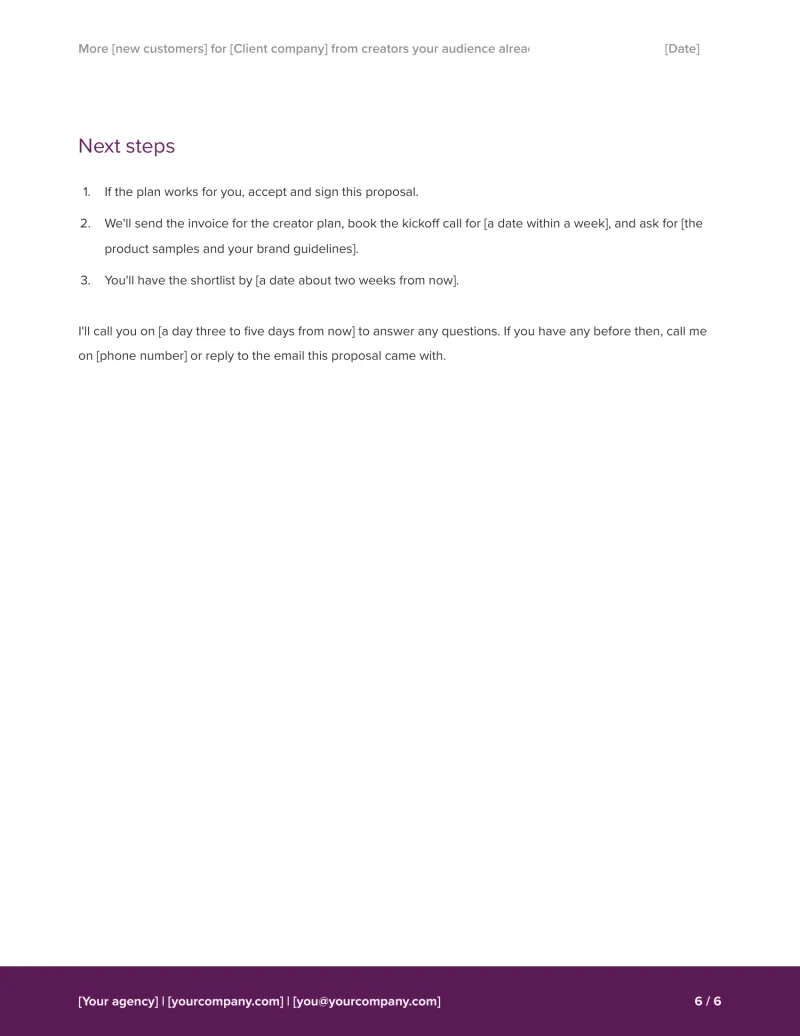
7. Next steps

Tells the brand exactly what to do to say yes, what happens after, and when you'll call.

  1. If the plan works for you, accept and sign this proposal.
  2. We'll send the invoice for the creator plan, book the kickoff call for [a date within a week], and ask for [the product samples and your brand guidelines].
  3. You'll have the shortlist by [a date about two weeks from now].

I'll call you on [a day three to five days from now] to answer any questions. If you have any before then, call me on [phone number] or reply to the email this proposal came with.

Agencies' accepted proposals got their yes in a median of 3.9 days in Nusii, and 62% of the yeses came within a week (November 2025 to October 2026). A call three to five days after you send it lands while most clients are still deciding.

An influencer marketing proposal example, filled in

Two sections of the template above with a client's words in the brackets, so you can see how it reads when it's done. Brightmoor Granola, a small granola brand that sells online and in a few shops, is made up, and so are its numbers.

More new customers for Brightmoor Granola from creators your audience already follows

What we heard

  • You said you sent free bags to people with big followings and never knew what it brought in. We'll give every creator their own discount code and link, so each report shows the orders each one brought in.
  • You said the creators who message you have big numbers, but their followers don't look like your customers. We'll check each creator's audience before they reach the shortlist: where their followers live, how old they are, and whether the likes and comments come from real people.
  • You said you want it to sound like Brightmoor, not like an ad read. We'll write a one-page brief for each creator and show you every post before it goes out. The creators say it in their own words; you check the facts.

What success looks like: 300 first orders with the creators' codes and links in the eight weeks after the first post, and 16 posts you can use in your own ads, counted in your Shopify store.

What it's worth: you told us a new customer spends about $140 in their first year, and about $55 of that is profit. 300 new customers would be about $16,500 in profit in their first year, against $10,500 for the whole campaign. The 300 is our estimate until the first posts have been out for two weeks.

If nothing changes: you launch the new maple pecan flavor to the 4,000 people on your email list and hope the shops reorder.

Investment

Creator plan and shortlist

$1,500

Campaign management, six weeks

$3,000

Creator fees, at cost

$6,000

Total: $10,500

See it as your client will

Every page of the PDF, printed by Nusii. Sent as a link, it's one scrolling page on any device: your client accepts with one button and signs with their name.

Open the live preview

The template in Nusii, the way your client will see it. It opens in a new tab.

Labeled as ads, and who has to check

A creator campaign is also a promise about how the posts will run. In the US, the FTC's Endorsement Guides put part of that on the brand and its agency, not only on the creator. Most influencer templates leave it out. This one has a line for each of these:

  • Hard to miss. A disclosure should be “difficult to miss (i.e., easily noticeable) and easily understandable by ordinary consumers”, and on social media it “should be unavoidable”.

    In the template: Labeled as ads, under How we’ll work: the paid partnership label and #ad in the first line of the caption

  • Not the platform's label alone. “Don’t assume that a platform’s disclosure tool is good enough.”

    In the template: Labeled as ads: the platform’s label and #ad, never the label alone

  • The brand and the agency check. Advertisers should “Provide guidance to their endorsers”, “Monitor their endorsers’ compliance” and fix what goes wrong; agencies can be liable for “hiring and directing endorsers who fail to make necessary disclosures”.

    In the template: the briefs and “we check every post”

  • Claims need proof. An endorsement “may not convey any express or implied representation that would be deceptive if made directly by the advertiser.”

    In the template: What we need from you: what you can and can’t say about the product

  • No bought followers. No one may buy “fake indicators of social media influence” (followers, views, likes and the like) that “materially misrepresent their influence or importance for a commercial purpose”.

    In the template: Not included: fake followers, likes or views

Sources: the FTC's Endorsement Guides (16 CFR 255), Disclosures 101 for Social Media Influencers, the rule on fake reviews and social media influence (16 CFR 465). These are US rules, and this isn't legal advice. Other countries have their own; check the ones where the posts run.

What to charge for an influencer campaign

What agencies and creators charge, from the sources we could check. The template's example prices, $4,500 for the agency's work and up to $6,000 for eight creators, put the agency at 43% of the budget, above the 30% big advertisers reported: a small campaign takes about as long to run as a big one. In Nusii, agencies' accepted proposals had a median value of $4,000, monthly fees left out (255 proposals, July to September 2026).

What Price
The agency's share of an influencer budget 30% on average the other 70% went to the creators; a survey of 84 brand-side marketers, many of them large advertisers ANA
An Instagram collaboration $193 on average what brands paid on one creator marketplace in 2025; creators asked $214 Collabstr
A TikTok collaboration $186 on average creators asked $182 Collabstr
A YouTube collaboration $255 on average creators asked $311 Collabstr
A creator with 10,000 to 100,000 followers $198 on average per collaboration; using the post in your ads, or exclusivity, raises the price Collabstr
Influencer agency hourly rate $100 to $149 an hour US average Clutch

Sources: ANA, Influencer Marketing Agency Compensation, February 2026; Collabstr, what influencers cost in 2026, from its own marketplace; Clutch, a directory of influencer agencies, updated September 2026. Collabstr's averages come from more than 21,000 collaborations on its own marketplace, where most are a single post for a small brand (nearly 80% cost under $300). A campaign booked through an agency, with several posts per creator and use in ads, costs more. Clutch lists agencies, and ANA's members are mostly large advertisers.

How often proposals got a yes, by price

Proposals over $15,000 got a yes about a third of the time. Agencies' accepted proposals had a median value of $4,000. From 1,713 proposals first sent with Nusii, July to September 2026.

Under $1,000
67.1%
$1,000 to $5,000
50.7%
$5,000 to $15,000
48.9%
$15,000 to $50,000
36.1%
Over $50,000
33.3%

Share accepted, by the total the client saw. Bigger proposals are bigger decisions, so this shows what happened, not that a lower price would win. Method: The State of Proposals 2026.

The email to send it with

The proposal does the explaining, so the email only has to get it opened and say when you'll call. Leave the price out, so the brand reads the plan before they judge the number. In Nusii this goes in the Send Proposal window, and you can save it as your template for next time.

Subject: [The plan for your creator campaign]

Hi [first name],

Here's the proposal we talked about on [day of your call]: [link].

In short: we find [eight] creators whose followers look like your customers and run a [six]-week campaign for [your new flavor]. You approve every creator and every post.

It's short, and you can accept it right on the page. If anything's off, reply to this email and I'll change it.

I'll call you on [a day three to five days from now] to answer any questions.

[Your name]

What happens after you send it

From 3,782 proposals first sent with Nusii by marketing, web, advertising and video agencies from November 2025 to October 2026.

48.9%
were accepted
54 minutes
median time to the client's first look
3.9 days
median time to a yes
62.2%
of the yeses came within a week

Clients rarely say no. Of all proposals sent with Nusii from July to September 2026, 6.5% were rejected and 45.2% got no answer either way. Silence is the usual no, so a follow-up is worth sending.

Follow up after a week. Most yeses come within seven days. In Nusii you see when the proposal was opened and get an email when it's accepted, so you can follow up when they've read it, not when you guess they have.

More numbers and the method: The State of Proposals 2026.

Get the Word and PDF files

The same template as a Word file you can edit (it opens in Google Docs too) and a PDF printed by Nusii. We'll email you both, plus a few emails with proposal tips. Unsubscribe any time.

Or send it with Nusii

This template is in the gallery of every Nusii account. Send it as a link: you get an email when your client opens it, and they accept and sign online, on any device.

Not only does Nusii make doing quotes easier, I think it helps to close the deals because of the confidence the output from Nusii inspires.

Glenn Lidstone
Glenn Lidstone
President, StoneHouse Marketing Solutions

I’ve built a library of reusable sections and proposal templates, so I can pull together a tailored proposal without starting from scratch every time.

Russell Brown
Russell Brown
Owner & Director, Digital Stream
Start your free trial

14-day trial · 60-day money-back guarantee

Questions about influencer marketing proposals

What is an influencer marketing proposal?

A document an agency sends a brand to win a creator campaign: what the brand wants, the kind of creators you’ll work with, how the campaign runs, what it costs and how to start. It’s different from the agreement each creator signs and from the brief each creator gets.

How do you write an influencer proposal?

Start from your call with the brand: their problem in their words, the result they’ll count, and what a new customer is worth to them. Then write the plan, who approves what, what’s included, the price with the creators’ fees kept apart, and the next steps. Keep it short: most of it should be things you already agreed on the call.

How much should an agency charge for an influencer campaign?

There’s no standard rate. In ANA’s 2026 survey of 84 brand-side marketers, agency services took 30% of influencer spending on average and the creators 70%. This template uses $4,500 for the agency’s work and up to $6,000 for eight creators as example prices. On a small campaign the agency’s share is usually higher, because finding and briefing a creator takes about as long whatever they’re paid.

Should the creator fees be in the proposal?

Yes, on their own line, so the brand sees the whole budget and what goes to the creators. Only half of the marketers in ANA’s 2026 survey said they could see exactly what their agency paid the creators. The template lists the creator fees at cost, books a creator only after the brand approves their fee, and invoices each one with the fee shown.

Who owns the posts the creators make?

Usually the creator, unless their agreement says otherwise. The brand gets the right to use the posts for an agreed time and in agreed places. The template gives 30 days of use in the brand’s own ads, website and emails, and says longer use costs more. Put the details in each creator’s agreement; this isn’t legal advice.

Do influencer posts have to be labeled as ads?

Yes, in the US, whenever the creator is paid or gets something of value, free product included. The FTC expects the label to be hard to miss, in the post itself, and expects the brand and its agency to brief the creators and check. The template says how every post will be labeled and that you check each one.

Is this the same as an influencer contract?

No. The proposal is how the agency gets the brand’s yes to the campaign. Each creator then signs their own agreement with the posts, dates, fee, labeling and how long the brand can use the content. The proposal says those agreements will exist; it doesn’t replace them.

I’m a creator pitching a brand. Can I use this template?

Parts of it. A creator’s pitch is usually shorter: a short email, a media kit with your audience and your results for other brands, and your rates. The “What we heard” section still works: show the brand you understood what they want before you name a price.

Should it be one campaign or a monthly program?

Start with one campaign unless the brand asked for more. In Nusii, proposals with a monthly fee were accepted less often than one-off ones (39.7% against 54.5% for the same senders, July to September 2026). A first campaign with a report at the end gives you both the numbers to plan a monthly program on.

Should I offer several packages?

Only if the brand asked about choices. In Nusii, proposals where the client could choose between options were accepted less often (40% against 52% for the same senders, July to September 2026). This template has one price, with the creator fees as a ceiling the brand approves creator by creator.

What should I write in the email that goes with the proposal?

A few lines: a link to the proposal, the plan in one sentence and the day you’ll call. Leave the price out, so the brand reads the plan before judging the number. There’s an email to copy further up this page.

Can my client accept and sign the proposal online?

Yes, if you send it as an online proposal. In Nusii, your client opens a link, accepts with one button and signs with their typed name, on any device, and you get an email when they do. The Word file and the PDF need signing the old way.

More templates and guides

Send your next influencer marketing proposal as a link, and see when it's opened

Try Nusii free for 14 days

Cancel anytime · 60-day money-back guarantee