A recruitment proposal template for filling a role for a client company, in seven short sections: what the client told you about the role, how the search runs, the replacement guarantee, one fixed fee in three parts and the next steps. For recruitment agencies and independent recruiters. Read it here or get it as a Word file and a PDF.
A recruitment proposal is the document a recruitment agency or an independent recruiter sends a company to fill a role: who you'll find, how the search runs, what it costs and what happens if the hire doesn't work out. It should repeat what the client told you about the role, the result you'll both check and what the empty seat costs, how the search runs from the role brief to the start date, what's included and what isn't, one fee for the role with when each part is paid, the replacement guarantee and how to say yes. The template below has a section for each.
The recruitment proposal template, section by section
Copy one section or the whole thing. Under each section: what it's for, and one thing we've learned from the proposals sent with Nusii.
[Yellow] you write[Green] Nusii fills in when you send it
1. Introduction
The whole search in two sentences, who you are and who runs it. The person who signs (the owner or finance) is often not the one who briefed you, so it has to make sense to someone who wasn't on the call.
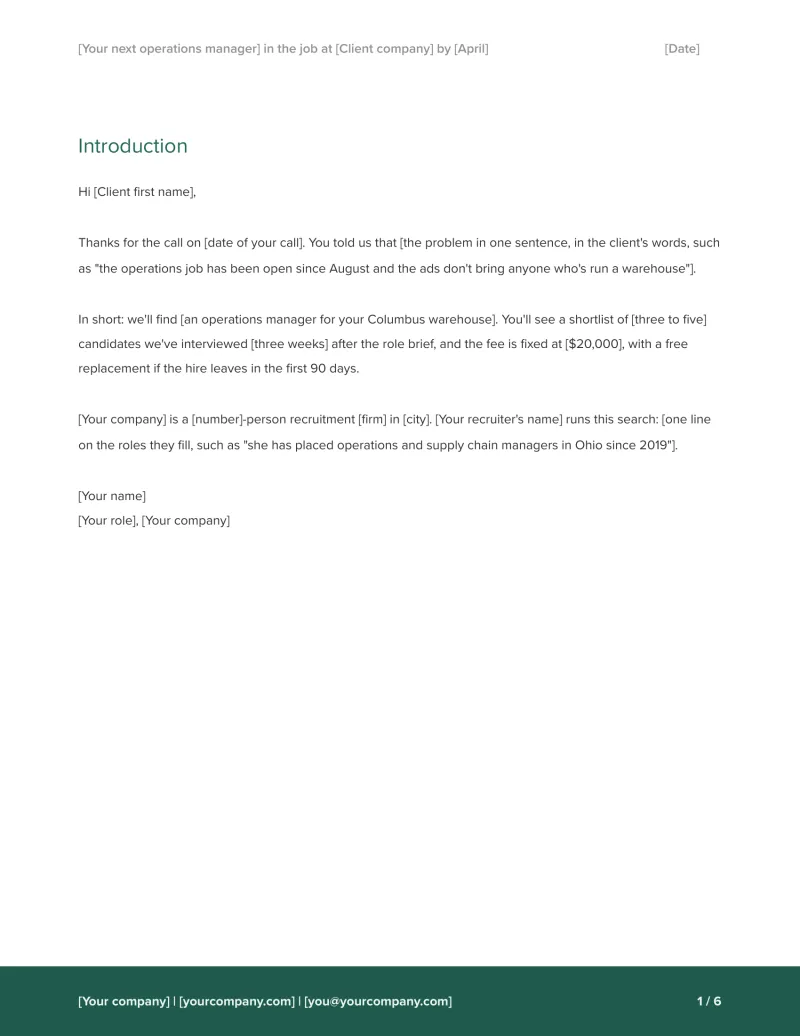
Hi [Client first name],
Thanks for the call on [date of your call]. You told us that [the problem in one sentence, in the client's words, such as "the operations job has been open since August and the ads don't bring anyone who's run a warehouse"].
In short: we'll find [an operations manager for your Columbus warehouse]. You'll see a shortlist of [three to five] candidates we've interviewed [three weeks] after the role brief, and the fee is fixed at [$20,000], with a free replacement if the hire leaves in the first 90 days.
[Your company] is a [number]-person recruitment [firm] in [city]. [Your recruiter's name] runs this search: [one line on the roles they fill, such as "she has placed operations and supply chain managers in Ohio since 2019"].
[Your name] [Your role], [Your company]
Professional services firms' proposals in Nusii got their first look in a median of 30 minutes (271 proposals, November 2025 to October 2026), and about a third of first views are on a phone. Say who you'll find and by when before you say who you are.
2. What we heard
Shows you listened, turns what the client told you about the role into goals you can both check, and puts a number on what the empty seat costs. Only you can write this one: replace the examples with your client's words.
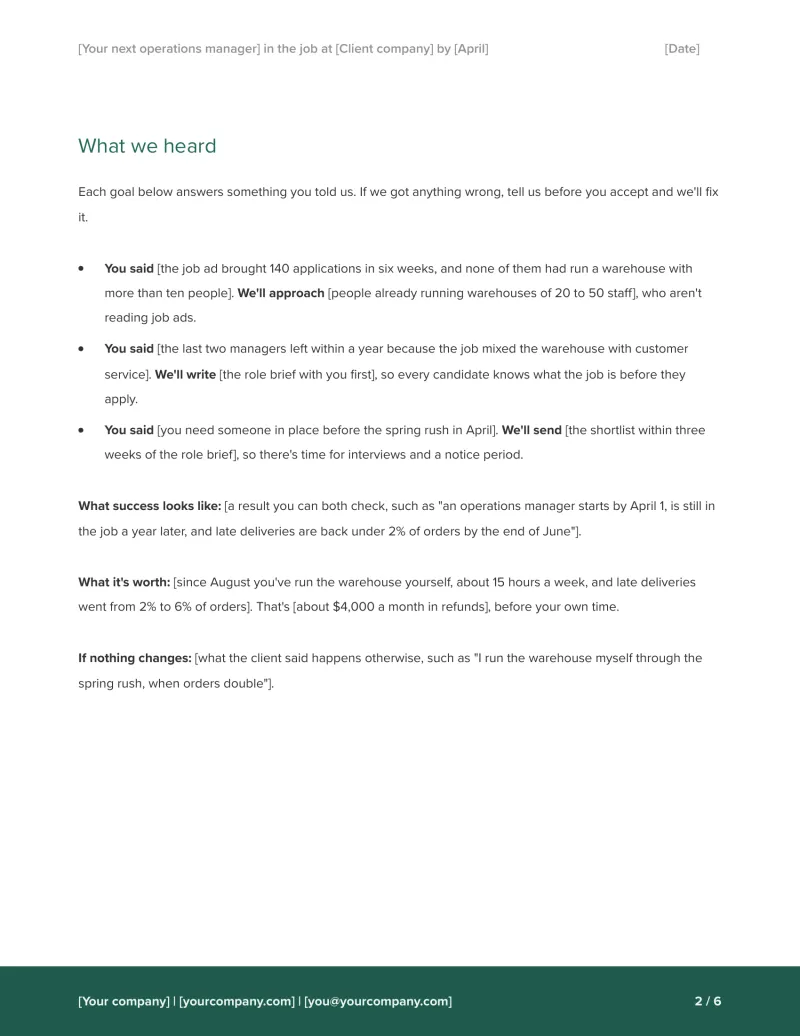
Each goal below answers something you told us. If we got anything wrong, tell us before you accept and we'll fix it.
You said[the job ad brought 140 applications in six weeks, and none of them had run a warehouse with more than ten people]. We'll approach[people already running warehouses of 20 to 50 staff], who aren't reading job ads.
You said[the last two managers left within a year because the job mixed the warehouse with customer service]. We'll write[the role brief with you first], so every candidate knows what the job is before they apply.
You said[you need someone in place before the spring rush in April]. We'll send[the shortlist within three weeks of the role brief], so there's time for interviews and a notice period.
What success looks like:[a result you can both check, such as "an operations manager starts by April 1, is still in the job a year later, and late deliveries are back under 2% of orders by the end of June"].
What it's worth:[since August you've run the warehouse yourself, about 15 hours a week, and late deliveries went from 2% to 6% of orders]. That's [about $4,000 a month in refunds], before your own time.
If nothing changes:[what the client said happens otherwise, such as "I run the warehouse myself through the spring rush, when orders double"].
"We need a recruiter" is the client's answer, not their problem. Our 2015 book on proposals calls what clients hand you "the end result of their problem". Ask why the role is open, why the last person left and why the ads didn't work: the answers decide who you look for, and they go here.
3. How the search works
The plan from the role brief to the start date, so the client knows what happens when, what they have to do, and where they can decide not to go on.
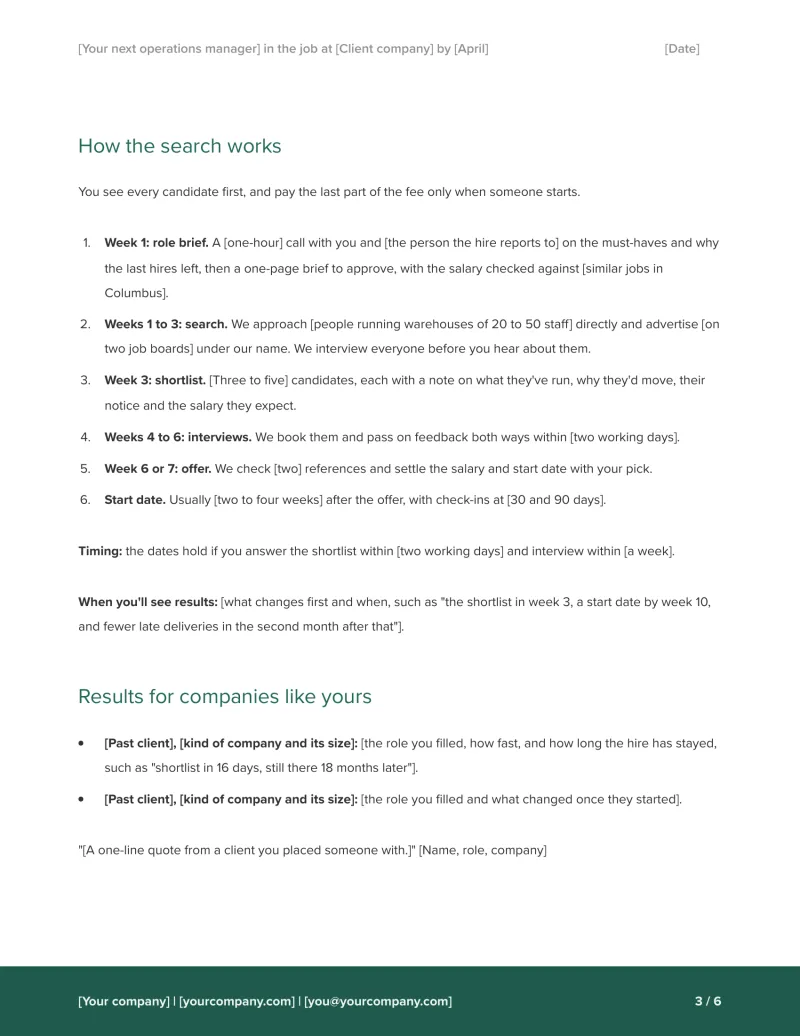
You see every candidate first, and pay the last part of the fee only when someone starts.
Week 1: role brief. A [one-hour] call with you and [the person the hire reports to] on the must-haves and why the last hires left, then a one-page brief to approve, with the salary checked against [similar jobs in Columbus].
Weeks 1 to 3: search. We approach [people running warehouses of 20 to 50 staff] directly and advertise [on two job boards] under our name. We interview everyone before you hear about them.
Week 3: shortlist.[Three to five] candidates, each with a note on what they've run, why they'd move, their notice and the salary they expect.
Weeks 4 to 6: interviews. We book them and pass on feedback both ways within [two working days].
Week 6 or 7: offer. We check [two] references and settle the salary and start date with your pick.
Start date. Usually [two to four weeks] after the offer, with check-ins at [30 and 90 days].
Timing: the dates hold if you answer the shortlist within [two working days] and interview within [a week].
When you'll see results:[what changes first and when, such as "the shortlist in week 3, a start date by week 10, and fewer late deliveries in the second month after that"].
Philip Morgan and Jonathan Stark, in our 2015 book: "If a project does require firm completion dates, call out your assumptions about what will be required to meet those dates." In a search, half the dates are the client's: how fast they answer the shortlist and book interviews, and the notice the new hire has to work.
4. Results for companies like yours
Short proof for the people who weren't on the call: a role like this one, how long it took and whether the hire stayed.
[Past client], [kind of company and its size]:[the role you filled, how fast, and how long the hire has stayed, such as "shortlist in 16 days, still there 18 months later"].
[Past client], [kind of company and its size]:[the role you filled and what changed once they started].
"[A one-line quote from a client you placed someone with.]" [Name, role, company]
Proposals to a repeat client were accepted 63.2% of the time in Nusii, against 43.2% for a first proposal to that client (July to September 2026). A new client hasn't seen you fill a role yet: one placement like theirs, with how long it took and how long the hire stayed, says more than a list of logos.
5. What's included
What the fee covers and what it doesn't, what you need from the client, and the terms recruitment fees go wrong on: the guarantee, candidates hired later and who else works on the role. If you also work to your own terms of business or an NDA, name it under Confidentiality.
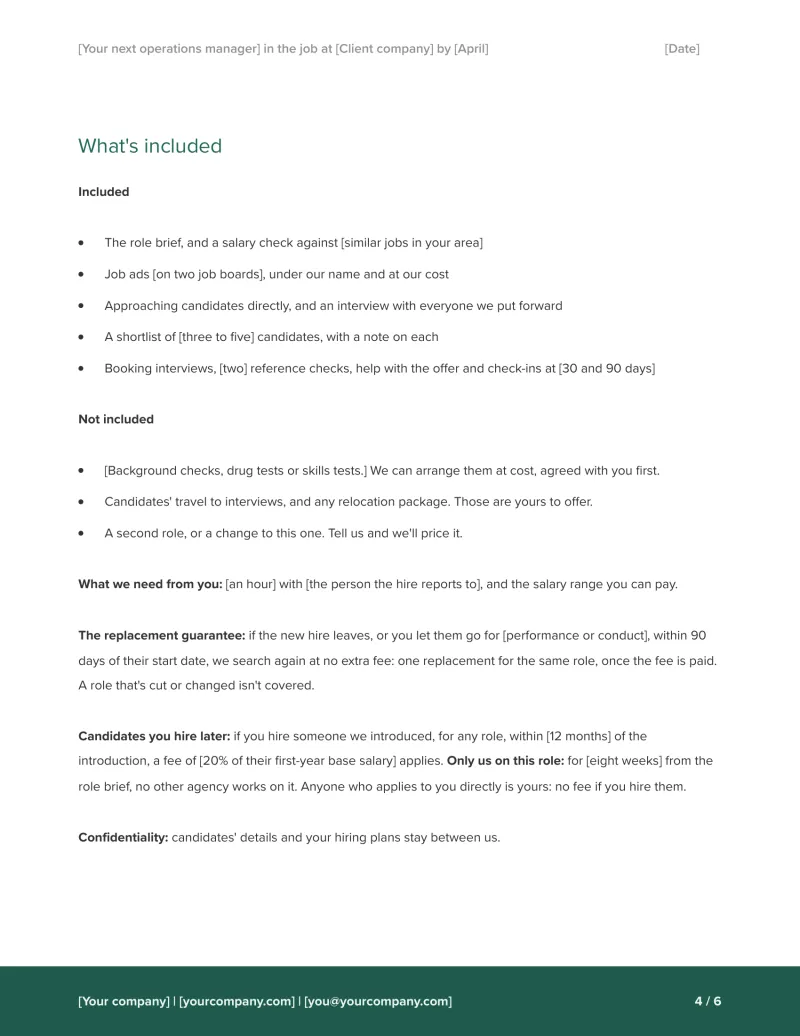
Included
The role brief, and a salary check against [similar jobs in your area]
Job ads [on two job boards], under our name and at our cost
Approaching candidates directly, and an interview with everyone we put forward
A shortlist of [three to five] candidates, with a note on each
Booking interviews, [two] reference checks, help with the offer and check-ins at [30 and 90 days]
Not included
[Background checks, drug tests or skills tests.] We can arrange them at cost, agreed with you first.
Candidates' travel to interviews, and any relocation package. Those are yours to offer.
A second role, or a change to this one. Tell us and we'll price it.
What we need from you:[an hour] with [the person the hire reports to], and the salary range you can pay.
The replacement guarantee: if the new hire leaves, or you let them go for [performance or conduct], within 90 days of their start date, we search again at no extra fee: one replacement for the same role, once the fee is paid. A role that's cut or changed isn't covered.
Candidates you hire later: if you hire someone we introduced, for any role, within [12 months] of the introduction, a fee of [20% of their first-year base salary] applies. Only us on this role: for [eight weeks] from the role brief, no other agency works on it. Anyone who applies to you directly is yours: no fee if you hire them.
Confidentiality: candidates' details and your hiring plans stay between us.
Kai Davis, interviewed for our 2015 book, calls proposals "a way to communicate value and reduce risk". The risk a client sees in a recruiter is paying a fee for someone who leaves in a month. The guarantee, the exclusive search and who a candidate belongs to answer it, so write them down here.
6. Investment
One fixed fee for the role in three parts, each with when it's invoiced, and a way out after the role brief. These are example prices; the table further down shows what recruiters charge.
Role brief, salary check and search
$5,000
The role brief call, the salary check and the start of the search. Invoiced when you accept. If the salary check shows the role can't be filled at the salary you have in mind, we tell you within [a week] of the role brief: you pay this part only, you keep the role brief and the salary data, and the search stops.
Shortlist of [three to five] interviewed candidates
$5,000
With a note on each. Invoiced when we send you the shortlist.
Start date of your new [operations manager]
$10,000
Invoiced on their first day, and only if you hire someone we introduced. Includes the free replacement if they leave within 90 days. The fee is fixed at [20% of the $100,000 base salary in the role brief], whatever the final offer.
Total: $20,000
That's 20% of the $100,000 base salary, the low end of the 20% to 25% SHRM reports for contingency recruiters, with half of it paid before the start date for a search no other agency works on. In Nusii, proposals between $15,000 and $50,000 got a yes a little over a third of the time (July to September 2026), so let "What it's worth" carry a fee this size.
7. Next steps
Tells the client exactly what to do to say yes, what happens after, and when you'll call. No expiry date and no "another company wants this candidate".
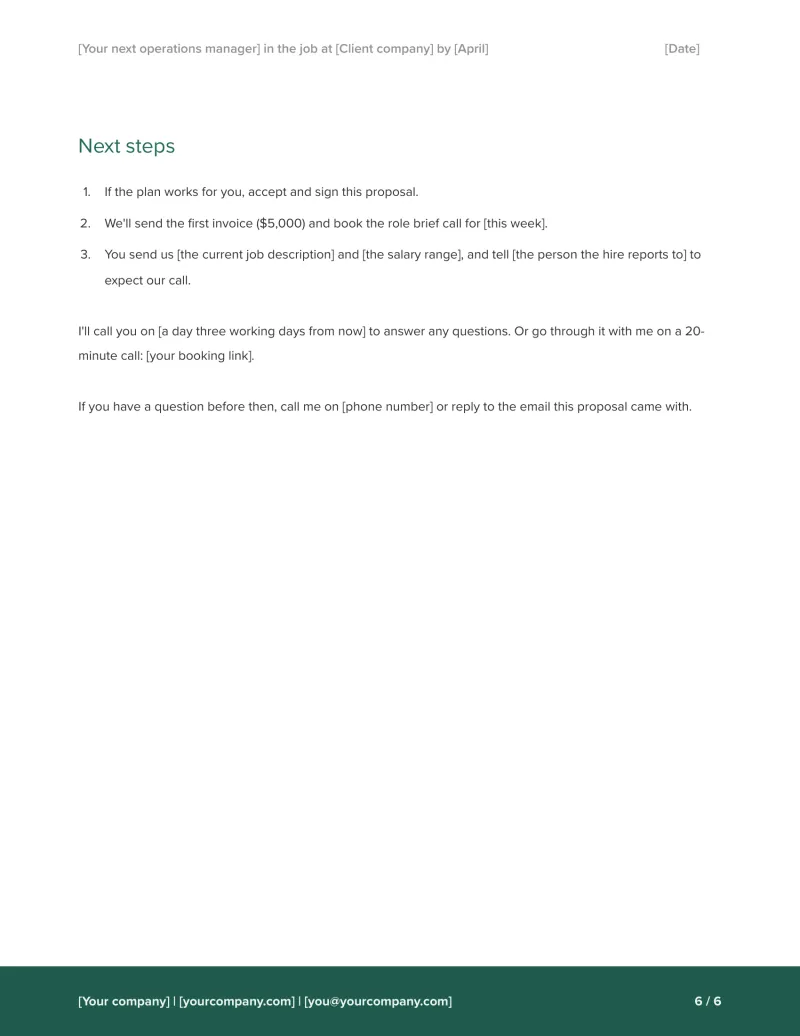
If the plan works for you, accept and sign this proposal.
We'll send the first invoice ($5,000) and book the role brief call for [this week].
You send us [the current job description] and [the salary range], and tell [the person the hire reports to] to expect our call.
I'll call you on [a day three working days from now] to answer any questions. Or go through it with me on a 20-minute call: [your booking link].
If you have a question before then, call me on [phone number] or reply to the email this proposal came with.
Professional services firms' accepted proposals in Nusii got their yes in a median of 1 day, and 72.7% of the yeses came within a week (271 proposals, November 2025 to October 2026). If you haven't heard in three working days, the call is due.
Contingency, retained, staffing or RPO: changing the fee
The template's fee is for an exclusive search: one fixed fee worked out from the salary, half of it paid before the start date and half on it. If you work another way, only the Investment section and a line or two of "What's included" change:
Contingency: one line item, the whole fee, invoiced on the start date and only if the client hires your candidate. Drop the way out (there's nothing to refund), and the line about being the only agency on the role unless the client agreed to it. SHRM puts contingency fees at 20% to 25% of first-year cash pay.
Retained search: three equal parts, often at the start of the search, with the shortlist and on the start date, for about a third of first-year pay (SHRM). Keep the way out after the first part.
Temporary or contract staff: no placement fee. Price each worker by the hour (their pay plus your margin, as one bill rate), invoiced [weekly], with the hours a week and the notice to end an assignment in the line item. If the client can hire the worker later, put the conversion fee in the same line.
Several roles, or recruitment process outsourcing (RPO): a monthly fee for running the client's hiring, with the roles it covers and a way out after the first [three] months, and the same guarantee for each hire.
Answering a request for proposals from a school district or a city for an executive search is a different document: their form asks for references, insurance and a fee schedule, and it's scored against its own questions. Use their form, and this template for what it leaves open.
A recruitment proposal example, filled in
Two sections of the template above with a client's words in the brackets, so you can see how it reads when it's done. Hollisbrook Restaurant Supply is made up, and so are its numbers.
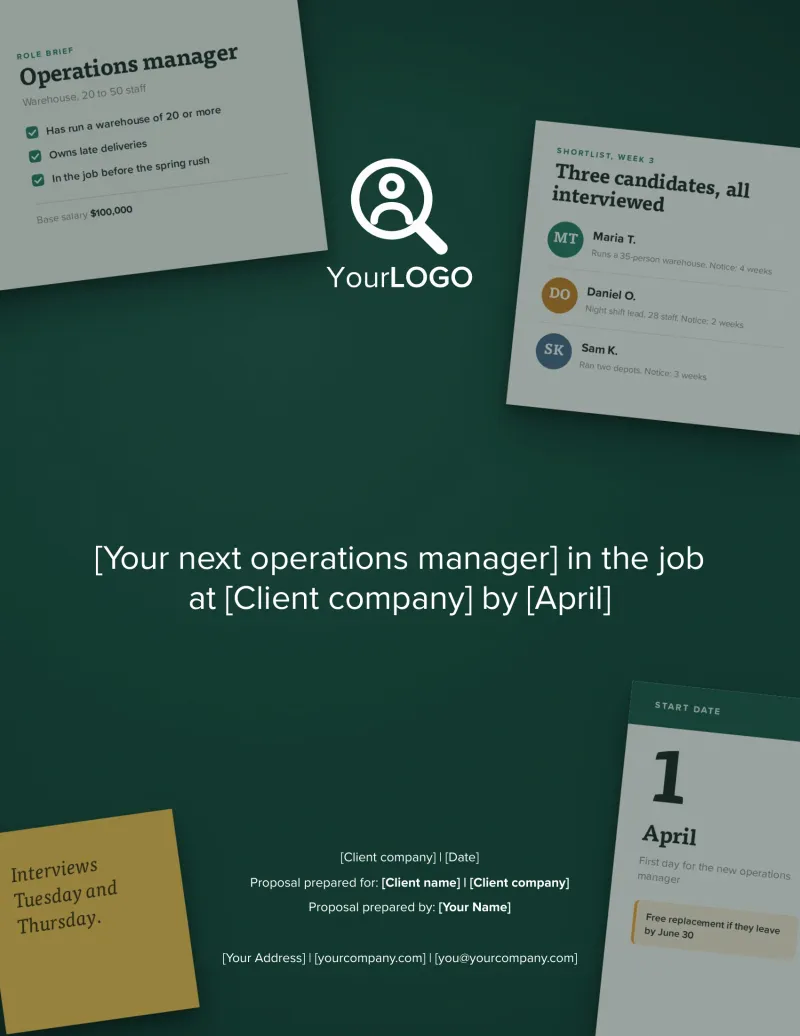
Your next operations manager in the job at Hollisbrook Restaurant Supply by April
What we heard
You said the job ad brought 140 applications in six weeks, and none of them had run a warehouse with more than ten people. We'll approach people already running warehouses of 20 to 50 staff, who aren't reading job ads.
You said the last two managers left within a year because the job mixed the warehouse with customer service. We'll write the role brief with you first, so every candidate knows what the job is before they apply.
You said you need someone in place before the spring rush in April. We'll send the shortlist within three weeks of the role brief, so there's time for interviews and a notice period.
What success looks like: an operations manager starts by April 1, is still in the job a year later, and late deliveries are back under 2% of orders by the end of June.
What it's worth: since August you've run the warehouse yourself, about 15 hours a week, and late deliveries went from 2% to 6% of orders. That's about $4,000 a month in refunds, before your own time: the fee is five months of those refunds.
If nothing changes: you run the warehouse yourself through the spring rush, when orders double.
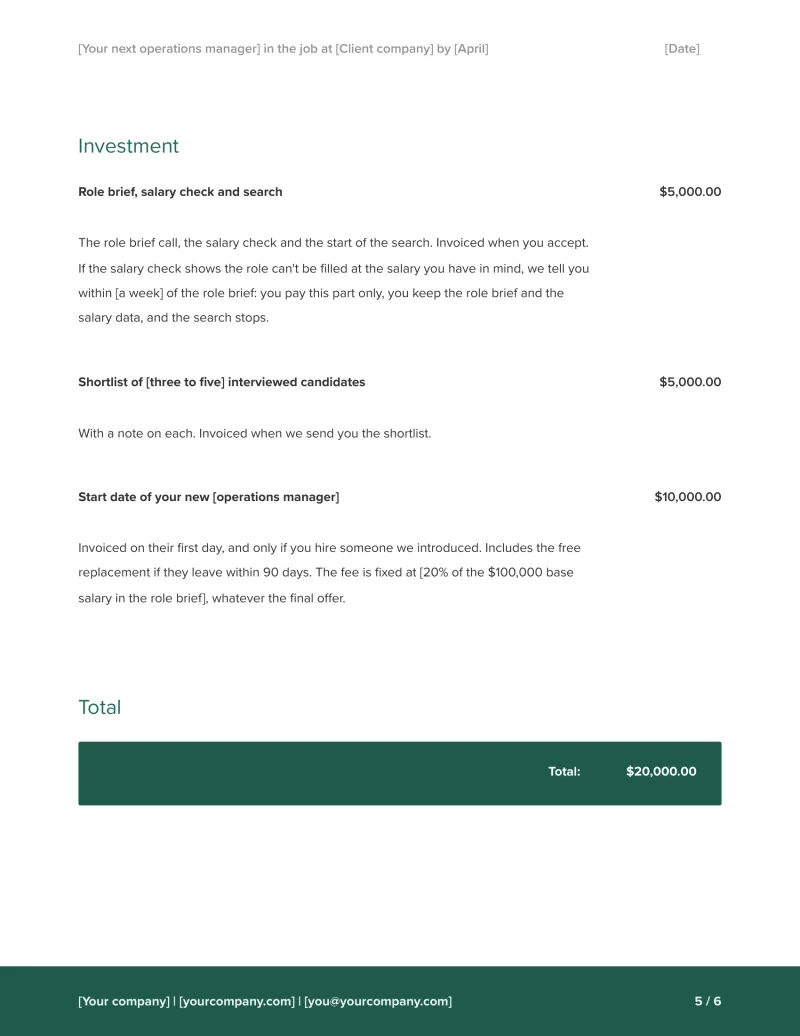
Investment
Role brief, salary check and search
$5,000
Shortlist of three to five interviewed candidates
$5,000
Start date of your new operations manager
$10,000
Total: $20,000
How to write a recruitment proposal, step by step
Six steps, from the first call to the follow-up. The template above already follows them; here's why each one matters.
1
Ask why the role is open, not just what it is
On the first call, find out why the job is open, why the last person left, what the first year should look like, the salary range and who else has to say yes. A job description tells you what the client thinks they need; the answers to those questions go in "What we heard". Our 10 questions for the first client call cover most of it, and how to ask about the budget covers the salary.
2
Check the salary before you promise a shortlist
If the salary is below what people in that job earn nearby, no search will fix it, and it's better to say so before the client has paid for one. The template makes this the way out: the salary check comes first, and if it shows the role can't be filled at that salary, the client pays the first part only and the search stops.
3
Write down what success looks like a year from now
"A good hire" isn't a goal. Pick what the client can check: a start date, the person still in the job a year later, and one thing that changes once they're there, such as fewer late deliveries. Then put a number on what the empty seat costs today, so the fee has something to stand next to.
4
Turn your percentage into one fee
Recruiters think in percentages; clients pay amounts. Write the fee as one number for this role (20% of a $100,000 base salary is $20,000), say what it's based on, and split it into parts with the moment each one is invoiced. Send one fee unless the client asked for choices: in Nusii, proposals where the client could choose between options were accepted less often (40.1% against 51.6% for the same senders, July to September 2026). What to charge has the outside rates.
5
Put the guarantee and who a candidate belongs to in writing
Most fee arguments start after the hire: the person leaves in week six, or the client hires someone you introduced for a different job. Say how long the guarantee runs, whether it's a replacement or a refund, how long a candidate you introduced stays yours, and whether you're the only agency on the role. 90 days and a replacement are the most common terms (Top Echelon's 2019 survey of recruiters).
6
Send it, then call when you said you would
Send it with a short email (there's one below) and call when you said you would. Professional services firms' accepted proposals in Nusii got their yes in a median of 1 day, and 72.7% of the yeses came within a week (November 2025 to October 2026).
See it as your client will
Every page of the PDF, printed by Nusii. Sent as a link, it's one scrolling page on any device: your client accepts with one button and signs with their name.
The template in Nusii, the way your client will see it. It opens in a new tab.
What recruiters charge
What recruitment agencies charge for a permanent hire, from the pages we could check at the source. The template's example, a fixed $20,000 for a role paying $100,000, is 20% of the base salary: the low end of the usual contingency range, with half paid before the start date because the search is yours alone.
What
Price
Source
Contingency search, paid only if you hire
20% to 25%of first-year cash pay (salary, bonus and signing bonus)SHRM
Sources: SHRM, working with search firms, July 2016; Indeed, what a headhunter fee costs, updated June 2026; Top Echelon, survey of recruiters on guarantees, March 2019. SHRM's rates come from a 2016 article quoting recruiting consultants, Indeed's from its editorial team, and Top Echelon surveyed recruiters in its own network in 2019. Some fees are worked out on base salary only, others on salary plus bonus, so say which in your proposal. Treat them as a rough guide.
How often proposals got a yes, by price
Recruitment fees run bigger than most proposals in Nusii: the template's $20,000 sits in the $15,000 to $50,000 band, where proposals got a yes a little over a third of the time. From 1,713 proposals first sent with Nusii, July to September 2026.
Under $1,000
67.1%
$1,000 to $5,000
50.7%
$5,000 to $15,000
48.9%
$15,000 to $50,000
36.1%
Over $50,000
33.3%
Share accepted, by the total the client saw. Bigger proposals are bigger decisions, so this shows what happened, not that a lower price would win. Method: The State of Proposals 2026.
The email to send it with
The proposal does the explaining, so the email only has to get it opened and say when you'll call. Leave the fee out, so your client reads the plan before they judge the number. The owner or finance often signs off a recruitment fee, so say in one line who you'll find and by when: that's the line they'll read. In Nusii this goes in the Send Proposal window, and you can save it as your template for next time.
Subject:[The plan for your new operations manager]
Hi [first name],
Here's the proposal we talked about on [day of your call]: [link].
In short: a role brief first, a shortlist of [three to five] candidates we've interviewed [three weeks] later, and a free replacement if the hire leaves in the first 90 days.
It's short, and you can accept it right on the page. If anything's off, reply to this email and I'll change it.
I'll call you on [a day three to five days from now] to answer any questions.
[Your name]
What happens after you send it
Of 271 proposals professional services firms first sent with Nusii, November 2025 to October 2026, 52.8% were accepted, with a median of 1 day to a yes.
52.8%
were accepted
30 minutes
median time to the client's first look
1 day
median time to a yes
72.7%
of the yeses came within a week
Clients rarely say no. Of all proposals sent with Nusii from July to September 2026, 6.5% were rejected and 45.2% got no answer either way. Silence is the usual no, so a follow-up is worth sending.
Call within three working days. Proposals sent a second time, more than an hour after the first send, were accepted 59.3% of the time, against 47.8%, for the same 100 accounts (July to September 2026). That's a correlation, not proof: an interested client may be why they were sent again. In Nusii you see when the proposal was opened, so you can call once the person who signs has read it.
The same template as a Word file you can edit (it opens in Google Docs too) and a PDF printed by Nusii. We'll email you both, plus a few emails with proposal tips. Unsubscribe any time.
Or send it with Nusii
This template is in the gallery of every Nusii account. Send it as a link: you get an email when your client opens it, and they accept and sign online, on any device.
“Nusii for us is the effective, easy to use option, that has little training overhead.”
Andrew Kris
Founding Partner, Borderless Executive Search
“I’ve closed over $400K in new business since becoming a user and I plan to stick with the small team behind it for years to come.”
A document a recruitment agency or an independent recruiter sends a company to fill a role: who you’ll find, how the search runs, what it costs and what happens if the hire doesn’t work out. The client accepts it before the search starts, so it also sets the terms: the fee, when each part is paid and the guarantee.
What should a recruitment proposal include?
What the client told you about the role and the result you’ll both check, how the search runs from the role brief to the start date, short proof from similar roles, what’s included and what isn’t, one fee for the role with when each part is paid, the replacement guarantee, and the next steps. That’s seven sections, the same as the template on this page.
How much do recruitment agencies charge?
Usually a percentage of the hire’s first-year pay. SHRM puts contingency fees at 20% to 25% of first-year cash pay and retained search at about 33%, and Indeed gives 20% to 25% as the average, from 15% to 40% or more. This template uses 20% of a $100,000 base salary: $20,000, in three parts.
Should I propose a contingency or a retained search?
Contingency is paid only when someone starts, so the client takes no risk, but you may be one of several agencies on the role. Retained is paid in parts whether or not anyone is hired, and is usual for senior or hard-to-fill roles. This template sits between the two: part paid up front for a search that’s yours alone, the biggest part on the start date.
How should a recruitment fee be paid?
In parts tied to what the client can see: the start of the search, the shortlist and the start date. Indeed describes a retained fee paid in exactly those three steps. Write each part as an amount with the moment it’s invoiced, and say the last part is due only if someone you introduced starts.
How long should a recruitment guarantee be?
90 days is the most common: 44.9% of the recruiters Top Echelon surveyed in 2019 offered it, and 61.4% replace the hire rather than refund the fee. Say when the 90 days start (the start date), what it covers (the hire leaving or being let go for cause) and what it doesn’t (the role being cut or changed).
Can I use this as a staffing proposal template?
Yes for permanent hires, as it is. For temporary or contract staff there’s no placement fee: swap the three parts for an hourly bill rate per worker, invoiced weekly, with the hours and the notice to end an assignment in the line item. Changing the fee shows what else changes.
Can I use it for a recruitment process outsourcing (RPO) proposal?
Yes, with a different price. RPO means running a client’s hiring for several roles, so the Investment section becomes a monthly fee with the roles it covers and a way out after the first few months. The role brief, the steps and the guarantee work as they are, once per role.
Can you show me an example of a recruitment proposal?
Yes: the filled-in example above shows “What we heard” and the Investment section for a made-up restaurant supply wholesaler hiring an operations manager, with every bracket filled in.
Should I offer the client several fee options?
Only if they asked for choices. In Nusii, proposals where the client could choose between options were accepted less often (40.1% against 51.6% for the same senders, July to September 2026). This template has one fee; if the client wants a second role filled, send a second proposal once the first search is going.
Should my terms of business be in the proposal?
Put the terms clients ask about in plain words, as this template does: the fee and when it’s paid, the guarantee, how long a candidate stays yours and who else works on the role. If you also use a longer terms of business or a contract, say so in the proposal, send it with the first invoice, and have a lawyer check it.
Can my client accept and sign the proposal online?
Yes, if you send it as an online proposal. In Nusii, your client opens a link, accepts with one button and signs with their typed name, on any device, and you get an email when they do. The Word file and the PDF need signing the old way.