


Proposal template

Bookkeeping & Accounting proposal template

A bookkeeping and accounting proposal template for small business clients, in seven short sections: what the client told you, the catch-up of the months behind, the monthly bookkeeping and the year-end, what's included and what isn't, one price with a way out, and the next steps. For bookkeepers and small accounting firms. Read it here or get it as a Word file and a PDF.

Michael Koper
By Michael Koper, founder of Nusii Updated
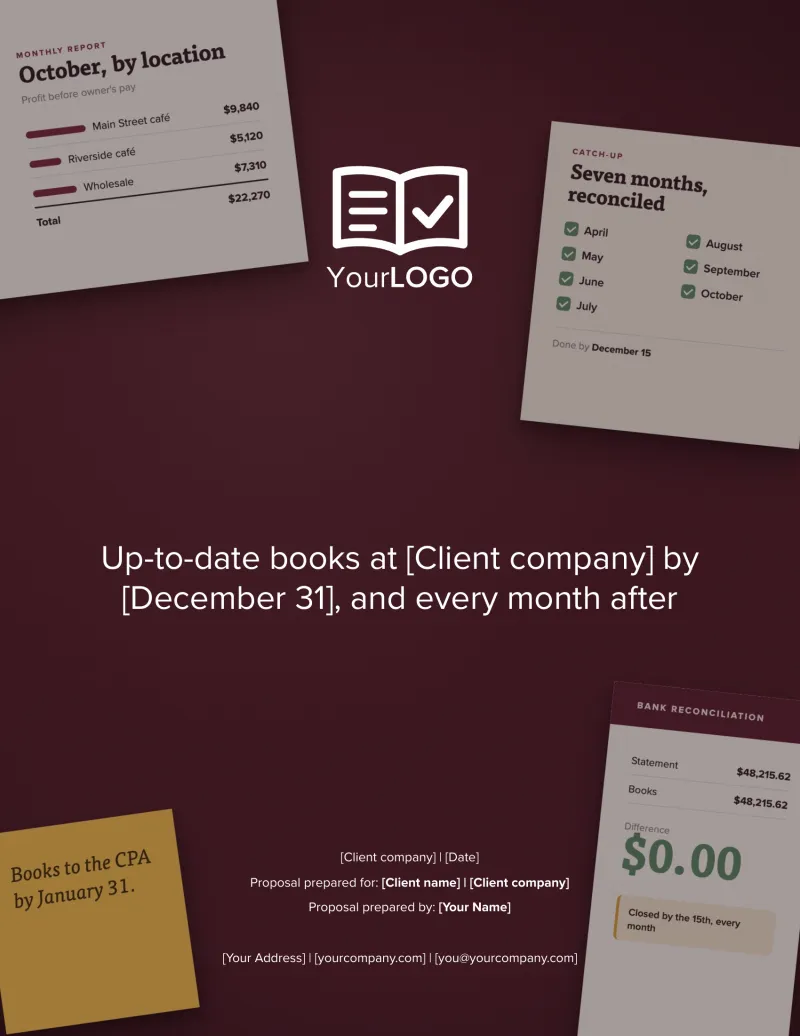
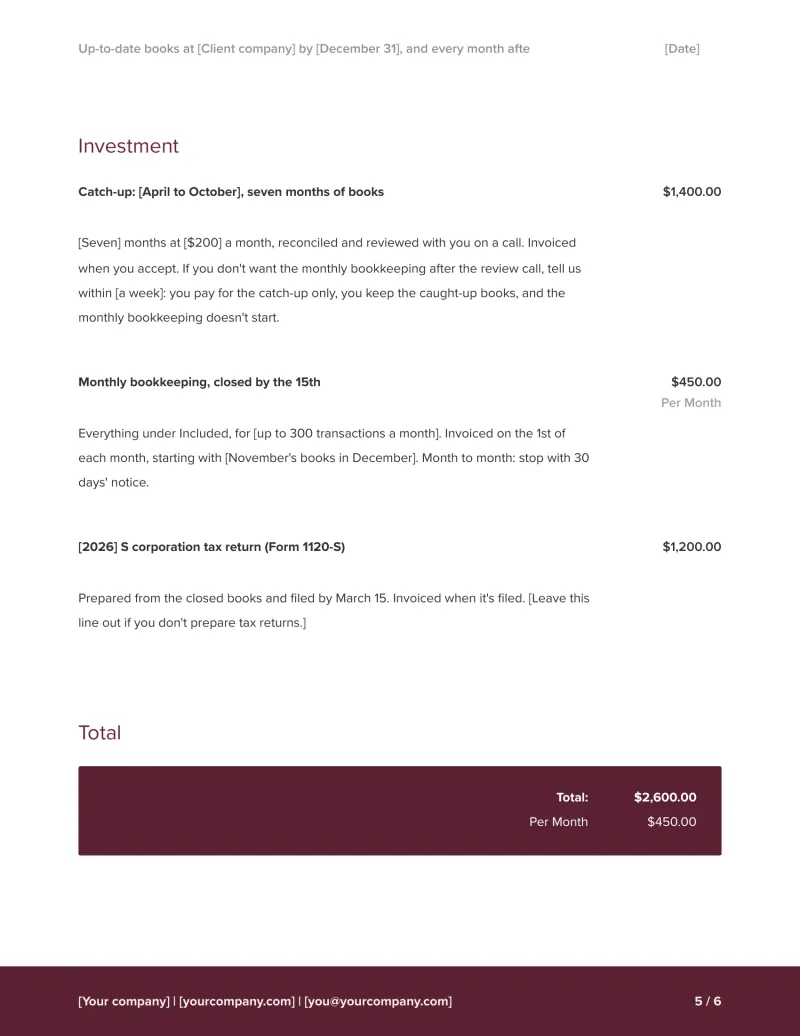
The bookkeeping and accounting proposal template: the cover and the investment page with a catch-up, monthly bookkeeping at $450 a month and the year's tax return
Get the Word + PDF
On this page
  1. What to include
  2. The template
  3. Proposal or engagement letter
  4. A filled-in example
  5. How to write one
  6. See it as your client will
  7. What to charge
  8. The email to send
  9. After you send it
  10. Word and PDF
  11. Questions

What should a bookkeeping proposal include?

A bookkeeping proposal is the document a bookkeeper or an accounting firm sends a business to take over its books: what's wrong with them now, what you'll do every month, what it costs and what the client has to send you. It should repeat what the client told you, the result you'll both check and what late or messy books cost them, how you'll catch up the months behind and then close each month, what's included and what isn't, one price with when each part is invoiced, and how to say yes. The template below has a section for each.

  1. 1 IntroductionThe whole plan in two sentences, and who does the books.
  2. 2 What we heardWhat the client told you, and what messy books cost them.
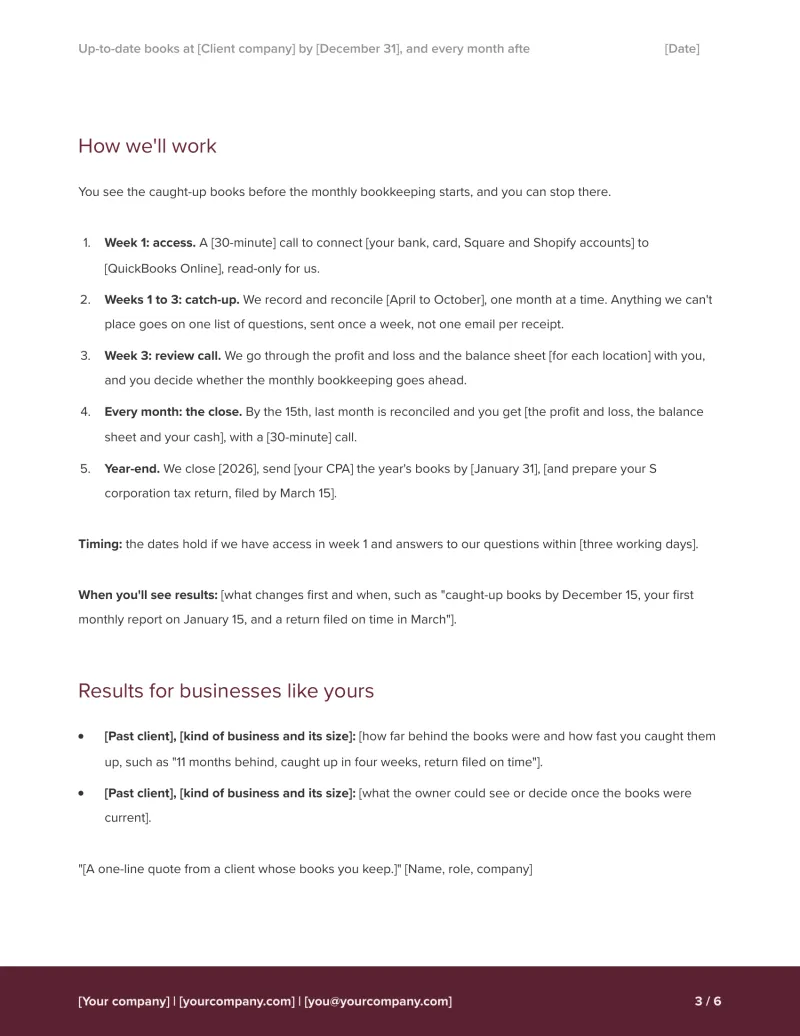
  3. 3 How we'll workThe catch-up, the monthly close and the year-end, with dates.
  4. 4 Results for businesses like yoursShort proof from businesses like theirs.
  5. 5 What's includedWhat's included, what isn't, and what you need from the client.
  6. 6 InvestmentThe catch-up, the monthly fee and the tax return, with a way out.
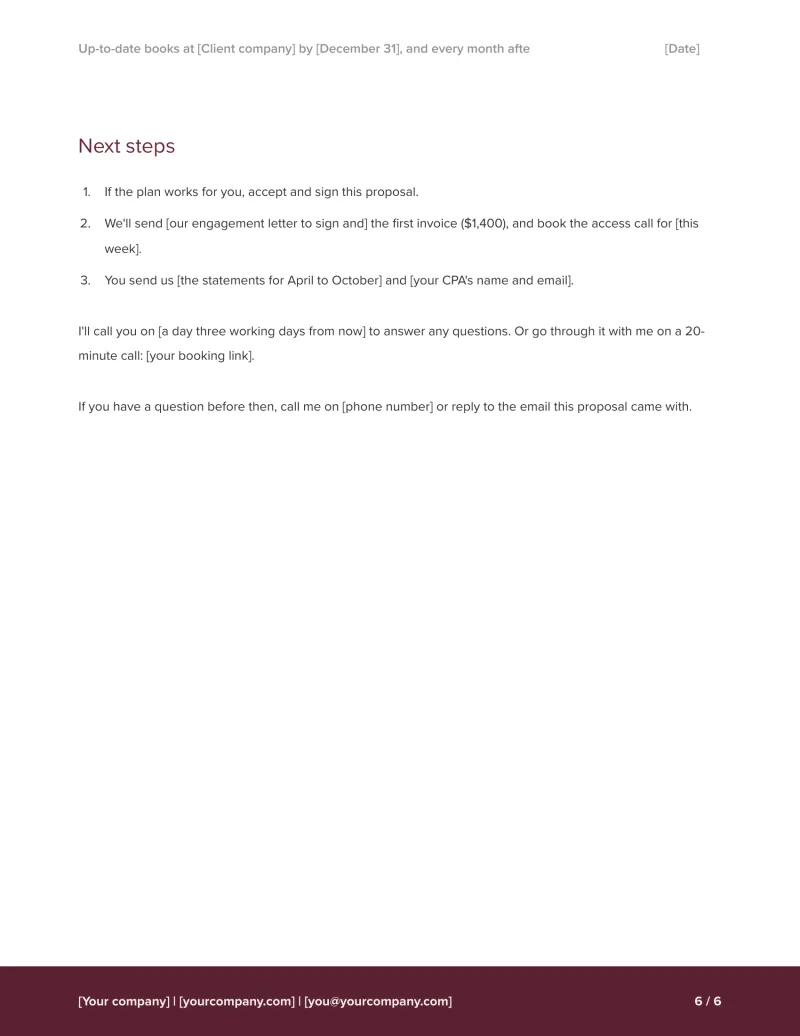
  7. 7 Next stepsHow to say yes, and when you'll follow up.

The bookkeeping and accounting proposal template, section by section

Copy one section or the whole thing. Under each section: what it's for, and one thing we've learned from the proposals sent with Nusii.

[Yellow] you write [Green] Nusii fills in when you send it

1. Introduction

The whole plan in two sentences, who you are and who does the books. The owner often reads it with a partner or their CPA, so it has to make sense to someone who wasn't on the call.

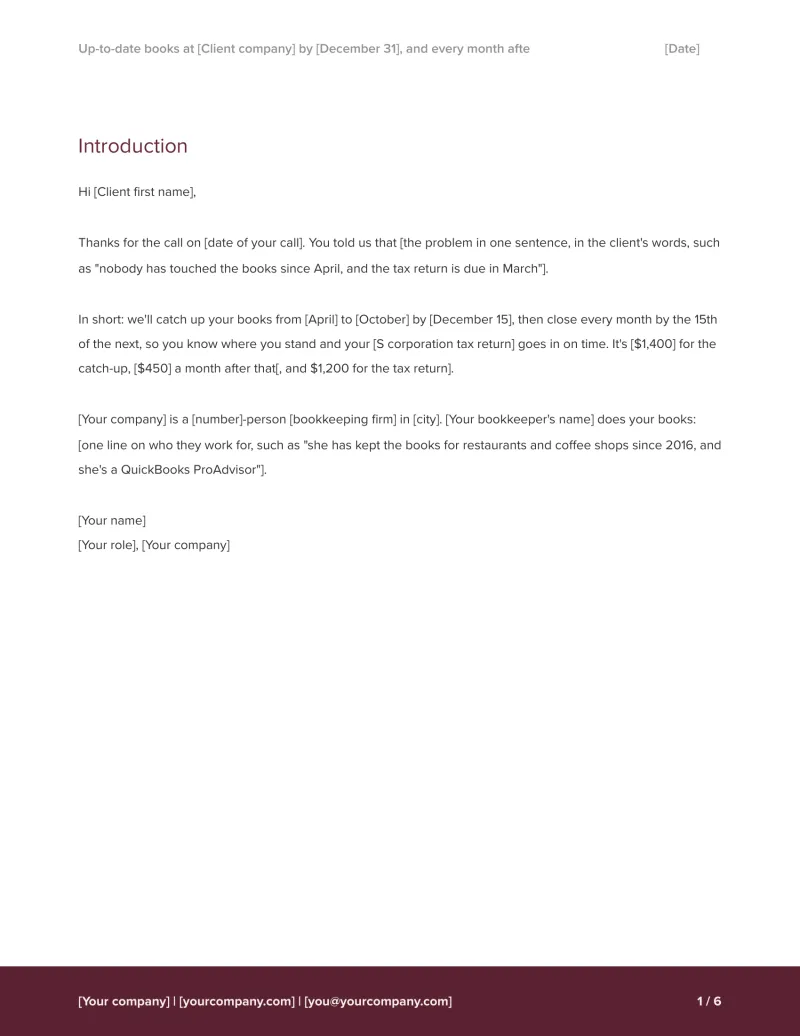
Hi [Client first name],

Thanks for the call on [date of your call]. You told us that [the problem in one sentence, in the client's words, such as "nobody has touched the books since April, and the tax return is due in March"].

In short: we'll catch up your books from [April] to [October] by [December 15], then close every month by the 15th of the next, so you know where you stand and your [S corporation tax return] goes in on time. It's [$1,400] for the catch-up, [$450] a month after that[, and $1,200 for the tax return].

[Your company] is a [number]-person [bookkeeping firm] in [city]. [Your bookkeeper's name] does your books: [one line on who they work for, such as "she has kept the books for restaurants and coffee shops since 2016, and she's a QuickBooks ProAdvisor"].

[Your name]
[Your role], [Your company]

Professional services firms' proposals in Nusii got their first look in a median of 30 minutes (271 proposals, November 2025 to October 2026), and about a third of first views are on a phone. Put the date the books are caught up and the monthly fee in the first lines.
2. What we heard

Shows you listened, turns what the client told you into goals you can both check, and puts a number on what messy books cost them. Only you can write this one: replace the examples with your client's words.

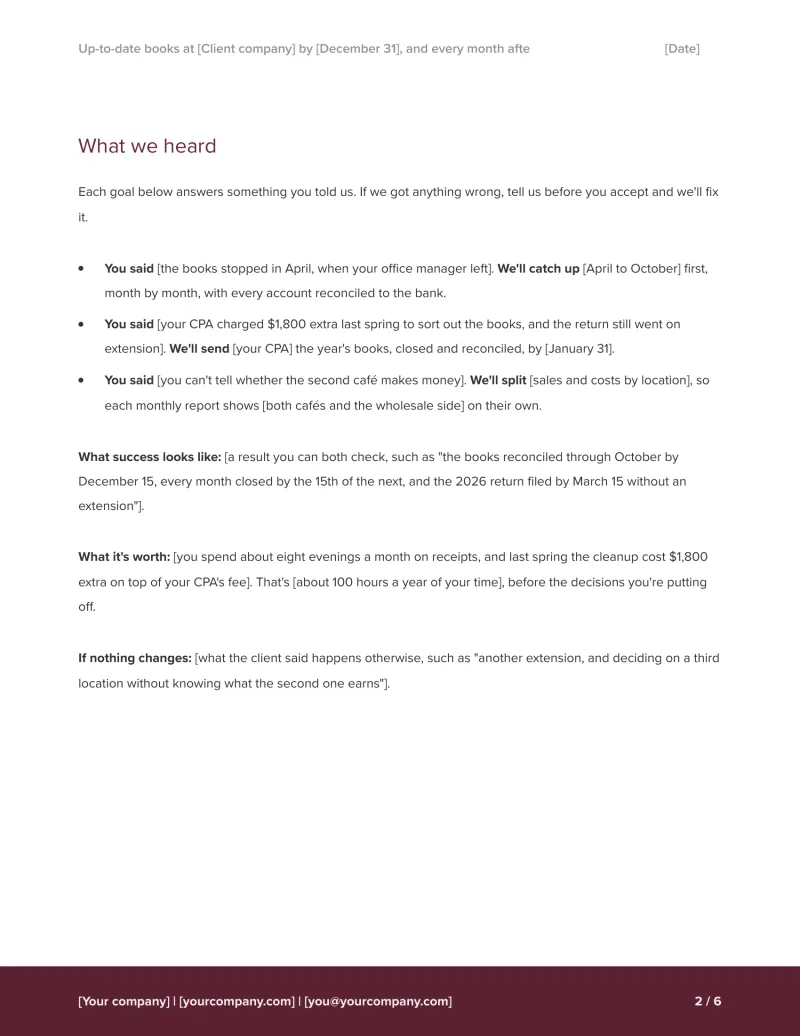
Each goal below answers something you told us. If we got anything wrong, tell us before you accept and we'll fix it.

  • You said [the books stopped in April, when your office manager left]. We'll catch up [April to October] first, month by month, with every account reconciled to the bank.
  • You said [your CPA charged $1,800 extra last spring to sort out the books, and the return still went on extension]. We'll send [your CPA] the year's books, closed and reconciled, by [January 31].
  • You said [you can't tell whether the second café makes money]. We'll split [sales and costs by location], so each monthly report shows [both cafés and the wholesale side] on their own.

What success looks like: [a result you can both check, such as "the books reconciled through October by December 15, every month closed by the 15th of the next, and the 2026 return filed by March 15 without an extension"].

What it's worth: [you spend about eight evenings a month on receipts, and last spring the cleanup cost $1,800 extra on top of your CPA's fee]. That's [about 100 hours a year of your time], before the decisions you're putting off.

If nothing changes: [what the client said happens otherwise, such as "another extension, and deciding on a third location without knowing what the second one earns"].

"We need a bookkeeper" is the client's answer, not their problem. Our 2015 book on proposals calls what clients hand you "the end result of their problem". Ask what they can't decide or can't file because the books are behind: that's what goes here, and it's what the monthly fee is worth to them.

3. How we'll work

The catch-up, the monthly close and the year-end, with dates, so the client knows what happens when, what they have to send you, and where they can decide not to go on.

You see the caught-up books before the monthly bookkeeping starts, and you can stop there.

  1. Week 1: access. A [30-minute] call to connect [your bank, card, Square and Shopify accounts] to [QuickBooks Online], read-only for us.
  2. Weeks 1 to 3: catch-up. We record and reconcile [April to October], one month at a time. Anything we can't place goes on one list of questions, sent once a week, not one email per receipt.
  3. Week 3: review call. We go through the profit and loss and the balance sheet [for each location] with you, and you decide whether the monthly bookkeeping goes ahead.
  4. Every month: the close. By the 15th, last month is reconciled and you get [the profit and loss, the balance sheet and your cash], with a [30-minute] call.
  5. Year-end. We close [2026], send [your CPA] the year's books by [January 31], [and prepare your S corporation tax return, filed by March 15].

Timing: the dates hold if we have access in week 1 and answers to our questions within [three working days].

When you'll see results: [what changes first and when, such as "caught-up books by December 15, your first monthly report on January 15, and a return filed on time in March"].

Philip Morgan and Jonathan Stark, in our 2015 book: "If a project does require firm completion dates, call out your assumptions about what will be required to meet those dates." In bookkeeping, half the dates are the client's: how fast they give you access, send the missing statements and answer your questions.

4. Results for businesses like yours

Short proof for the people who weren't on the call: a business like theirs, how far behind it was and what changed once the books were current.

  • [Past client], [kind of business and its size]: [how far behind the books were and how fast you caught them up, such as "11 months behind, caught up in four weeks, return filed on time"].
  • [Past client], [kind of business and its size]: [what the owner could see or decide once the books were current].

"[A one-line quote from a client whose books you keep.]" [Name, role, company]

Proposals to a repeat client were accepted 63.4% of the time in Nusii, against 47.2% for a first proposal to that client, for the same 122 accounts (July to September 2026). A new client hasn't seen your monthly reports yet: one business like theirs, with how far behind it was and what changed, says more than a list of software logos.

5. What's included

What the fees cover and what they don't, what you need from the client, and the terms bookkeeping goes wrong on: more work than you priced, missing receipts, and who the books belong to. If your firm also signs an engagement letter, name it here.

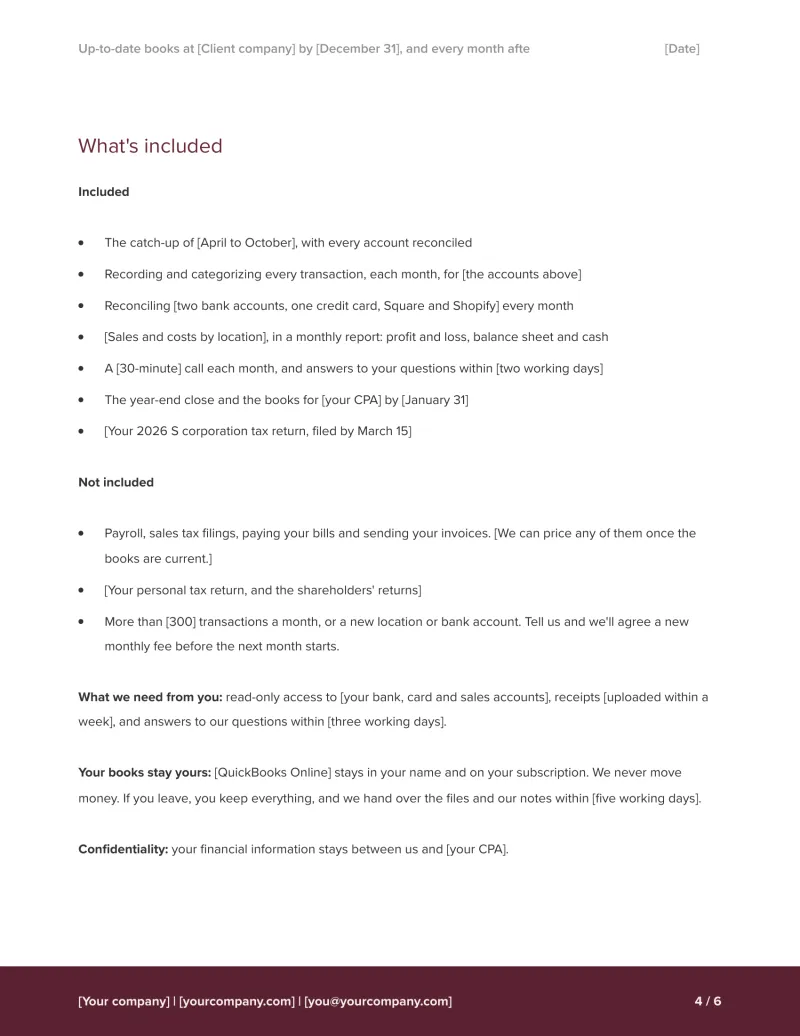
Included

  • The catch-up of [April to October], with every account reconciled
  • Recording and categorizing every transaction, each month, for [the accounts above]
  • Reconciling [two bank accounts, one credit card, Square and Shopify] every month
  • [Sales and costs by location], in a monthly report: profit and loss, balance sheet and cash
  • A [30-minute] call each month, and answers to your questions within [two working days]
  • The year-end close and the books for [your CPA] by [January 31]
  • [Your 2026 S corporation tax return, filed by March 15]

Not included

  • Payroll, sales tax filings, paying your bills and sending your invoices. [We can price any of them once the books are current.]
  • [Your personal tax return, and the shareholders' returns]
  • More than [300] transactions a month, or a new location or bank account. Tell us and we'll agree a new monthly fee before the next month starts.

What we need from you: read-only access to [your bank, card and sales accounts], receipts [uploaded within a week], and answers to our questions within [three working days].

Your books stay yours: [QuickBooks Online] stays in your name and on your subscription. We never move money. If you leave, you keep everything, and we hand over the files and our notes within [five working days].

Confidentiality: your financial information stays between us and [your CPA].

Kai Davis, interviewed for our 2015 book, calls proposals "a way to communicate value and reduce risk". The risk a client sees in a new bookkeeper is losing control of their own numbers. Saying the books stay in their name, and what happens when they leave, answers it.

6. Investment

One price in up to three parts: the catch-up, the monthly bookkeeping and the year's tax return, each with when it's invoiced, and a way out after the catch-up. These are example prices; the table further down shows what others charge.

Catch-up: [April to October], seven months of books

$1,400

[Seven] months at [$200] a month, reconciled and reviewed with you on a call. Invoiced when you accept. If you don't want the monthly bookkeeping after the review call, tell us within [a week]: you pay for the catch-up only, you keep the caught-up books, and the monthly bookkeeping doesn't start.

Monthly bookkeeping, closed by the 15th

$450 a month

Everything under Included, for [up to 300 transactions a month]. Invoiced on the 1st of each month, starting with [November's books in December]. Month to month: stop with 30 days' notice.

[2026] S corporation tax return (Form 1120-S)

$1,200

Prepared from the closed books and filed by March 15. Invoiced when it's filed. [Leave this line out if you don't prepare tax returns.]

Total: $2,600 then $450 a month

In Nusii, proposals with a recurring fee were accepted less often than one-off ones (39.5% against 54.6% for the same 84 accounts, July to September 2026). A monthly fee is a bigger decision than a project, so the catch-up works as a paid trial: the client sees the books before they commit to the months after.

7. Next steps

Tells the client exactly what to do to say yes, what happens after, and when you'll call. No expiry date and no "spots are limited before tax season".

  1. If the plan works for you, accept and sign this proposal.
  2. We'll send [our engagement letter to sign and] the first invoice ($1,400), and book the access call for [this week].
  3. You send us [the statements for April to October] and [your CPA's name and email].

I'll call you on [a day three working days from now] to answer any questions. Or go through it with me on a 20-minute call: [your booking link].

If you have a question before then, call me on [phone number] or reply to the email this proposal came with.

Professional services firms' accepted proposals in Nusii got their yes in a median of 1 day, and 72.7% of the yeses came within a week (271 proposals, November 2025 to October 2026). If you haven't heard in three working days, the call is due.

Proposal, engagement letter or both?

They do different jobs. The proposal gets the yes: what the client told you, what you'll do, what it costs. An engagement letter sets the terms of the work once they've said yes: who's responsible for what, what you don't do, how either side ends it. Many accounting firms sign one with every client.

  • A bookkeeper with a few clients: this template's What's included section (scope, what you need, who owns the books, how to leave) is often enough. Have a lawyer check it once.
  • An accounting firm: keep your engagement letter, send it right after the yes (the template's next steps say so), and make sure the two say the same thing about scope and fees.

Answering a request for proposals from a city, a school district or a nonprofit is a different document again: their form asks for licenses, insurance, references and a fee schedule, and it's scored against its own questions. Use their form, and this template for what it leaves open.

A bookkeeping proposal example, filled in

Two sections of the template above with a client's words in the brackets, so you can see how it reads when it's done. Brindle Lane Coffee Roasters is made up, and so are its numbers.

Up-to-date books at Brindle Lane Coffee Roasters by December 31, and every month after

What we heard

  • You said the books stopped in April, when your office manager left. We'll catch up April to October first, month by month, with every account reconciled to the bank.
  • You said your CPA charged $1,800 extra last spring to sort out the books, and the return still went on extension. We'll send your CPA the year's books, closed and reconciled, by January 31.
  • You said you can't tell whether the second café makes money. We'll split sales and costs by location, so each monthly report shows both cafés and the wholesale side on their own.

What success looks like: the books reconciled through October by December 15, every month closed by the 15th of the next, and the 2026 return filed by March 15 without an extension.

What it's worth: you spend about eight evenings a month on receipts, and last spring the cleanup cost $1,800 extra on top of your CPA's fee. That's about 100 hours a year of your time, before the decisions you're putting off.

If nothing changes: another extension, and deciding on a third location without knowing what the second one earns.

Investment

Catch-up: April to October, seven months of books

$1,400

Monthly bookkeeping, closed by the 15th

$450 a month

2026 S corporation tax return (Form 1120-S)

$1,200

Total: $2,600 then $450 a month

How to write a bookkeeping proposal, step by step

Six steps, from the first call to the follow-up. The template above already follows them; here's why each one matters.

  1. Ask what the late books are stopping

    On the first call, find out how far behind the books are, which accounts there are, who runs payroll, when the tax return is due and who prepares it, and what the owner can't decide right now because the numbers aren't there. That last answer goes in "What we heard". Our 10 questions for the first client call cover most of it.

  2. Look at the books before you quote

    Ask for read-only access to the accounting file and the bank statements before you write a number. Count the months behind, the accounts and the transactions a month: the catch-up price comes from the first, the monthly fee from the other two.

  3. Price the catch-up and the month separately

    The catch-up is a one-off: a price per month of books behind, times the months. The monthly fee covers a number of accounts and transactions; say what happens above it (a new fee agreed before the next month), so growth doesn't turn into unpaid work. What bookkeepers charge has the outside rates.

  4. Write down who does what

    Most bookkeeping disputes are about scope: the client thought you'd pay their bills, you thought they'd send receipts. List what's included and what isn't (payroll, sales tax, bills and invoices), and what you need from them and by when.

  5. Give the client a way out after the catch-up

    A monthly fee is a bigger yes than a project. In Nusii, proposals with a recurring fee were accepted less often (39.5% against 54.6% for the same senders, July to September 2026). Letting the client stop after the catch-up, keeping the caught-up books, makes the first yes smaller.

  6. Send it, then call when you said you would

    Send it with a short email (there's one below) and call when you said you would. Professional services firms' accepted proposals in Nusii got their yes in a median of 1 day, and 72.7% of the yeses came within a week (November 2025 to October 2026).

See it as your client will

Every page of the PDF, printed by Nusii. Sent as a link, it's one scrolling page on any device: your client accepts with one button and signs with their name.

Open the live preview

The template in Nusii, the way your client will see it. It opens in a new tab.

What bookkeepers charge

What online bookkeeping services list for small businesses, from their own pricing pages, and what an employee doing it in-house earns. The template's example prices, a $1,400 catch-up, $450 a month and $1,200 for the tax return, sit in this range for a business with two bank accounts, a card and two sales channels.

What Price
Monthly bookkeeping, online service From $300/mo after a one-off cleanup fee; no bills, invoices or payroll QuickBooks Live
Cleanup of past books, online service From $600 by the number of months behind QuickBooks Live
Monthly bookkeeping, with a U.S. team From $400/mo books closed monthly or weekly Bookkeeper360
Catch-up and prior-period cleanup From $1,000 a one-off project before the monthly work Bookkeeper360
Business tax return From $1,200 a year, priced separately from the bookkeeping Bookkeeper360
An in-house bookkeeping clerk $24.36/hr median pay, before payroll taxes and benefits ($50,670 a year) U.S. Bureau of Labor Statistics

Sources: QuickBooks Live, Full-Service Bookkeeping, November 2026; QuickBooks Live, Expert Cleanup, November 2026; Bookkeeper360, pricing, November 2026; U.S. Bureau of Labor Statistics, bookkeeping clerks, May 2025. These are starting prices from two online services and the pay of an employee, not a survey of bookkeeping firms. A local firm with a named bookkeeper and a monthly call usually charges more than the online starting price. Treat them as a rough guide.

How often proposals got a yes, by price

The template's one-off total, the $1,400 catch-up and the $1,200 tax return, sits in the $1,000 to $5,000 band, where about half of proposals got a yes; the monthly fee comes on top. From 1,713 proposals first sent with Nusii, July to September 2026.

Under $1,000
67.1%
$1,000 to $5,000
50.7%
$5,000 to $15,000
48.9%
$15,000 to $50,000
36.1%
Over $50,000
33.3%

Share accepted, by the total the client saw. Bigger proposals are bigger decisions, so this shows what happened, not that a lower price would win. Method: The State of Proposals 2026.

The email to send it with

The proposal does the explaining, so the email only has to get it opened and say when you'll call. Leave the fees out, so your client reads the plan before they judge the numbers. Owners often forward it to their CPA or a partner, so say in one line what changes and by when: that's the line they'll read. In Nusii this goes in the Send Proposal window, and you can save it as your template for next time.

Subject: [Your books caught up by December 15]

Hi [first name],

Here's the proposal we talked about on [day of your call]: [link].

In short: we catch up [April to October] first, you see the books on a call, and then we close every month by the 15th.

It's short, and you can accept it right on the page. If anything's off, reply to this email and I'll change it.

I'll call you on [a day three to five days from now] to answer any questions.

[Your name]

What happens after you send it

Of 271 proposals professional services firms first sent with Nusii, November 2025 to October 2026, 52.8% were accepted, with a median of 1 day to a yes.

52.8%
were accepted
30 minutes
median time to the client's first look
1 day
median time to a yes
72.7%
of the yeses came within a week

Clients rarely say no. Of all proposals sent with Nusii from July to September 2026, 6.5% were rejected and 45.2% got no answer either way. Silence is the usual no, so a follow-up is worth sending.

Call within three working days. Proposals sent a second time, more than an hour after the first send, were accepted 59.8% of the time, against 47.9%, for the same 100 accounts (July to September 2026). That's a correlation, not proof: an interested client may be why they were sent again. In Nusii you see when the proposal was opened, so you can call once the owner has read it.

More numbers and the method: The State of Proposals 2026.

Get the Word and PDF files

The same template as a Word file you can edit (it opens in Google Docs too) and a PDF printed by Nusii. We'll email you both, plus a few emails with proposal tips. Unsubscribe any time.

Or send it with Nusii

This template is in the gallery of every Nusii account. Send it as a link: you get an email when your client opens it, and they accept and sign online, on any device.

I have been using Nusii for about 3 years now and it’s the most professional and easy to use proposal software I have come across. In a world where everybody sends ugly PDF proposals, using Nusii makes you stand out.

Roberto Cornejo
Roberto Cornejo
Founder & CEO, Start-Ops Mexico

I use Nusii all the time when I send proposals to clients. They find it easy to use so I never have to explain anything how to accept the proposals.

Yos William
Yos William
Director, Infinite Ace
Start your free trial

14-day trial · 60-day money-back guarantee

Questions about bookkeeping and accounting proposals

What is a bookkeeping proposal?

A document a bookkeeper or an accounting firm sends a business to take over its books: what’s wrong with them now, what you’ll do each month, what it costs and what the client has to send you. The client accepts it before the work starts, so it also sets the terms: the fees, when they’re invoiced and how either side stops.

What should a bookkeeping proposal include?

What the client told you and the result you’ll both check, how you’ll catch up the months behind and close each month, short proof from similar businesses, what’s included and what isn’t, one price with when each part is invoiced, and the next steps. That’s seven sections, the same as the template on this page.

How much should I charge for monthly bookkeeping?

Price it by the accounts and the transactions a month, not by the hour. Online services start at $300 a month (QuickBooks Live) and $400 (Bookkeeper360) before a cleanup fee, and a local bookkeeper with a monthly call usually charges more. This template uses $450 a month for a business with about 300 transactions across five accounts.

How do I price catch-up or cleanup bookkeeping?

As a one-off, by the months behind: the template uses $200 a month for seven months, $1,400. QuickBooks Live’s cleanup starts at $600 and Bookkeeper360’s catch-up at $1,000. Look at the books before you quote: books that were kept badly take longer than books that weren’t kept at all.

Can I use this as an accounting proposal template?

Yes. It already has the year-end close and the business tax return as its own line. An accounting firm usually adds its engagement letter after the yes, and can add advisory work (a quarterly planning call, for example) as another line in the Investment section.

What’s the difference between a bookkeeping proposal and an engagement letter?

The proposal gets the yes: the problem, the plan and the price. The engagement letter sets the terms of the work after the yes: responsibilities, limits and how it ends. Many accounting firms send both; proposal or engagement letter shows how they fit.

Should I offer three packages?

Only if the client asked for choices. In Nusii, proposals where the client could choose between options were accepted less often (40.4% against 51.7% for the same senders, July to September 2026). This template has one price for what the client told you they need; add payroll or advisory later, once the books are current.

Can you show me an example of a bookkeeping proposal?

Yes: the filled-in example above shows “What we heard” and the Investment section for a made-up coffee roaster with two cafés, seven months behind, with every bracket filled in.

Is the template free, and does it come in Word and PDF?

Yes. The whole template is on this page to copy, and the download gives you an editable Word file and a PDF. You can also open it in Nusii and send it as an online proposal.

Can my client accept and sign the proposal online?

Yes, if you send it as an online proposal. In Nusii, your client opens a link, accepts with one button and signs with their typed name, on any device, and you get an email when they do. The Word file and the PDF need signing the old way.

More templates and guides

Send your next bookkeeping and accounting proposal as a link, and see when it's opened

Try Nusii free for 14 days

Cancel anytime · 60-day money-back guarantee