A public relations proposal in seven sections, from what your client told you to a paid story and media plan, monthly pitching and the next steps. For PR agencies and freelance publicists. Read it here or get it as a Word file and a PDF.
A PR proposal should say what the client told you, the goal you'll both measure, how you'll work (usually a story and media plan, then monthly pitching), what you can and can't promise, what's included and what isn't, the price, and exactly how to say yes. The template below has a section for each.
Copy one section or the whole thing. Under each section: what it's for, and one thing we've learned from the proposals sent with Nusii.
[Yellow] you write[Green] Nusii fills in when you send it
1. Introduction
The whole plan in two sentences, what you can't promise, and who you are. Partners and colleagues read it too, often without having been on the call. Working on your own? Write "I" instead of "we".
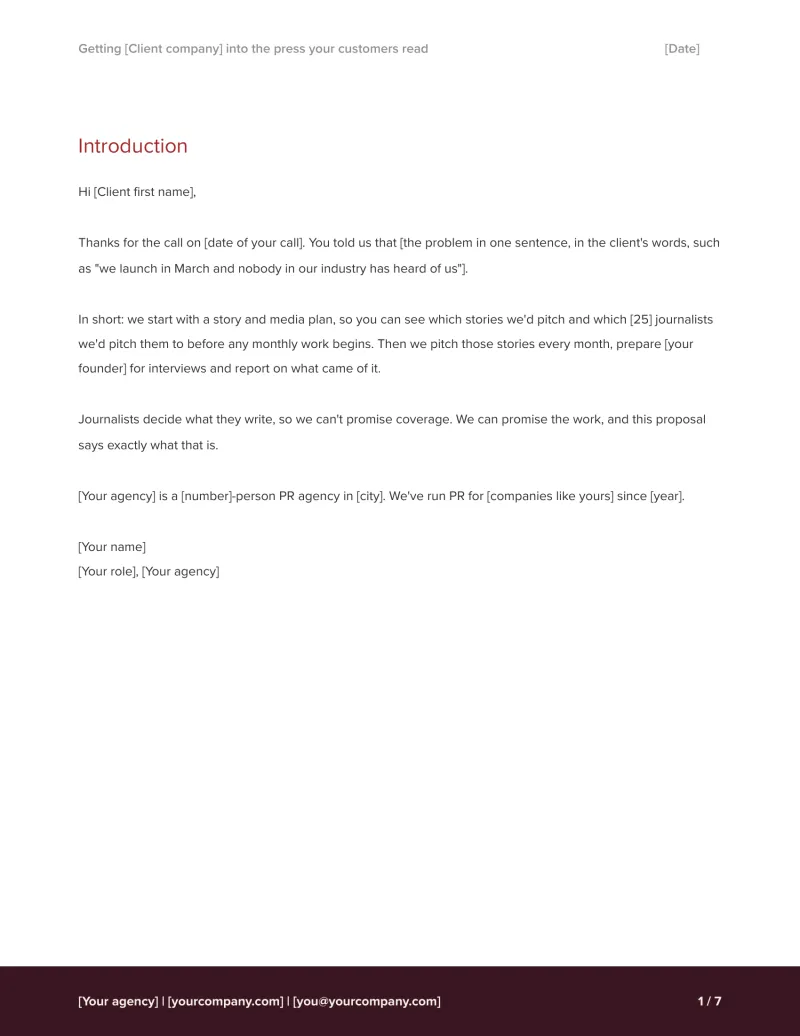
Hi [Client first name],
Thanks for the call on [date of your call]. You told us that [the problem in one sentence, in the client's words, such as "we launch in March and nobody in our industry has heard of us"].
In short: we start with a story and media plan, so you can see which stories we'd pitch and which [25] journalists we'd pitch them to before any monthly work begins. Then we pitch those stories every month, prepare [your founder] for interviews and report on what came of it.
Journalists decide what they write, so we can't promise coverage. We can promise the work, and this proposal says exactly what that is.
[Your agency] is a [number]-person PR agency in [city]. We've run PR for [companies like yours] since [year].
[Your name] [Your role], [Your agency]
Agencies' proposals in Nusii got their first look in a median of 54 minutes (3,782 proposals, November 2025 to October 2026), and about a third of first views are on a phone. That's why the line about coverage is up here, on the first screen, and not under the price.
2. What we heard
Shows you listened, turns what the client told you into goals you can both check later, and puts a number on what PR is worth to them. Only you can write this one: replace the examples with your client's words.
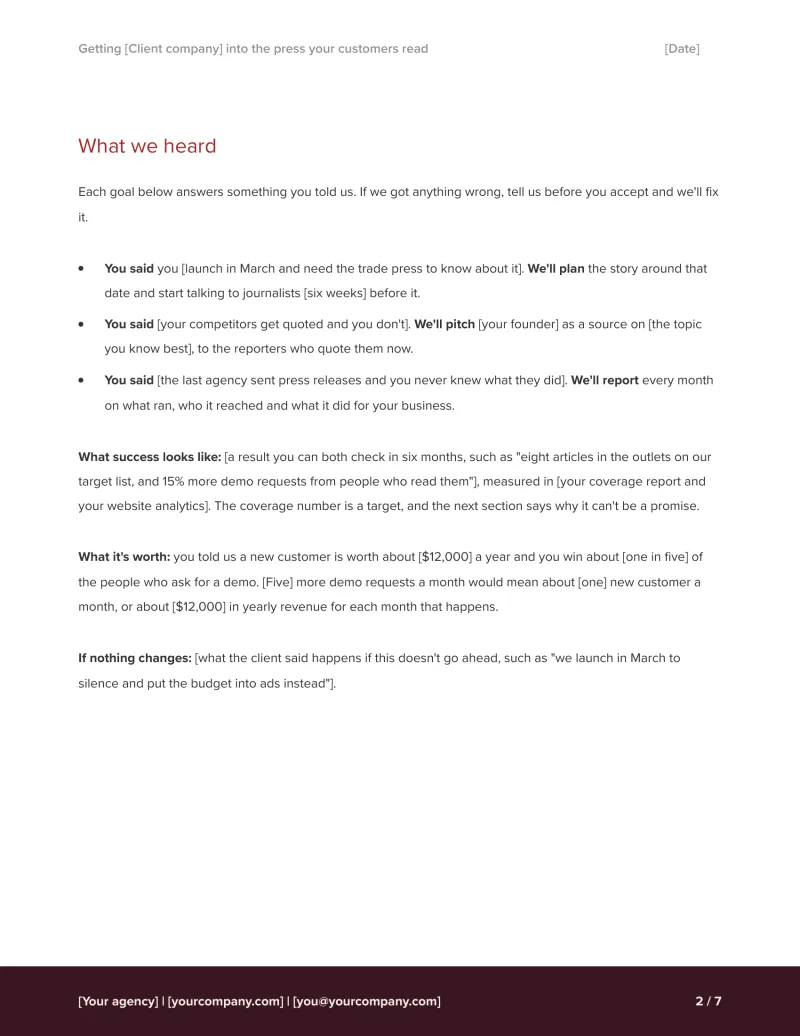
Each goal below answers something you told us. If we got anything wrong, tell us before you accept and we'll fix it.
You said you [launch in March and need the trade press to know about it]. We'll plan the story around that date and start talking to journalists [six weeks] before it.
You said[your competitors get quoted and you don't]. We'll pitch[your founder] as a source on [the topic you know best], to the reporters who quote them now.
You said[the last agency sent press releases and you never knew what they did]. We'll report every month on what ran, who it reached and what it did for your business.
What success looks like:[a result you can both check in six months, such as "eight articles in the outlets on our target list, and 15% more demo requests from people who read them"], measured in [your coverage report and your website analytics]. The coverage number is a target, and the next section says why it can't be a promise.
What it's worth: you told us a new customer is worth about [$12,000] a year and you win about [one in five] of the people who ask for a demo. [Five] more demo requests a month would mean about [one] new customer a month, or about [$12,000] in yearly revenue for each month that happens.
If nothing changes:[what the client said happens if this doesn't go ahead, such as "we launch in March to silence and put the budget into ads instead"].
Ask three things on the call: why now, who they want to reach, and what a new customer is worth. Not every customer will say where they heard of you, so agree on something you can count, such as demo requests. As Philip Morgan and Jonathan Stark put it in our 2015 book on proposals, "the buyer will set the value", so the numbers should be your client's.
3. How we'll work
The plan step by step, what you can promise and what you can't, and when to expect results.
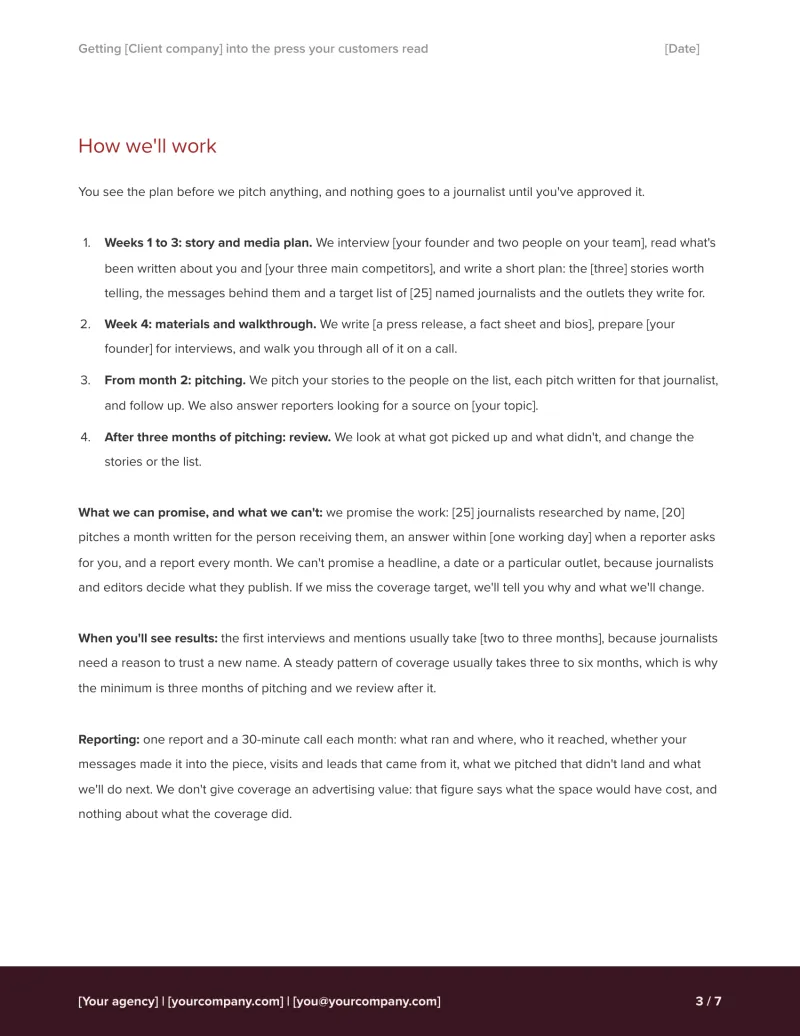
You see the plan before we pitch anything, and nothing goes to a journalist until you've approved it.
Weeks 1 to 3: story and media plan. We interview [your founder and two people on your team], read what's been written about you and [your three main competitors], and write a short plan: the [three] stories worth telling, the messages behind them and a target list of [25] named journalists and the outlets they write for.
Week 4: materials and walkthrough. We write [a press release, a fact sheet and bios], prepare [your founder] for interviews, and walk you through all of it on a call.
From month 2: pitching. We pitch your stories to the people on the list, each pitch written for that journalist, and follow up. We also answer reporters looking for a source on [your topic].
After three months of pitching: review. We look at what got picked up and what didn't, and change the stories or the list.
What we can promise, and what we can't: we promise the work: [25] journalists researched by name, [20] pitches a month written for the person receiving them, an answer within [one working day] when a reporter asks for you, and a report every month. We can't promise a headline, a date or a particular outlet, because journalists and editors decide what they publish. If we miss the coverage target, we'll tell you why and what we'll change.
When you'll see results: the first interviews and mentions usually take [two to three months], because journalists need a reason to trust a new name. A steady pattern of coverage usually takes three to six months, which is why the minimum is three months of pitching and we review after it.
Reporting: one report and a 30-minute call each month: what ran and where, who it reached, whether your messages made it into the piece, visits and leads that came from it, what we pitched that didn't land and what we'll do next. We don't give coverage an advertising value: that figure says what the space would have cost, and nothing about what the coverage did.
Accepted proposals in Nusii had a median of 7 sections, the rest 9 (1,713 proposals, July to September 2026). The stories and the target list belong in the written plan from week 3, not here.
4. Results for businesses like yours
Short proof for the people who weren't on the call: what happened for businesses like this one. Use real numbers from a real client, or leave this section out.
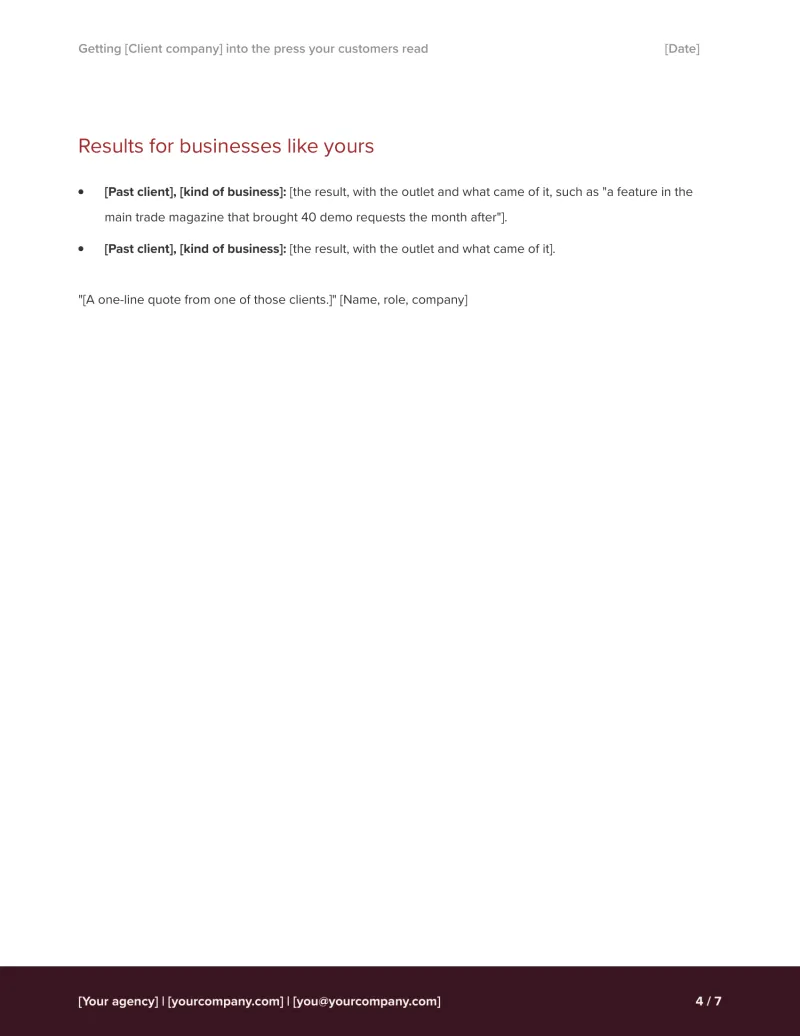
[Past client], [kind of business]:[the result, with the outlet and what came of it, such as "a feature in the main trade magazine that brought 40 demo requests the month after"].
[Past client], [kind of business]:[the result, with the outlet and what came of it].
"[A one-line quote from one of those clients.]" [Name, role, company]
Proposals to a client who had accepted one before were accepted 63% of the time in Nusii, against 46% for a first proposal from the same senders (July to September 2026). A new client hasn't seen your work yet: one article with what came of it does more here than a row of publication logos.
5. What's included
Draws the line between what you'll do and what you won't, says what you need from the client, and what they keep. Selling to consumers? The line in brackets says what to swap.
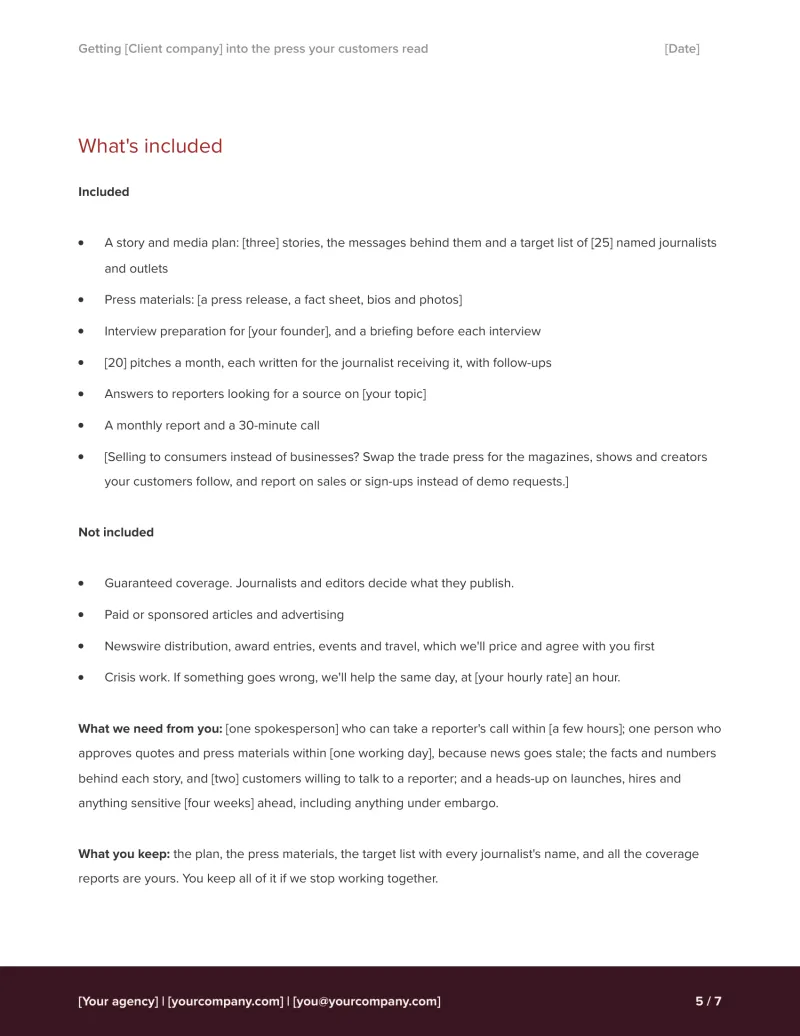
Included
A story and media plan: [three] stories, the messages behind them and a target list of [25] named journalists and outlets
Press materials: [a press release, a fact sheet, bios and photos]
Interview preparation for [your founder], and a briefing before each interview
[20] pitches a month, each written for the journalist receiving it, with follow-ups
Answers to reporters looking for a source on [your topic]
A monthly report and a 30-minute call
[Selling to consumers instead of businesses? Swap the trade press for the magazines, shows and creators your customers follow, and report on sales or sign-ups instead of demo requests.]
Not included
Guaranteed coverage. Journalists and editors decide what they publish.
Paid or sponsored articles and advertising
Newswire distribution, award entries, events and travel, which we'll price and agree with you first
Crisis work. If something goes wrong, we'll help the same day, at [your hourly rate] an hour.
What we need from you:[one spokesperson] who can take a reporter's call within [a few hours]; one person who approves quotes and press materials within [one working day], because news goes stale; the facts and numbers behind each story, and [two] customers willing to talk to a reporter; and a heads-up on launches, hires and anything sensitive [four weeks] ahead, including anything under embargo.
What you keep: the plan, the press materials, the target list with every journalist's name, and all the coverage reports are yours. You keep all of it if we stop working together.
Idea Grove, a B2B PR agency, lists what usually costs extra: newswire distribution, survey costs, award entry fees, travel, event expenses, design or video production, and paid or sponsored content. Agree on who pays before the work starts. And link to past coverage instead of pasting it in: proposals with images were accepted less often in Nusii (42% against 54% for the same senders, July to September 2026).
6. Investment
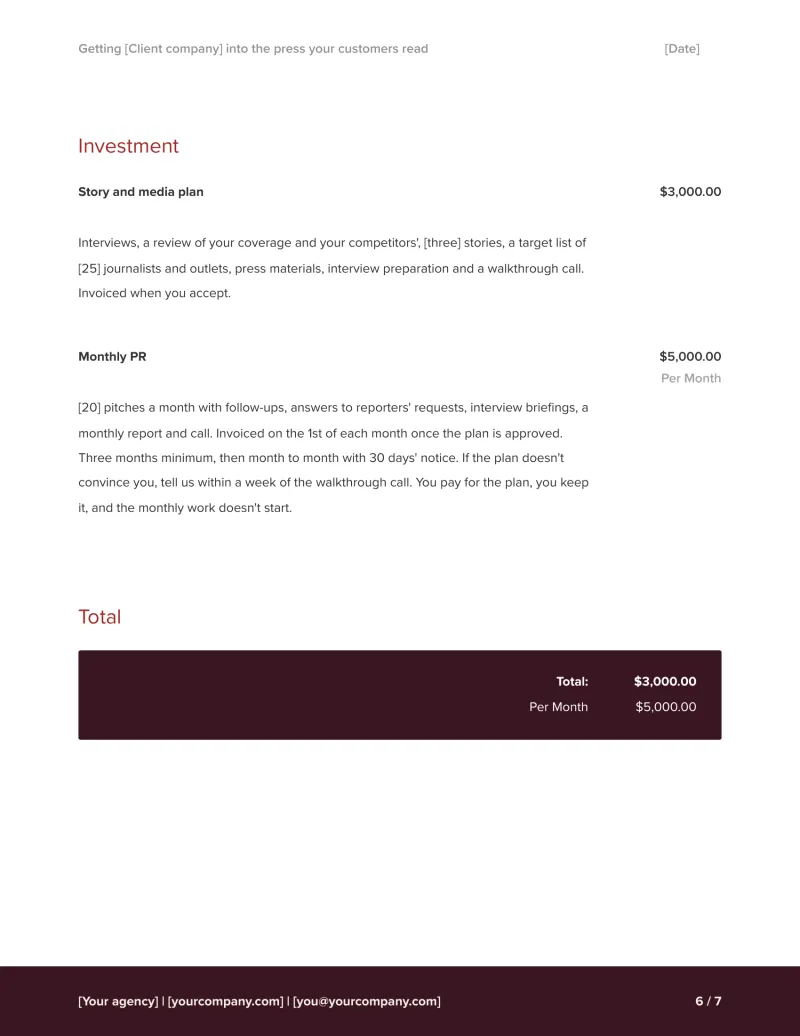
One price to start, for the story and media plan, then a monthly fee, each with when it's invoiced, and a way out before the monthly work begins. These are example prices; the table further down shows what others charge.
Story and media plan
$3,000
Interviews, a review of your coverage and your competitors', [three] stories, a target list of [25] journalists and outlets, press materials, interview preparation and a walkthrough call. Invoiced when you accept.
Monthly PR
$5,000 a month
[20] pitches a month with follow-ups, answers to reporters' requests, interview briefings, a monthly report and call. Invoiced on the 1st of each month once the plan is approved. Three months minimum, then month to month with 30 days' notice. If the plan doesn't convince you, tell us within a week of the walkthrough call. You pay for the plan, you keep it, and the monthly work doesn't start.
Total: $3,000then $5,000 a month
In Nusii, proposals with a recurring fee were accepted less often than one-off ones (39% against 55% for the same senders, July to September 2026). A monthly fee is a bigger decision. The plan gives the client a first step with a clear end.
7. Next steps
Tells the client exactly what to do to say yes, what happens after, and when you'll call.
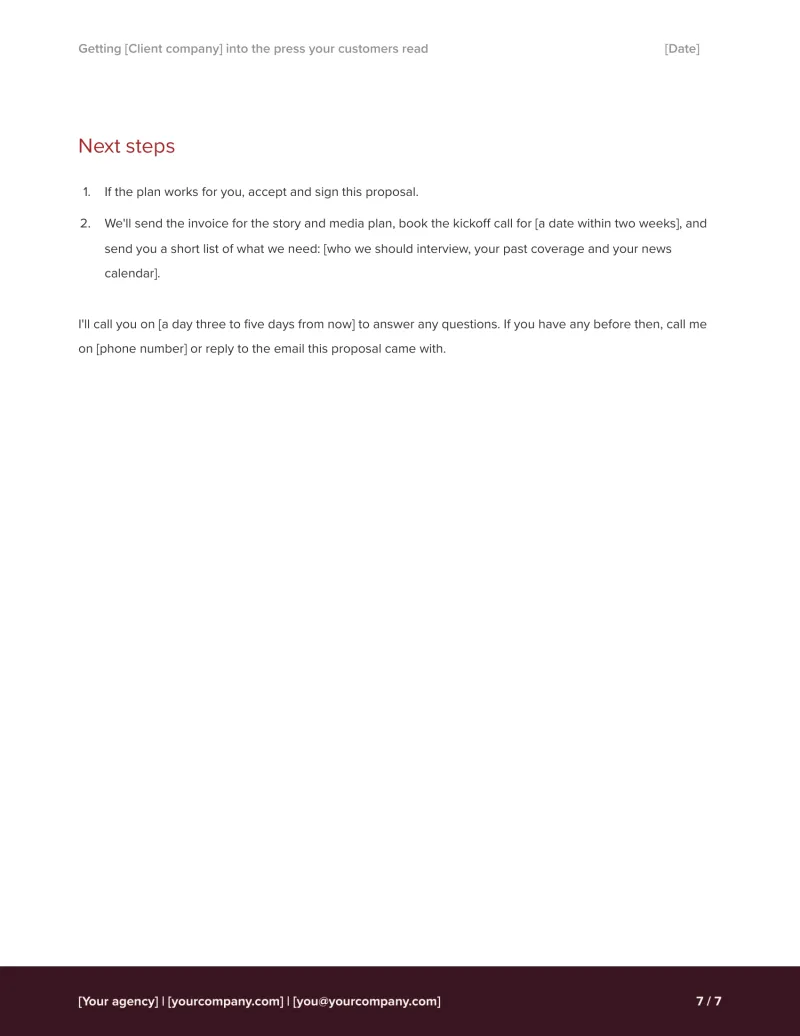
If the plan works for you, accept and sign this proposal.
We'll send the invoice for the story and media plan, book the kickoff call for [a date within two weeks], and send you a short list of what we need: [who we should interview, your past coverage and your news calendar].
I'll call you on [a day three to five days from now] to answer any questions. If you have any before then, call me on [phone number] or reply to the email this proposal came with.
Agencies' accepted proposals in Nusii got their yes in a median of 3.9 days, and 62% of them within a week (November 2025 to October 2026). A call three to five days after you send it lands while most clients are still deciding.
What a PR proposal can and can't promise
Your client will ask whether you can guarantee coverage. None of the pages at the top of Google for this search deals with that (November 2026), so here's how this template does.
“Earned media isn't guaranteed because the journalist or editor ultimately makes the decision,” writes Scott Baradell, who has run a B2B PR agency for more than 20 years. Prowly, which makes PR software, is blunter: “no honest and transparent PR proposal or PR contract can include guaranteed placements.”
So the template promises what you control and sets coverage as a target:
Promise the work: the journalists you'll research, the pitches you'll write, how fast you'll answer a reporter, the report.
Target the coverage: a number of articles in the outlets on your list, with a date, and call it a target.
Measure what follows it: visits and leads from the coverage, and whether your messages made it into the piece.
Leave out advertising value.AMEC, the international association for measuring communication, campaigns to “eradicate fully the use of Advertising Equivalency Value (AVE) and all of its derivatives as metrics”.
See it as your client will
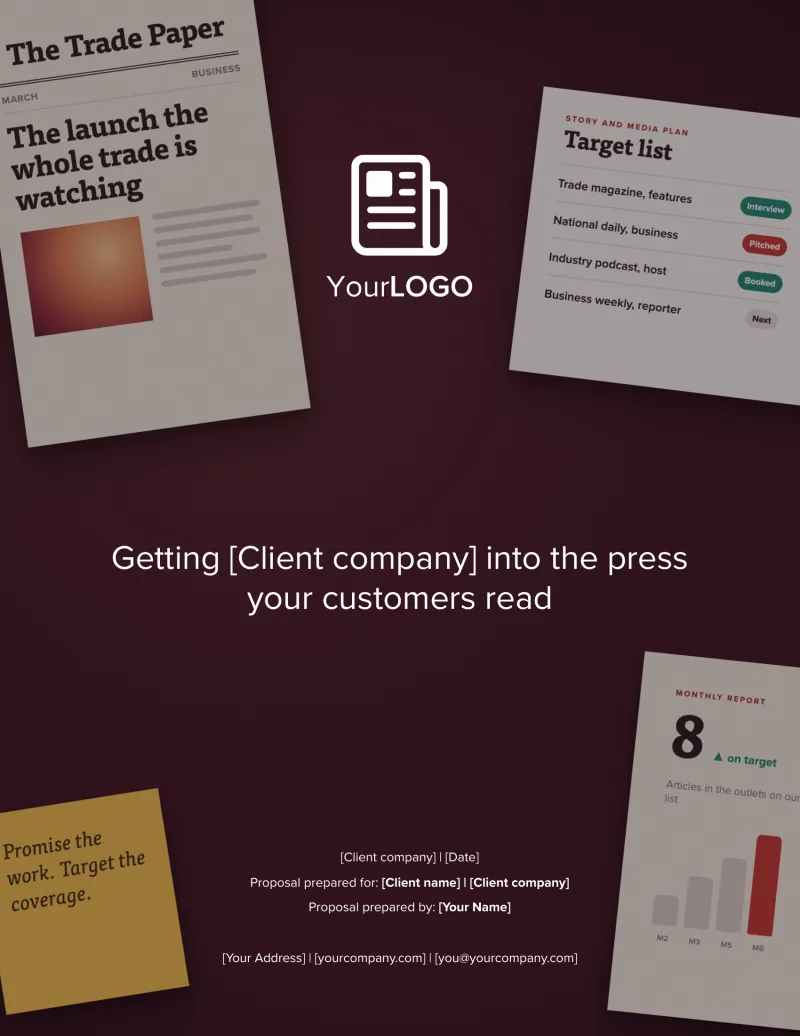
Every page of the PDF, printed by Nusii. Sent as a link, it's one scrolling page on any device: your client accepts with one button and signs with their name.
The template in Nusii, the way your client will see it. It opens in a new tab.
What to charge for PR
What PR costs, from the pages we could check at the source. The template's example prices, $3,000 for the plan and $5,000 a month, sit at the low end of what agencies publish for small businesses. In Nusii, agencies' accepted proposals had a median value of $4,000, monthly fees left out (253 proposals, July to September 2026).
What
Price
Source
Retainer for a small business
$5,000 to $10,000 a montha directory's own figures for small businesses and startupsDesignRush
Sources: DesignRush, an agency directory, updated March 2026; Idea Grove, a B2B PR agency, August 2026; Clutch, a directory of PR firms, updated September 2026. DesignRush and Clutch list agencies, and Idea Grove sells PR. We didn't find an independent survey of what PR agencies charge, or a freelance rate we could check.
How often proposals got a yes, by price
Proposals over $15,000 got a yes about a third of the time. Agencies' accepted proposals had a median value of $4,000. From 1,713 proposals first sent with Nusii, July to September 2026.
Under $1,000
67.1%
$1,000 to $5,000
50.6%
$5,000 to $15,000
48.9%
$15,000 to $50,000
36.1%
Over $50,000
33.3%
Share accepted, by the total the client saw. Bigger proposals are bigger decisions, so this shows what happened, not that a lower price would win. Method: The State of Proposals 2026.
What happens after you send it
From 3,782 proposals agencies first sent with Nusii, November 2025 to October 2026.
48.9%
were accepted
54 min
median time to the client's first look
3.9 days
median time to a yes
62.2%
of the yeses came within a week
Clients rarely say no. Of all proposals sent with Nusii from July to September 2026, 6.4% were rejected and 45.4% got no answer either way. Silence is the usual no, so a follow-up is worth sending.
Follow up after a week. Most yeses come within seven days. In Nusii you see when the proposal was opened and get an email when it's accepted, so you can follow up when they've read it, not when you guess they have.
The same template as a Word file you can edit (it opens in Google Docs too) and a PDF printed by Nusii. We'll email you both, plus a few emails with proposal tips. Unsubscribe any time.
Or send it with Nusii
This template is in the gallery of every Nusii account. Send it as a link: you get an email when your client opens it, and they accept and sign online, on any device.
“Have been using Nusii for years for all our marketing proposals. It’s well structured, easy to use and delivers a very professional impression to our prospects and clients. Service is excellent too. Highly recommend.”
Annette Welsford
Founder & CEO, Commonsense Marketing
“I’ve built a library of reusable sections and proposal templates, so I can pull together a tailored proposal without starting from scratch every time.”
A document that tells a prospective client how you’ll run their public relations, what it costs and how to start. It usually covers their goals, the stories you’ll pitch and to whom, what’s included and what isn’t, the price (often a first phase, then a monthly retainer) and how you’ll report results.
What should a PR proposal include?
What the client told you and the goals that follow from it, your plan, what you can and can’t promise, short proof from similar clients, what’s included and what isn’t, the price, and the next steps. That’s seven sections, the same as the template on this page.
Can a PR agency guarantee coverage?
No. Journalists and editors decide what they publish, so an honest proposal promises the work and sets coverage as a target. Prowly, which makes PR software, says “no honest and transparent PR proposal or PR contract can include guaranteed placements”. This template puts both in writing: what you’ll do, and the coverage you’re aiming for.
How much should I charge for PR?
Published figures for small businesses run from about $5,000 to $10,000 a month, and Idea Grove, a B2B PR agency, says plenty of good programs cost $5,000 or $6,000. This template uses $3,000 for a first plan and $5,000 a month as example prices. Those figures come from directories and agencies, and we found no independent survey or freelance rate we could check.
Should I charge a retainer or a project fee?
Start with a one-off fee, then offer a retainer. The plan is a project with a clear end, and pitching is ongoing work. In Nusii, proposals with a recurring fee were accepted less often (39% against 55% for the same senders, July to September 2026), so the template starts with a fixed first step and gives the client a way out before the monthly fee begins.
How long does PR take to show results?
Usually three to six months for a steady pattern of coverage. DesignRush says “PR usually takes about 3-6 months to show consistent results”, and Idea Grove calls three to six months a reasonable period to judge whether a program is gaining traction. That’s why the template has a three-month minimum and a review after it.
What’s the difference between a PR proposal and a PR plan?
A proposal sells the work to a client: the goal, the approach, the price and how to say yes. A PR plan is the working document that follows, with the stories, messages, journalists and dates. In this template the plan is the first paid step, so the client gets it before any monthly fee starts.
What is an RFP in public relations?
A request for proposals: a written brief a company sends to several agencies, asking each to bid for its PR work. It usually sets the format, so follow it, and reuse this template’s sections where they fit. Our 2015 book on proposals warns that some RFPs are a formality, so ask for a call with the client before you spend days on one.
Can I use this template as a freelance publicist?
Yes. Write “I” instead of “we”, describe yourself in the introduction, and set the number of journalists and pitches to what you can do on your own. Everything else, from the goals to the way out after the plan, works the same.
Can I use it for a consumer brand or a nonprofit?
Yes. Swap the trade press for the magazines, shows and creators your client’s audience follows, and report on sales, sign-ups or donations instead of demo requests. Change the title to match, such as “the press your donors read”. There’s a line in brackets under “What’s included” to remind you.
Should I offer several packages?
Offer them only if the client asked about choices. In Nusii, proposals where the client could choose between options were accepted less often (40% against 51% for the same senders, July to September 2026). This template has one clear price; add an optional section for an extra the client asked about.
Do I need a contract as well?
Attach your own agreement if you use one. This template covers the scope, the price, who owns what and how to end the work in plain words, and it isn’t legal advice.
Can my client accept and sign the proposal online?
Yes, if you send it as an online proposal. In Nusii, your client opens a link, accepts with one button and signs with their typed name, on any device, and you get an email when they do. The Word file and the PDF need signing the old way.