


Proposal template

Virtual assistant proposal template

A virtual assistant proposal template for pitching a small business owner, in seven short sections: what the owner told you eats their week, the setup week and your working hours, how you handle their logins, one monthly price and the next steps. For freelance VAs and small VA teams. Read it here or get it as a Word file and a PDF.

Michael Koper
By Michael Koper, founder of Nusii Updated
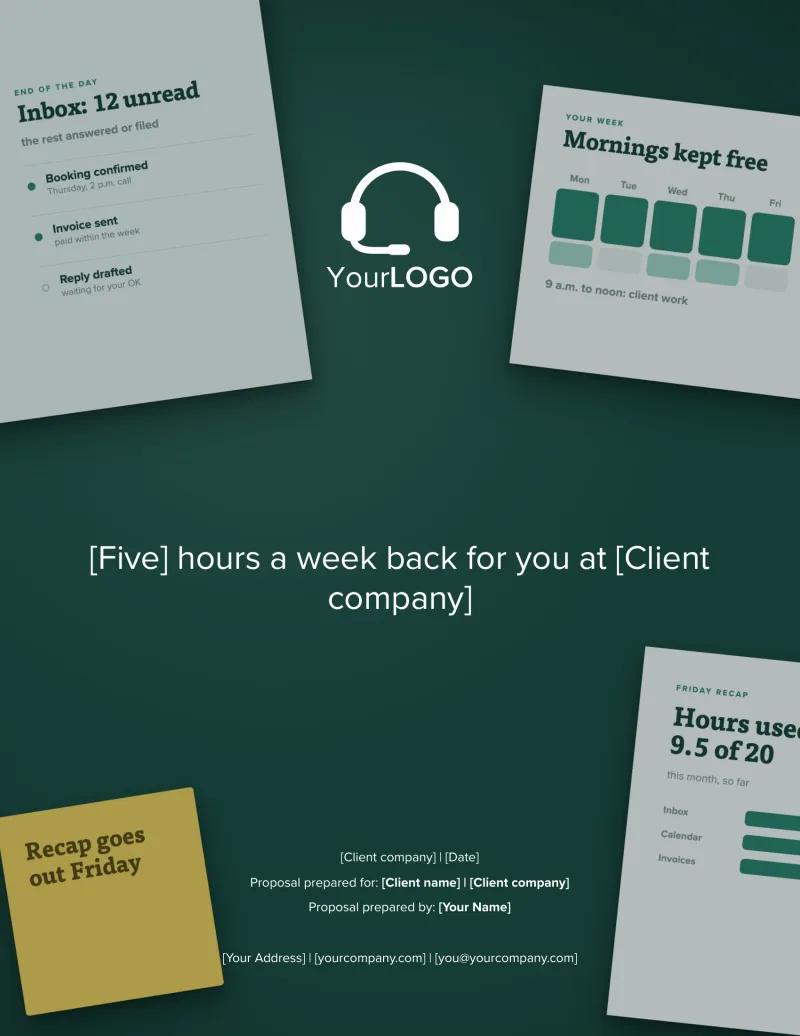
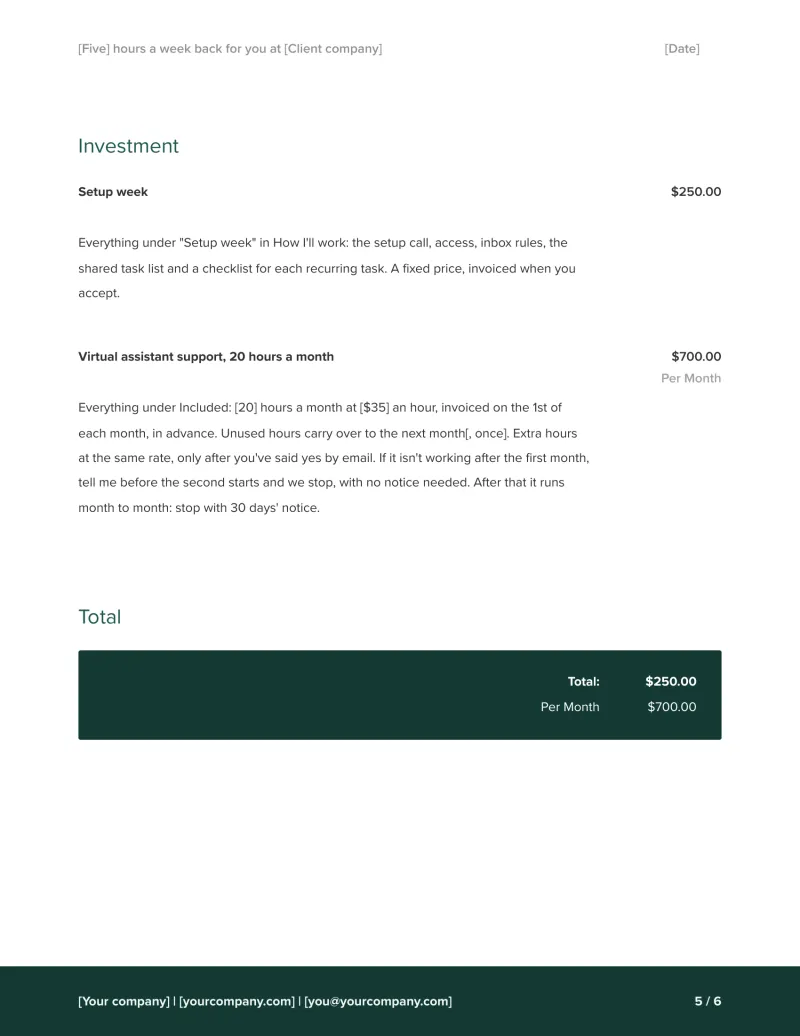
The virtual assistant proposal template: the cover and the investment page with a $250 setup week and $700 a month for 20 hours
Get the Word + PDF
On this page
  1. What to include
  2. The template
  3. A filled-in example
  4. How to write one
  5. See it as your client will
  6. What to charge
  7. The email to send
  8. After you send it
  9. Word and PDF
  10. Questions

What should a virtual assistant proposal include?

A virtual assistant proposal is the document a VA sends a business owner after a discovery call to take over part of their week: which tasks you'll handle, when you work and how fast you answer, how you'll get into their accounts, what it costs each month and how to start. It should have these seven parts:

  1. 1 IntroductionThe tasks, the hours, the price and how to stop, in three sentences.
  2. 2 What I heardWhat the owner told you eats their week, and what that time is worth.
  3. 3 How I'll workThe setup week, then what you do every day, week and month.
  4. 4 Results for businesses like yoursShort proof from owners like this one, and a reference.
  5. 5 What's includedWhat the hours cover, what they don't, confidentiality and access.
  6. 6 InvestmentA setup week, then one monthly price for a block of hours.
  7. 7 Next stepsHow to say yes, how access is shared, and when you'll call.

The virtual assistant proposal template, section by section

Copy one section or the whole thing. Under each section: what it's for, and one thing we've learned from the proposals sent with Nusii.

[Yellow] you write [Green] Nusii fills in when you send it

1. Introduction

The whole plan in three sentences, with both prices and how to stop, then who you are. The owner often reads it on a phone between two other jobs, so it all fits on the first screen. Written as "I"; if you run a VA team, write "we".

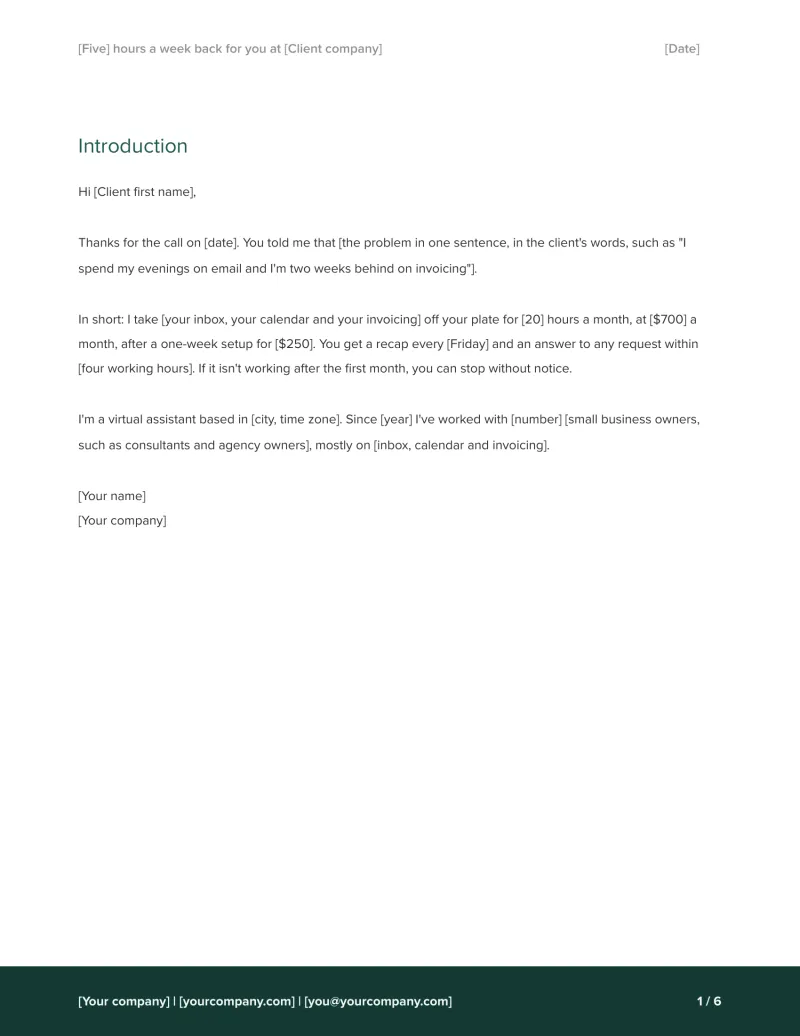
Hi [Client first name],

Thanks for the call on [date]. You told me that [the problem in one sentence, in the client's words, such as "I spend my evenings on email and I'm two weeks behind on invoicing"].

In short: I take [your inbox, your calendar and your invoicing] off your plate for [20] hours a month, at [$700] a month, after a one-week setup for [$250]. You get a recap every [Friday] and an answer to any request within [four working hours]. If it isn't working after the first month, you can stop without notice.

I'm a virtual assistant based in [city, time zone]. Since [year] I've worked with [number] [small business owners, such as consultants and agency owners], mostly on [inbox, calendar and invoicing].

[Your name]
[Your company]

About a third of first looks at proposals sent with Nusii happen on a phone (32.5%, July to September 2026). A busy owner who's hiring help is exactly the person reading it there, so the hours, the price and the way out come first.
2. What I heard

Shows you listened on the call: what eats the client's week, in their words, what it costs them, and what will be different. Only you can write this one: replace the examples with your client's words.

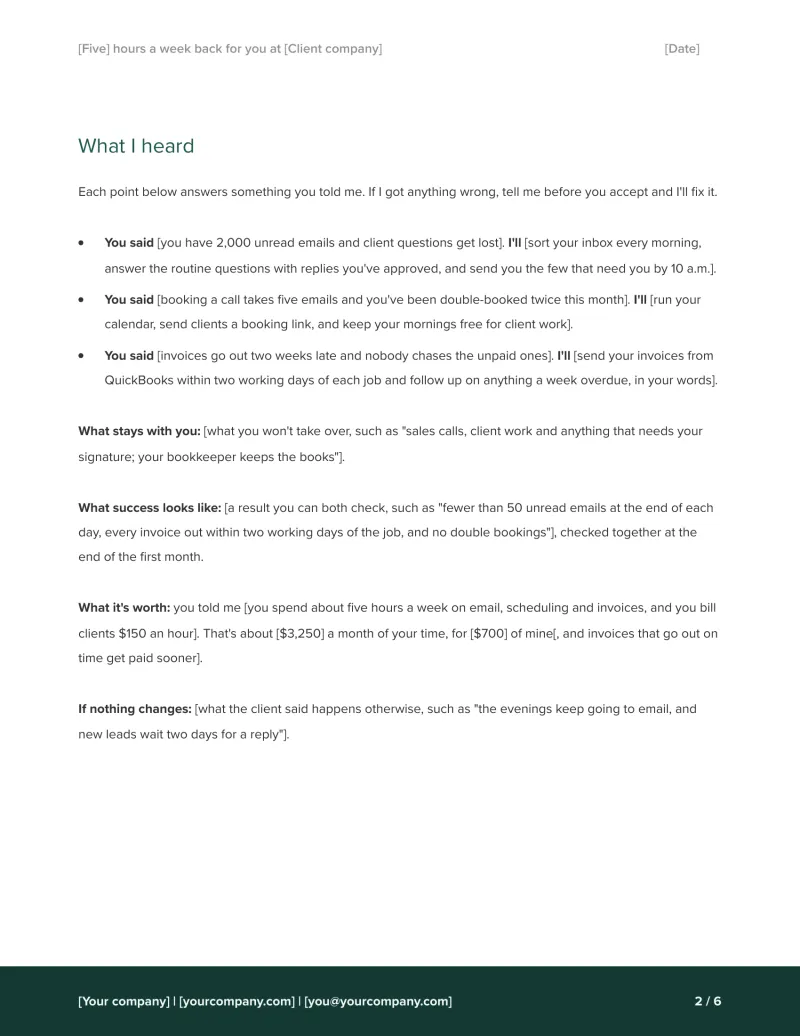
Each point below answers something you told me. If I got anything wrong, tell me before you accept and I'll fix it.

  • You said [you have 2,000 unread emails and client questions get lost]. I'll [sort your inbox every morning, answer the routine questions with replies you've approved, and send you the few that need you by 10 a.m.].
  • You said [booking a call takes five emails and you've been double-booked twice this month]. I'll [run your calendar, send clients a booking link, and keep your mornings free for client work].
  • You said [invoices go out two weeks late and nobody chases the unpaid ones]. I'll [send your invoices from QuickBooks within two working days of each job and follow up on anything a week overdue, in your words].

What stays with you: [what you won't take over, such as "sales calls, client work and anything that needs your signature; your bookkeeper keeps the books"].

What success looks like: [a result you can both check, such as "fewer than 50 unread emails at the end of each day, every invoice out within two working days of the job, and no double bookings"], checked together at the end of the first month.

What it's worth: you told me [you spend about five hours a week on email, scheduling and invoices, and you bill clients $150 an hour]. That's about [$3,250] a month of your time, for [$700] of mine[, and invoices that go out on time get paid sooner].

If nothing changes: [what the client said happens otherwise, such as "the evenings keep going to email, and new leads wait two days for a reply"].

Our 2015 book on proposals: what a client tells you is "the end result of their problem". "I need help with admin" means something specific: the inbox at night, the invoices that go out late, the call that took five emails to book. Ask which task they dread most and how long it takes them, and write it down in their words.

3. How I'll work

The setup week, then what happens every day, week and month, so the client knows what the hours buy. The first line says why the cheaper route won't do; if you didn't talk about one, delete it. The access line answers the question every client has before handing over their inbox.

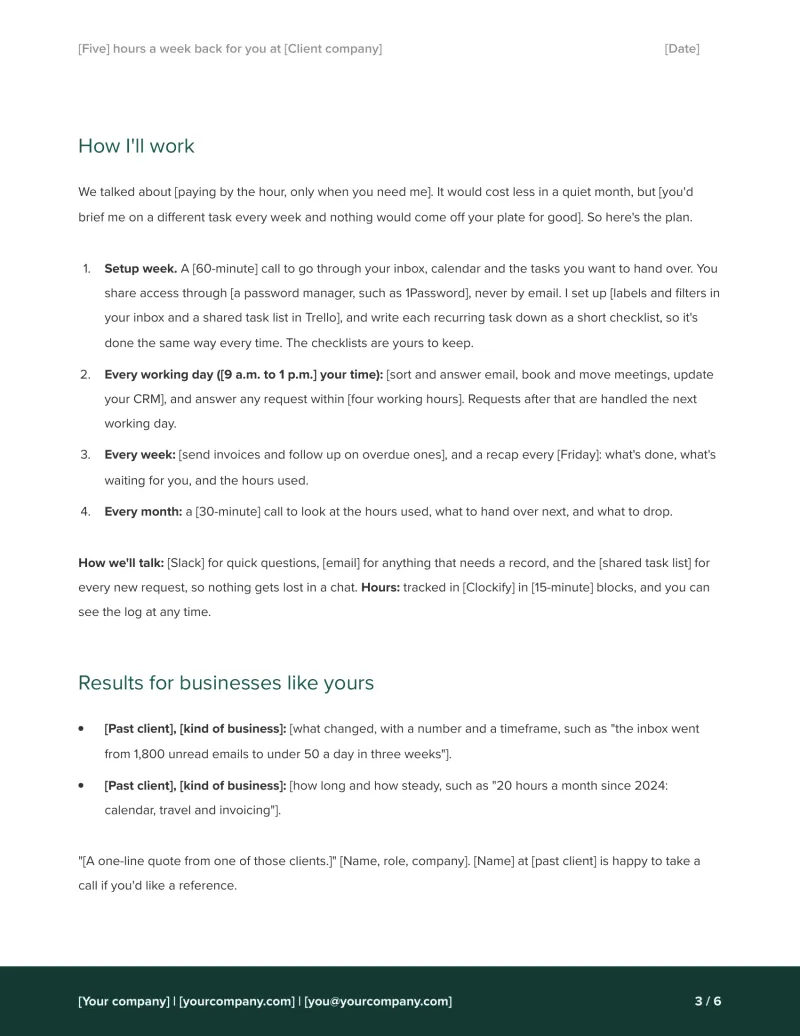
We talked about [paying by the hour, only when you need me]. It would cost less in a quiet month, but [you'd brief me on a different task every week and nothing would come off your plate for good]. So here's the plan.

  1. Setup week. A [60-minute] call to go through your inbox, calendar and the tasks you want to hand over. You share access through [a password manager, such as 1Password], never by email. I set up [labels and filters in your inbox and a shared task list in Trello], and write each recurring task down as a short checklist, so it's done the same way every time. The checklists are yours to keep.
  2. Every working day ([9 a.m. to 1 p.m.] your time): [sort and answer email, book and move meetings, update your CRM], and answer any request within [four working hours]. Requests after that are handled the next working day.
  3. Every week: [send invoices and follow up on overdue ones], and a recap every [Friday]: what's done, what's waiting for you, and the hours used.
  4. Every month: a [30-minute] call to look at the hours used, what to hand over next, and what to drop.

How we'll talk: [Slack] for quick questions, [email] for anything that needs a record, and the [shared task list] for every new request, so nothing gets lost in a chat. Hours: tracked in [Clockify] in [15-minute] blocks, and you can see the log at any time.

Philip Morgan and Jonathan Stark, in our 2015 book on proposals: "Your proposal must contain zero or fewer surprises for your client." Go through the task list on the call, one task at a time, so nothing here is new when they read it.

4. Results for businesses like yours

Short proof: what changed for owners like this one, and who will take a call about it. Use real numbers from real clients. No clients yet? Leave this section out rather than fill it with general claims.

  • [Past client], [kind of business]: [what changed, with a number and a timeframe, such as "the inbox went from 1,800 unread emails to under 50 a day in three weeks"].
  • [Past client], [kind of business]: [how long and how steady, such as "20 hours a month since 2024: calendar, travel and invoicing"].

"[A one-line quote from one of those clients.]" [Name, role, company]. [Name] at [past client] is happy to take a call if you'd like a reference.

Proposals to a client who had accepted one before were accepted 63.4% of the time in Nusii, against 47.2% for a first proposal from the same senders (July to September 2026). A VA's next client usually comes from the last one: ask a happy client for one introduction once the first month has gone well.

5. What's included

Draws the line between what the monthly hours cover and what doesn't, says what you need from the client, and lowers the risk of handing a stranger the inbox: confidentiality, access, and who owns what.

Included

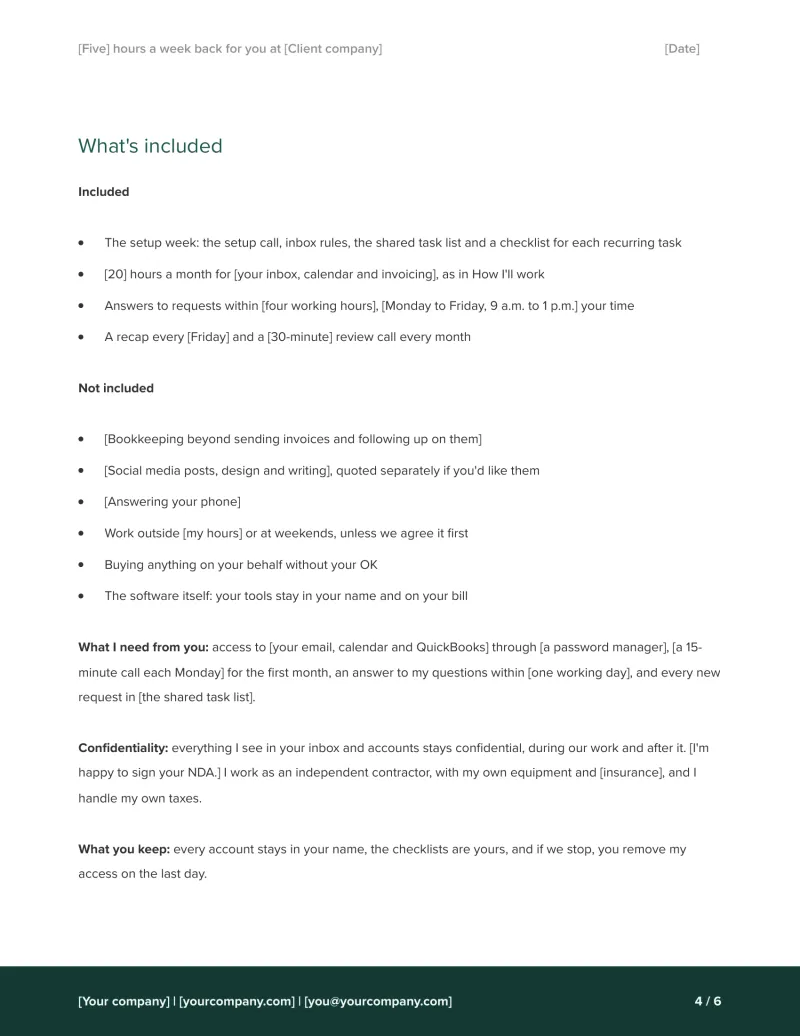
  • The setup week: the setup call, inbox rules, the shared task list and a checklist for each recurring task
  • [20] hours a month for [your inbox, calendar and invoicing], as in How I'll work
  • Answers to requests within [four working hours], [Monday to Friday, 9 a.m. to 1 p.m.] your time
  • A recap every [Friday] and a [30-minute] review call every month

Not included

  • [Bookkeeping beyond sending invoices and following up on them]
  • [Social media posts, design and writing], quoted separately if you'd like them
  • [Answering your phone]
  • Work outside [my hours] or at weekends, unless we agree it first
  • Buying anything on your behalf without your OK
  • The software itself: your tools stay in your name and on your bill

What I need from you: access to [your email, calendar and QuickBooks] through [a password manager], [a 15-minute call each Monday] for the first month, an answer to my questions within [one working day], and every new request in [the shared task list].

Confidentiality: everything I see in your inbox and accounts stays confidential, during our work and after it. [I'm happy to sign your NDA.] I work as an independent contractor, with my own equipment and [insurance], and I handle my own taxes.

What you keep: every account stays in your name, the checklists are yours, and if we stop, you remove my access on the last day.

Philip Morgan and Jonathan Stark, in our 2015 book: "You will almost never be the only party responsible for the outcome of a project." A VA can't answer an email the owner never decided on. Write down what you need from them and how fast.

6. Investment

One price in two parts: the setup week, then the monthly hours, each with when it's invoiced, what happens to unused hours, and a way out after the first month. These are example prices; the table further down shows what others charge.

Setup week

$250

Everything under "Setup week" in How I'll work: the setup call, access, inbox rules, the shared task list and a checklist for each recurring task. A fixed price, invoiced when you accept.

Virtual assistant support, 20 hours a month

$700 a month

Everything under Included: [20] hours a month at [$35] an hour, invoiced on the 1st of each month, in advance. Unused hours carry over to the next month[, once]. Extra hours at the same rate, only after you've said yes by email. If it isn't working after the first month, tell me before the second starts and we stop, with no notice needed. After that it runs month to month: stop with 30 days' notice.

Total: $250 then $700 a month

In Nusii, proposals with a recurring fee were accepted less often than one-off ones (39.5% against 54.6% for the same senders, July to September 2026). Hiring someone into your inbox is a bigger decision than buying a project, so the first month works as a trial and the notice period is short.

7. Next steps

Tells the client exactly what to do to say yes, what happens after, and when you'll call. No expiry date, no "limited spots".

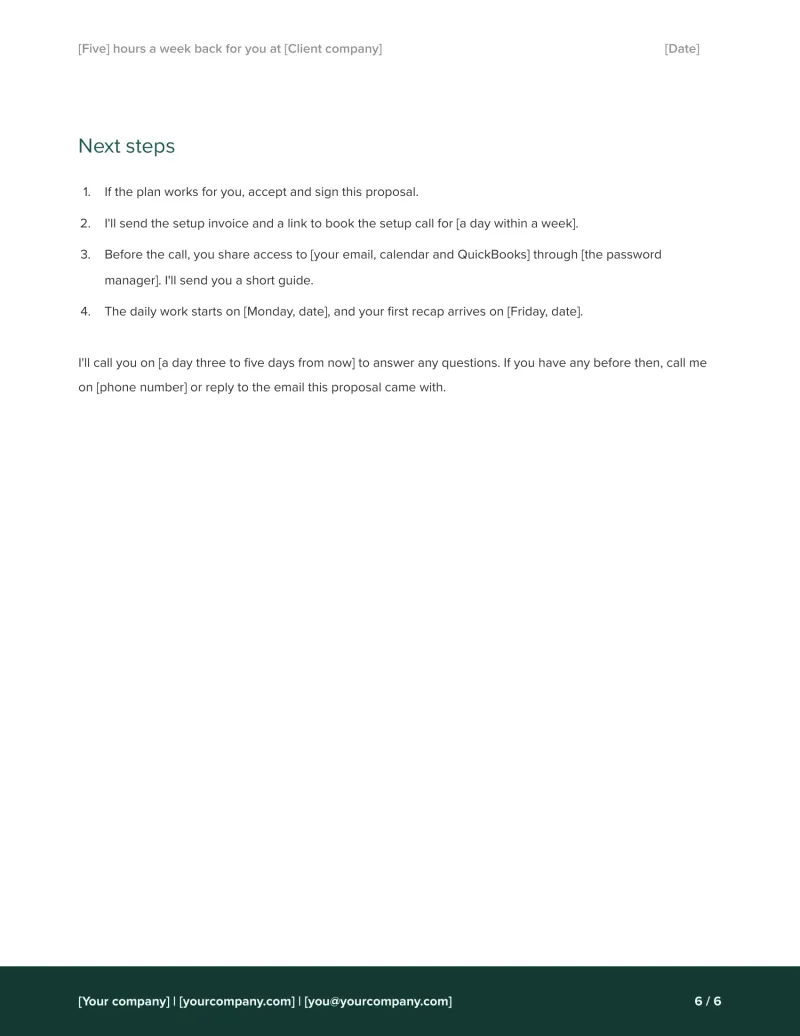
  1. If the plan works for you, accept and sign this proposal.
  2. I'll send the setup invoice and a link to book the setup call for [a day within a week].
  3. Before the call, you share access to [your email, calendar and QuickBooks] through [the password manager]. I'll send you a short guide.
  4. The daily work starts on [Monday, date], and your first recap arrives on [Friday, date].

I'll call you on [a day three to five days from now] to answer any questions. If you have any before then, call me on [phone number] or reply to the email this proposal came with.

Half the proposals accepted in Nusii were accepted within a day of the client's first look (50.3%, July to September 2026). The rest take longer: our 2015 book on proposals suggests a call three to five days after you send it, while they're still deciding.

A virtual assistant proposal example, filled in

Two sections of the template above with a client's words in the brackets, so you can see how it reads when it's done. Fenwright Consulting, a two-person operations consultancy, is made up, and so are its numbers.

Five hours a week back for you at Fenwright Consulting

What I heard

  • You said you have 2,000 unread emails and client questions get lost. I'll sort your inbox every morning, answer the routine questions with replies you've approved, and send you the few that need you by 10 a.m.
  • You said booking a call takes five emails and you've been double-booked twice this month. I'll run your calendar, send clients a booking link, and keep your mornings free for client work.
  • You said invoices go out two weeks late and nobody chases the unpaid ones. I'll send your invoices from QuickBooks within two working days of each job and follow up on anything a week overdue, in your words.

What stays with you: sales calls, client work and anything that needs your signature; your bookkeeper keeps the books.

What success looks like: fewer than 50 unread emails at the end of each day, every invoice out within two working days of the job, and no double bookings, checked together at the end of the first month.

What it's worth: you told me you spend about five hours a week on email, scheduling and invoices, and you bill clients $150 an hour. That's about $3,250 a month of your time, for $700 of mine, and invoices that go out on time get paid sooner.

If nothing changes: the evenings keep going to email, and new leads wait two days for a reply.

Investment

Setup week

$250

Virtual assistant support, 20 hours a month

$700 a month

Total: $250 then $700 a month

How to write a virtual assistant proposal, step by step

Six steps, from the discovery call to the follow-up. The template above already follows them; here's why each one matters.

  1. Find out what eats their week before you write anything

    Owners rarely say "I need a virtual assistant". They say they're drowning in email or two weeks behind on invoices. On the call, ask which tasks they dread, how long each takes, what they'd do with the time, and what they'd never hand over. Write the answers down in their words: they become "What I heard". Our 10 questions for the first client call work here too, and so does asking about the budget.

  2. Turn the task list into hours

    Put a time on each task: from the owner's own estimate, a week of them noting what they did, or how long the same work takes you for other clients. Add the hours up and round to a block the owner can picture, such as 10, 20 or 40 hours a month. Price the setup separately: getting access, setting up the inbox and writing the checklists takes longer than a normal week.

  3. Sell one block of hours, not a menu of tasks

    A price per task (so much for the inbox, so much per blog post) invites the owner to cut items, and our 2015 book on proposals argues against it for that reason. One block of hours for the tasks you agreed on is easier to say yes to. In Nusii, proposals where the client could choose between options were accepted less often (40.4% against 51.7% for the same 91 accounts, July to September 2026). Send one plan.

  4. Put the trust details in writing

    The owner is about to give a stranger their inbox. Say how you'll get access (a password manager or your own login, never passwords by email), that everything you see stays confidential, that you work as an independent contractor, and that every account stays in their name. These lines answer questions the owner would otherwise ask, or just think and not hire you.

  5. Keep the commitment small

    One monthly price, invoiced in advance, with a way to stop after the first month and a short notice period after that. In Nusii, proposals with a recurring fee were accepted less often than one-off ones (39.5% against 54.6% for the same 84 accounts, July to September 2026), so the first month works as a trial.

  6. Send it as a link, then call

    Send it with a short email (there's one below) and call when you said you would, three to five days later, as our 2015 book suggests. In Nusii you see when it was opened, so you know whether they've read it before you pick up the phone.

    If two weeks pass in silence, send one last line, from Blair Enns via our 2015 book: “I haven't heard back from you on the proposal, so I'm going to assume you've gone in a different direction or your priorities have changed.”

See it as your client will

Every page of the PDF, printed by Nusii. Sent as a link, it's one scrolling page on any device: your client accepts with one button and signs with their name.

Open the live preview

The template in Nusii, the way your client will see it. It opens in a new tab.

What virtual assistants charge

What freelance virtual assistants and US VA agencies charge, from the figures we could check at the source. The template's example, $35 an hour for 20 hours a month ($700), is the top of Upwork's average for freelance VAs and under what the US agencies below charge for the same hours. The $250 setup week is about seven hours at $35. Before you name your price, find out what the owner has in mind: how eight freelancers and agency owners ask about the budget.

What Price
Freelance virtual assistants $18 to $35 an hour Upwork's average, by skills and experience Upwork
Admin and data entry $12 to $20+ an hour North America, freelancers with 1,000+ hours on Upwork Upwork
Marketing, customer service and accounting support $20 to $35+ an hour North America, freelancers with 1,000+ hours on Upwork Upwork
Business, project and IT support $38 to $50+ an hour North America, freelancers with 1,000+ hours on Upwork Upwork
US VA agency, 20 hours a month $760 a month $38 an hour; 10 hours $390, 60 hours $2,160 Time etc
US VA agency, 12 hours a month $599 a month about $50 an hour Zirtual
What an administrative assistant earns $23.23 an hour median pay, May 2025: an employee's wage, before the taxes, tools and unbilled hours a freelancer pays for U.S. Bureau of Labor Statistics

Sources: Upwork, the freelance marketplace's VA cost guide, read November 2026; Time etc, a US virtual assistant agency, pricing page, November 2026; Zirtual, a US virtual assistant agency, pricing page, November 2026; U.S. Bureau of Labor Statistics, Occupational Outlook Handbook, secretaries and administrative assistants. Upwork's figures are what freelancers ask on a marketplace that takes a fee from them; the agencies' prices pay for the agency as well as the assistant. Price from the hours the work takes and what the owner told you their time is worth.

How often proposals got a yes, by price

These totals leave monthly fees out, so for a virtual assistant they show the one-time part: the template's $250 setup week is in the under $1,000 band. Proposals with a recurring fee were accepted less often than one-off ones (40% against 55% for the same senders). From 1,713 proposals first sent with Nusii, July to September 2026.

Under $1,000
67.1%
$1,000 to $5,000
50.7%
$5,000 to $15,000
48.9%
$15,000 to $50,000
36.1%
Over $50,000
33.3%

Share accepted, by the total the client saw. Bigger proposals are bigger decisions, so this shows what happened, not that a lower price would win. Method: The State of Proposals 2026.

The email to send it with

The proposal does the explaining, so the email only has to get it opened and say when you'll call. Leave the price out, so the owner reads what you'll take off their plate before they judge the number. In Nusii this goes in the Send Proposal window, and you can save it as your template for next time.

Subject: [Your inbox, calendar and invoicing: the plan]

Hi [first name],

Thanks for the call on [day of the call]. Here's the proposal: [link].

In short: I take [your inbox, your calendar and your invoicing] off your plate for [20] hours a month, with a recap every [Friday].

You can accept it right on the page. If you'd like to go through it together, reply with a time that suits you.

I'll call you on [a day three to five days from now] to answer any questions.

[Your name]

What happens after you send it

Of 1,153 proposals first sent with Nusii by one-person businesses from November 2025 to October 2026, 52.6% were accepted, with a median of 3.1 days to a yes.

52.6%
were accepted
48 minutes
median time to the client's first look
3.1 days
median time to a yes
67.2%
of the yeses came within a week

Clients rarely say no. Of all proposals sent with Nusii from July to September 2026, 6.5% were rejected and 45.2% got no answer either way. Silence is the usual no, so a follow-up is worth sending.

Call within the week. Half the proposals accepted in Nusii were accepted within a day of the client's first look (50.3%, July to September 2026). In Nusii you see when the proposal was opened, so you can call once the owner has read it.

More numbers and the method: The State of Proposals 2026.

Get the Word and PDF files

The same template as a Word file you can edit (it opens in Google Docs too) and a PDF printed by Nusii. We'll email you both, plus a few emails with proposal tips. Unsubscribe any time.

Or send it with Nusii

This template is in the gallery of every Nusii account. Send it as a link: you get an email when your client opens it, and they accept and sign online, on any device.

Nusii is my favorite platform for proposals and contracts. Truly indispensable product for my business!

Anna Ren
Anna Ren
Founder, Elite Advantage Prep

Not only does Nusii save me loads of time, but my clients are equally impressed with how professional I come across. I love it!

Laura Williams
Laura Williams
Founder, client-portal.io
Start your free trial

14-day trial · 60-day money-back guarantee

Questions about virtual assistant proposals

What is a virtual assistant proposal?

A document a virtual assistant sends a business owner to take over part of their week: the tasks you’ll handle, your hours and response time, how you’ll get into their accounts, the monthly price and how to start. It comes after a call with the owner, and they accept it to get started.

What should a virtual assistant proposal include?

What the owner told you eats their week, the setup and what you’ll do every day, week and month, proof from similar clients, what the hours cover and what they don’t, confidentiality and access, the price and the next steps. That’s seven sections, the same as the template on this page.

How much should I charge as a virtual assistant?

Upwork puts freelance virtual assistants at $18 to $35 an hour on average, and $38 to $50 or more for business and project support. US VA agencies charge more: Time etc $38 an hour for 20 hours a month (November 2026). This template uses $35 an hour for 20 hours, $700 a month, as an example price. Price from the hours the tasks take and what the owner’s time is worth.

Should I charge by the hour or sell monthly packages?

For ongoing work, a monthly block of hours: the owner knows the bill, and you know your month. Charge by the hour for one-off jobs, like clearing an inbox backlog. In Nusii, proposals with a recurring fee were accepted less often than one-off ones (39.5% against 54.6% for the same 84 accounts, July to September 2026), so this template lets the owner stop after the first month.

What happens to unused hours?

Whatever the proposal says, so say it. This template carries unused hours over to the next month, once, and bills extra hours only after the owner says yes by email. Agencies differ: Time etc rolls hours over on plans of 20 hours and up; Zirtual doesn’t roll them over.

Can I use this template for an Upwork proposal?

Not as it is. An Upwork proposal answers a job post in a few paragraphs: who you are, what you understood from the post, how you’d do it, and your rate. Use this template’s introduction and “What I heard” as the shape. If the client found you on Upwork, read Upwork’s rules on taking work off the platform before you send your own payment terms.

How do I write a virtual assistant proposal with no experience?

Leave out “Results for businesses like yours” rather than fill it with general claims. Let the rest carry it: a clear task list in the owner’s words, a setup week with checklists they keep, and a first month they can stop without notice. If a former employer or a client from another job will take a call, offer that as your reference.

How do I get access to a client’s accounts safely?

Through a password manager the owner shares with you, or your own login where the tool offers one (most email, calendar and accounting tools let the owner add a user). Never by email or chat. Write it into the proposal, and when the work ends, the owner removes your access on the last day.

Is a virtual assistant proposal the same as a contract?

No. The proposal wins the work: the owner’s problem, your plan and the price. A contract or service agreement sets the legal terms. This template covers the scope, the price, the notice period and confidentiality in plain words, and it isn’t legal advice. If you use an agreement, attach it.

Can my client accept and sign the proposal online?

Yes, if you send it as an online proposal. In Nusii, your client opens a link, accepts with one button and signs with their typed name, on any device, and you get an email when they do. The Word file and the PDF need signing the old way.

More templates and guides

Send your next virtual assistant proposal as a link, and see when it's opened

Try Nusii free for 14 days

Cancel anytime · 60-day money-back guarantee